
Comprehensive Mobile App Development Guide for Businesses
sunil.yadav@xcelore.com
Key Takeaways
- Anchor every mobile initiative to a measurable business outcome (revenue, cost, or risk) before any design or engineering begins.
- Treat architecture and integration decisions as long-term commitments. They are the most expensive choices to reverse once the system is at scale.
- Select technology against security, scalability, reliability, and performance requirements, not popularity or initial price.
- Start with a tightly scoped MVP to validate demand, test assumptions, and contain risk before scaling investment.
- Build security, privacy, and compliance into the engineering lifecycle from the first sprint, not as a late-stage review.
- Choose a partner with enterprise delivery depth and a clear post-launch operating model, because most failures occur after release.
Mobile apps tend to evolve continuously; what started as a simple communication utility has now become an important part of business strategies. It helps with more involved engagements and more income than ever. But building mobile apps is not all about interactive design or smart features. Instead, it’s more about a common business goal with a more secure and enhanced plan for development. For senior leaders, the question is no longer whether to invest in mobile, but how to invest in a way that is secure, scalable, and accountable to business outcomes.
From evaluating ideas and identifying scopes to selecting technologies, preparing pilot models with minimal costs, and working with a dedicated team, this guide covers it all.
With the right mobile application development service provider, you can even streamline the workflows and feasibly prepare mobile applications for the future.
When to Build a Mobile Application For Your Business?
A mobile app must be developed to solve business challenges, not because every digital product automatically needs a dedicated application. The strongest cases of modular architecture in Android, iOS, or cross-platform apps involve features and behaviors that’re specific to mobile, such as device integrations like biometrics, cameras, GPS, push notifications, offline storage, and frequent habitual use.
Common, high-value business drivers include:
- Customer engagement: personalized experiences, notifications, and loyalty journeys that raise retention.
- Commerce performance: faster checkout, stored payment preferences, and lower cart abandonment.
- Field and workforce efficiency: fewer errors, faster task completion, and offline-capable workflows.
- Real-time visibility: live tracking of orders, assets, and services for customers and operations teams.
- Data capture at the point of action: structured, timestamped data that feeds analytics and decisions.
What are the Types of Mobile Apps Enterprises Can Develop?
Selection of technology affects cost, speed of development, user experience, maintenance, and future flexibility. There is no single best solution, but only the application approaches that best suit the given needs.
| Type | Ideal For | Advantages | Considerations |
| Native | Performance-heavy applications | UI/UX quality and access controls | Cost and platform maintenance |
| Cross-Platform | For iOS and Android targets | Rapid delivery and shared database | Requires manual inputs |
| Hybrid | Who needs to utilize existing tech | Multi-platform coverage | Architectural dependency |
| Progressive | Lightweight apps with content | Broader audience reach | Limited device feature access |
| Low-code | Quick prototypes | Low costs and fast speed | Limited customization |
| Custom | Enterprises | High control and flexibility | High planning and investments |
Cross-platform development tends to offer the best solutions for business applications that need to operate on both major platforms. Native development is still better for applications that require advanced graphics or heavy processing of information. It is very costly to change architectural choices later, so it is a good idea to decide on them early when the expected growth and new integrations are clear.
Factors to Weigh Before Choosing a Framework
- User experience and performance needs
- Integration abilities with ERP, CRM, payment systems, and legacy systems
- Security requirements for authentication, authorization, and data protection
- Project timeline and available technical skills
- Anticipated number of users, frequency of releases, and maintenance over time
Key Note: Choosing a framework just because of its popularity or price is a bad strategy since a relatively cheap framework could have architecture that does not allow future requirements to be met.
Framework to Build Custom or Modify Existing Applications
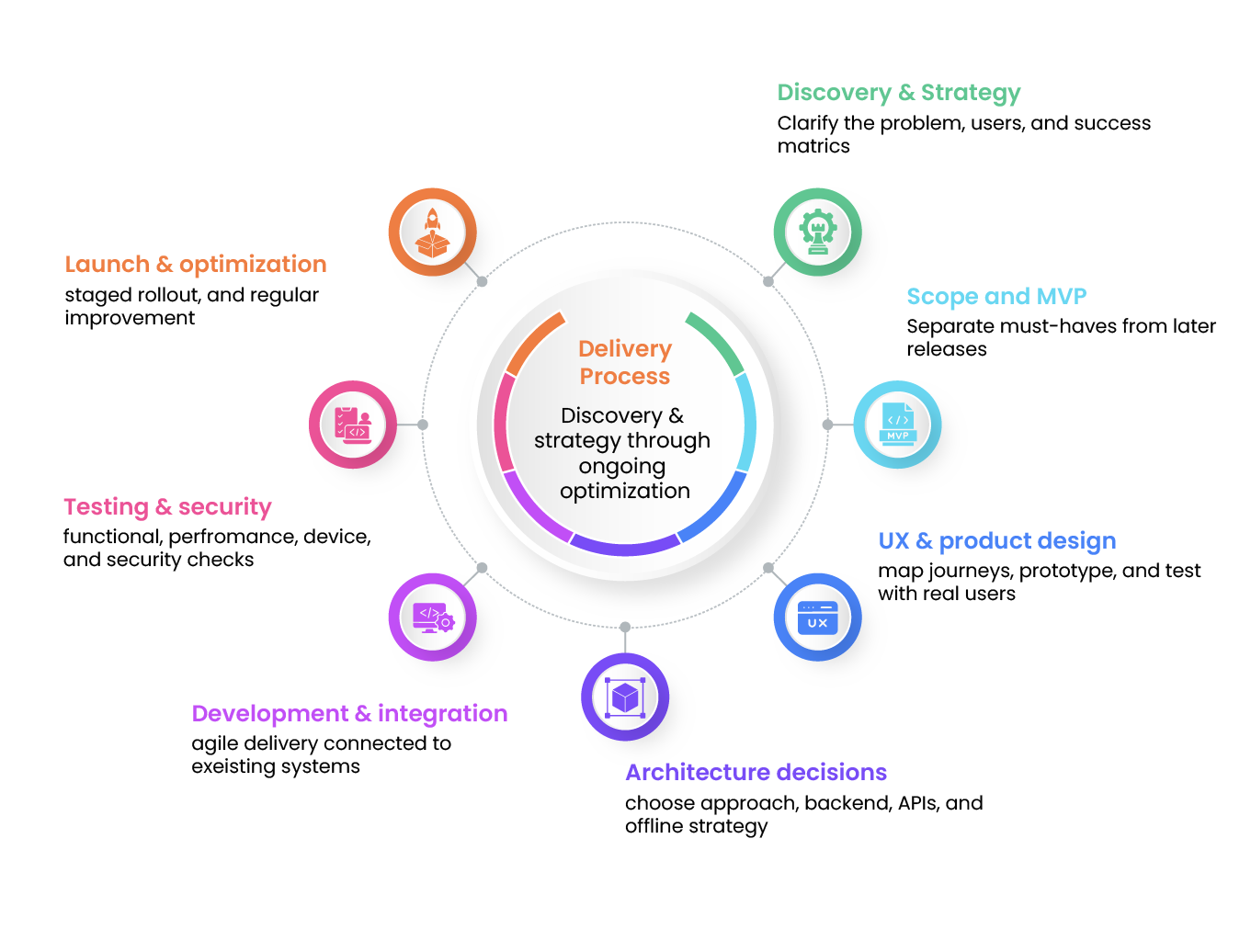
Consider this lifecycle because each one of these stages has some common pitfalls where they may go wrong if not followed appropriately. These are:
1. Goal Identification
Initiate the development process from what outcomes your business requires with this application, not feature planning. Understand your problem, users, and KPIs, and match them with the market and competitors for better results.
2. Planning Prototypes
Ensure your requirements don’t drift awry. Clarify your performance, security, and compliance needs for stable MVP development.
3. Product Design
Map internal systems to one another, not the user tasks, as they may differ depending on their needs for the application. Check the app accessibility clearly.
4. Developing Architecture
Don’t be quick to take decision for your application as it gets difficult to reverse them when the development is at scale. Therefore, opt for dedicated mobile app development services and partner carefully.
5. App Build and Integration
Underestimating the integration of current technologies with the existing stack is the most common mistake that many mobile app developers face. So, ensure that CI/CD pipelines, CRM, and other techs match the systems for seamless development.
6. Test and Validate App
Beyond creating the mobile app, it’s essential to match it with the goals, industry standards, compliance, and governance requirements. Do not pilot test it on only a few devices with average load; instead, do a thorough check with proper releases.
7. Deployment and Maintenance
Releasing the developed mobile app to the audience isn’t always the last step; optimization and continuous improvements are part of the framework too. Verify the app with staged rollouts, A/B tests, and continuous upgrades and releases for success.
Plan Your Mobile App Investments: From MVP to ROI During Build-Ups
Investing in mobile apps is something that isn’t limited to a one-time task and instead is similar to a complete lifecycle. It moves from creating a pilot to determining costs, KPIs, and measuring ROI for improvement and growth. It is understood as follows:
Developing a Minimum Viable Product Prototype
The least viable product is the smallest release that can show benefit to real clients, clarify the core issue, lay out the critical process, rank features by both business effect and viability, and include just the essentials for understanding (authorization, basic backend, analysis, and required integrations). Avoid putting excessive features in the first release.
Cost and Timeline to Create a Mobile App
The aforementioned ranges can be used as a reference for budget creation. The specific prices are determined depending on the project scope and complexity, number of integrations, compliance needs, location of the teams, and acceptance criteria.
| Type of App | Scope | Time | Investment |
| MVP | Simple backend, authentication, and simple workflow | Approx. 2 to 4 months | 40,000 to 80,000 $ |
| Mid-sized | Analytics, payments, custom UI/UX, and API integration | Approx. 4 to 8 months | 50,000 to 1,80,000 $ |
| Complex | Live features, APIs, integration with existing CRM, ERP, etc., payments, scale, and compliance | More than 8 months, based on the needs | 1,00,000 to 5,00,000 $ or so |
*These are rough figure estimates and not the actual cost or timeline.
The mobile app development cost completely depends on the business requirements. The key factors influencing them are:
- Number of platforms
- Depth of design
- Complexity of backend and integrations
- Security and compliance demands
- Presence of advanced functionality (AI, IoT, offline synchronization)
- Degree of testing and engagement model.
Moreover, ongoing costs (cloud infrastructure, licenses, OS updates, monitoring, security, and new feature releases) should be taken into account from the very beginning as well. The low first quote can be misleading when the above-mentioned responsibilities are not included at the right time.
How to Evaluate KPIs and ROI During Development?
Baselines and targets must be established before the process to create mobile applications starts. It is important so that the mobile application development team works towards the results and not just embedding usable features. The example metrics include:
- Downloads and cost per installation during app acquisition
- Successful onboarding completion when the app is activated
- High user engagement with multiple active users on a daily or weekly basis
- Simplified feature adoption and easy retention churn in 1, 7, or 30 days
- Higher conversion rate, subscriptions, and average revenue/user
- Less completion time for regular operations
- Efficient resolution of the voluminous support tickets
- Crash-free sessions, faster application load time, and latent APIs
Amidst this, to measure your ROI, just track your revenue, savings, and investment as:
ROI= (Savings + Incremental Revenue – Cost of Full Investment)/Full Investment Pricing
What You Must Consider?
- The cost of building the app, its launch, infrastructure, maintenance, and marketing must be included too over the time for the defined period.
- In the case of internal applications, the cost generally depends more on the actual time saved, reduced errors, and less support offered rather than the direct revenue from development, with all factors.
How to Build Smart, Secure, and Compliant Mobile Apps?
AI becomes most effective in mobile apps if it can fulfill specific requirements of users, such as:
- Offering recommendations
- Constant chat support
- Processing documents or images
- Early signaling of fraud
- Automating regular workflows
The aim of AI introduction should not be the impression of being innovative. Since on-device processing leads to lower delays, the ability to operate offline, and improved privacy, while cloud computing provides more capabilities and easier updates, many enterprises use both technologies.
Therefore, mobile app developers should focus on one measurable task at a time, determine conditions for obtaining data, check the results of operation, use app-specific technologies, and involve expertise for reliable development.
Mobile apps often deal with customer information, payment details, location data, or employee data. Henceforth, security and privacy must be part of the design and development plan from the first step, not added later as an extra.
Tools like the OWASP Mobile Application Security Verification Standard can help set starting points. Identify the applicable GDPR, U.S. State laws, HIPAA, PCI DSS, SOC 2 and more obligations, during the early planning stage to make a compliant and governed application with full flexibility and data security.
Top Mobile App Trends for Large Businesses and Enterprises
Several changes are shaping what users want and what teams can create. Sensor Tower’s State of Mobile 2026 report states record global in-app purchase revenue of $167 billion in 2025, alongside growing AI-driven opportunities. The evolving trends include:
- AI-based experiences that go beyond basic questions to offer real help
- AI that works on devices and at the edge to make things faster and keep information private
- Better ways to build apps that work on many different platforms
- Security that puts privacy first and uses a zero-trust approach
- Stronger connections with 5G and the Internet of Things for work in the field and for operations
- Augmented reality and computer vision where seeing things adds real benefits
- Systems that are built in parts and use progressive web apps or low-code tools when needed to make things faster
Focus on trends that match what customers need, give clear results, have enough data, and meet security needs. Just being new is not a reason to choose something.
Read More: Top Mobile App Development Trends
How Xcelore Helps to Build Mobile Apps?
Most applications fail after the launch because of no post-launch support or system incapability, integration issues, and much more. This happens due to rapid decisions taken at an early stage without key considerations. We ensure that strategy and the entire engineering lifecycle are combined when businesses build mobile apps so that they directly map with the desired outcomes.
Our team has spent a lot of dedicated time building custom mobile apps and integrating technologies into existing legacy solutions. With our dedicated app development team, you can achieve:
- Strategic planning and appropriate product development as per your business needs
- Reliable UI/UX design and engineered mobile applications for high engagement
- Cross-platform mobile solutions that align well with your project requirements
- AI-enabled features, post-launch support, faster delivery cycles, and scope for growth
- Compliance and security built into the apps and continuous monitoring with upgrades
If you are planning to create mobile applications and need consultation or custom development services, then connect with our experts to build scalable mobile apps for your business. Keep your system stable with the right development partner and remove the challenges that stop your company from effective production.
Frequently Asked Questions
Q. What do businesses mean by the need to develop mobile applications?
A. Mobile app development is generally what your application does, like when you log in or book a session; it connects with databases and APIs to connect with servers, verify logins, and respond. It’s not just about making a single feature work but the entire system (app) functioning as a whole.
Q. How to create a secure and successful mobile app with AI?
A. You can use AI to add personalization, conversational interfaces, intelligence for document processing, fraud detection, and automating tasks in mobile apps. Also, with security, encryption, protected APIs, access controls, and privacy practices, managing its security becomes easy and simplified. All of this leads to the development of a value-driven application with flexibility and optimal control.
Q. How can enterprises select the right mobile app development company in today’s market?
A. Evaluate the capabilities of a company in terms of enterprise delivery, architecture, integration, security, compliance, scalability, service level agreements, ownership of intellectual property, and support after the app is launched. Authenticate the partner’s experience with data from case studies, estimates of costs, delivery dates, and business results.
Q. Which technology stack is essential to build mobile apps?
A. Build faster Android apps with jetpack compose and Kotlin. For iOS, use Swift and Swift UI, but if the business needs cross-platform mobile app development, then Flutter and React Native are considered the best technology set for the build-up.
Q. What are the top factors for the failure of mobile applications development?
A. Lack of market and competitors research by the businesses, identification of the target audience, plan for a robust mobile strategy, poor design and implementation, and impromptu marketing are some of the major factors why a mobile app may fail after the build and launch. To ensure this doesn’t happen for your business, partnering with the right service provider is a must.
Related Blogs



More Than a Development Partner. A Partner in Progress.
We stay with your product beyond launch. From modernization and optimization to platform upgrades, security improvements, and continuous evolution, we help your solution keep moving forward.