
AI in FinTech: Key Use Cases, Emerging Trends, and Business Impact in 2026
sunil.yadav@xcelore.com
Key Takeaways
- RSM Middle Market AI Survey 2026 states that 87% of financial organizations partially utilize AI in their operations, with 41% achieving complete integration into major processes.
- AI in FinTech is rapidly making headway towards fraud detection, evaluation of creditworthiness, and risk management.
- AI performance might be compromised due to low-quality data or unresolved integration issues, regardless of the model’s reliability.
- Involvement of AI in financial decision-making raises the experts’ concerns regarding explainability, fairness, and accountability.
- The best way to approach AI in financial technology operations is to use a high-impact case for business and to make subsequent efforts when the effectiveness and risks are identified.
Financial services depend on several decisions, including loan approval, payment blocking, escalation of alerts, etc. The purpose of using AI in FinTech is to ensure that these decisions can be made accurately and easily audited through the use of financial data.
When there is a need to act, the opportunity goes beyond automation. This is where the use of machine learning, predictive analysis, fraud detection, and other AI models with a trusted solution provider comes in.
It is noticed that fraud losses tend to increase day by day, and the commercial aspect is becoming more important. With this in regard, IMARC assessed the AI FinTech market to be worth USD 21.2 billion by 2025, with the prediction of USD 100.5 billion by 2034.
For financial institutions looking to move beyond experimentation, the priority is identifying high-impact use cases and implementing AI systems that integrate with existing infrastructure while meeting security, governance, and compliance requirements. This guide explores key AI applications in FinTech, emerging trends, business benefits, implementation challenges, and the considerations that shape successful adoption at scale.
What Is the Strategic Value of AI in FinTech Market?
Artificial intelligence in finance means utilizing new technologies to automate financial transactions, improving decision-making ability. Where traditional governance issues are resolved in predictable situations, AI is helpful in recognizing complicated patterns for improved functioning.
In production, a set of four decision-making methods allows us to deliver the most significant benefits and gain the most attention from financial regulators, namely:
- Supervised Machine Learning that deals with classification patterns
- Anomaly Detection to notify of suspicious activities and transactions
- Predictive Analytics to predict outcomes, whether it is loan defaults, cash flows, churn of customers, or any other risks
- Natural Language Processing (NLP) for reading unstructured data automatically
The aim is not to place AI everywhere, but to deploy it in adequate places with precise problem-solving functions.
How AI Enables Financial Decision-Making in FinTech?
AI-powered financial platforms generally follow the same structured six-stage process to achieve predictions, risk scores, alerts, and recommendations from business financial data, respectively. It is as follows:
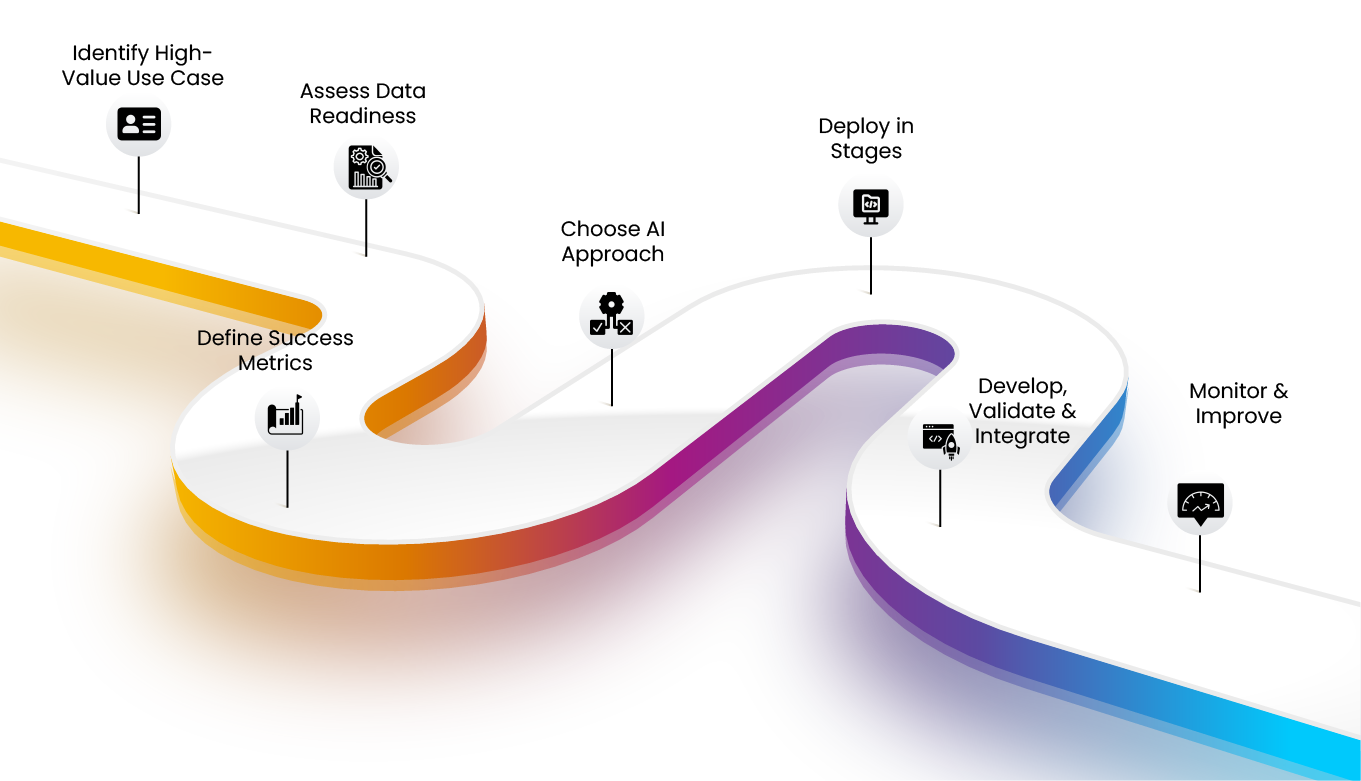
1. Financial Data Aggregation
The platform accesses information from sources such as transactions, account history, profiles, payment and credit records, etc., with defined data permissions and usage.
2. Financial Data Preparation
Identify missing values, inconsistencies, duplicates, and quality issues in records, and mask or tokenize sensitive fields to protect them as per applicable privacy regulations.
3. Model Development and Scoring
The developed statistical or ML model is configured and trained to identify patterns and generate outputs for the relevant business problem, becoming a financial decision.
4. Model Evaluation and Application
The designed model is tested on financial data to assess accuracy, reliability, fairness, and performance, and is evaluated against financial policies, limits, and user consent.
5. System Integration and Action
The model connects with the relevant application, API, workflow, or decisions to return data to help with flagging payments, credit limit recommendations, and so on.
6. Outcome Monitoring and Maintenance
Financial teams can track accuracy, performance, operational costs, fairness, overrides, response time, and business results after the final deployment.
For instance:
When processing a card payment, various real-time signals, including payment information, business type, and the type of device used by the user, are taken into account by an AI-based fintech model trained on historical fraud cases to deliver a risk score in milliseconds. The risk score is then utilized by the institution’s policy framework, which can decide whether to approve, question, or deny the transaction.
Why AI in FinTech Matters for the Real World?
AI in the financial industry is moving beyond experimentation, and it is clearly stated in the figures.
- A survey by Cambridge Judge Business School in 2026 indicated that the use of artificial intelligence is widespread globally. NICE Actimize, a large US retail bank with AML alert scoring and unsupervised ML, saves around 11,769 investigator hours a year.
- The Singapore Monetary Authority took active measures by issuing risk management guidelines in October 2026, scheduled to take effect on 7 October 2027. HSBC has an AI-powered dynamic risk assessment model that helps it prevent anti-money laundering with 2-4 times faster detection and transaction analysis in a few days.
- Another case example involves Feedzai, a one-time service provider, used real-time fraud detection and AML monitoring data models. It offered 13x fewer alerts and USD 5M lower losses within a few months.
The implication is obvious: AI technology is becoming a key part of financial systems, making management, security, and accountability essential for all businesses and enterprises.
Successful Use Cases of AI in Financial Technology
Proven use cases of artificial intelligence in financial services help drive measurable value outcomes across modern systems to improve financial workflows, transforming real-time decision-making.
1. Fraud and Risk Mitigation
AI technologies examine live transaction amounts, the type of device used, account history, and buying behavior. ML allows identifying potentially fraudulent deals, concentrating on investigating urgent cases and minimizing unwarranted refusals to make payments.
Business Impact: Accelerated fraud detection, reduction of losses, and better customer experience.
Key Concern: Models must find the right balance between detecting fraud and decreasing false positives in order not to reject valid transactions.
2. Credit Assessment and Loan Deployment
AI in FinTech helps improve credit analytics by analyzing information about borrowers’ credit history, income, payment behavior, liabilities, and cash inflows corresponding to borrowers. The outcomes allow lenders to evaluate borrowers’ creditworthiness.
Business Impact: Faster loan processing, better risk evaluation, and better consistency in lending decisions.
Key Concern: Lenders must consider bias, provide transparency, and abide by applicable laws on fair lending and data protection.
3. Financial Crime Compliance and Integrity
Artificial Intelligence enhances compliance in financial technology services with the help of unusual transaction patterns, relationship detection, document verification, and suspicious activity prioritization. It also makes it easier to keep track of the compliance process and all regulations.
Business Impact: Alert management has been made more efficient, less manual effort is required, and compliance monitoring has improved.
Key Concern: AI must complement customer due diligence and regulatory reporting to ensure human supervision.
4. Risk Management and Predictive Forecasting
AI is used in financial institutions for cash flow forecasting, credit risk evaluation, default detection, and assessment of market and operational risks. It also allows the use of predictive models for stress testing and scenario analysis.
Business Impact: Risks can be identified in advance, analysis improves, and decisions are made on a more informed basis.
Key Concern: Constant monitoring is essential for the models since market conditions may change.
5. Personalized AI-Powered FinTech Services
AI supports analyzing client purchasing habits, financial behavior, and preferred services, making it possible to suggest appropriate products, offer them useful budgeting information, and provide assistance based on specific needs. AI can help predict the likelihood of customer loss and show signs of financial trouble.
Business Impact: Enhanced customer interaction, improved retention, and availability of the relevant financial services.
Key Concern: The personalization of the services should ensure no violation of financial privacy principles and other consumers’ rights.
6. Business Settlement and Transactional Operations
Artificial intelligence plays a crucial role in automating the payment reconciliation process, categorizing operational exceptions, predicting transactional volumes, and pinpointing processing irregularities. It directs personnel to inaccurate information and helps forecast problems in operations.
Business Impact: Quicker transaction processing, less human error, and greater operational efficiency.
Key Concern: The payment process must use relevant security mechanisms, including audit records.
7. Algorithmic Trading and Market Analytics
Investment companies can leverage artificial intelligence for analyzing market information, searching for statistical trends, developing trade signals, and evaluating risk in the portfolio. In fact, AI can also be used in trade monitoring by detecting anomalous market movements in order to investigate them further.
Business Impact: Rapid investment analysis, systematic evaluation, and better decision support.
Key Concern: Models will consider market volatility and transaction costs, besides other important aspects, along with the established limits on risk management.
8. Data Processing and Operational Infrastructure
AI services employ natural language processing and computer vision for retrieving data from invoices, loan applications, bank statements, and identification documents. AI is capable of confirming the accuracy of the information obtained, classifying the documents, and sending exceptions to the employees for investigation.
Business Impact: Less manual input, rapid performance, and fewer errors.
Key Concern: Enterprises need to check data accuracy and protect sensitive data, assuming human involvement in the most complicated or significant cases.
What is AI Equilibrium for Finance: Strategic Value vs Systematic Risks?
The distinction table below gives a clear picture of the advantages and challenges of using AI in FinTech:
| Measurable Benefits | Operational Hurdles | Addressal |
| Fast analysis and pattern identification when processing large datasets | Changing conditions can reduce model performance accuracy over time | Monitor and validate models regularly and establish rollback |
| Improved fraud prevention with suspicious transaction detection and investigation prioritization | Sensitive financial information needs stronger privacy and cybersecurity | Utilize encryption, access controls, and data minimization to prevent losses |
| Better risk assessment with credit scoring and predictive analytics | Incomplete and inconsistent data affects quality and outputs | Ensure quality checks and governance standards are maintained |
| Repetitive tasks are automated and manual workload is reduced | Legacy systems may complicate the deployment of fintech AI | Use secure APIs and integrate AI in several phases |
| Personalized services improve experiences and reduce complexities | Patterns change, and false positives in models may block correct transactions | Identify detection rates and monitor model performance |
| Operations scale with less manual efforts | Models may be biased and make difficult decisions | Conduct and review model fairness testing |
| Utilize advanced analytics for financial decisions and resource allocation | AI decisions in financial services must comply with regulatory requirements | Keep audit trails, clear accountability, and proper governance maintenance |
What is the Framework to Deploy AI in FinTech Services?
A successful initiative of applying AI in financial technology begins with the right procedure for your respective business problem. Here’s a quick roadmap that you can practically follow:
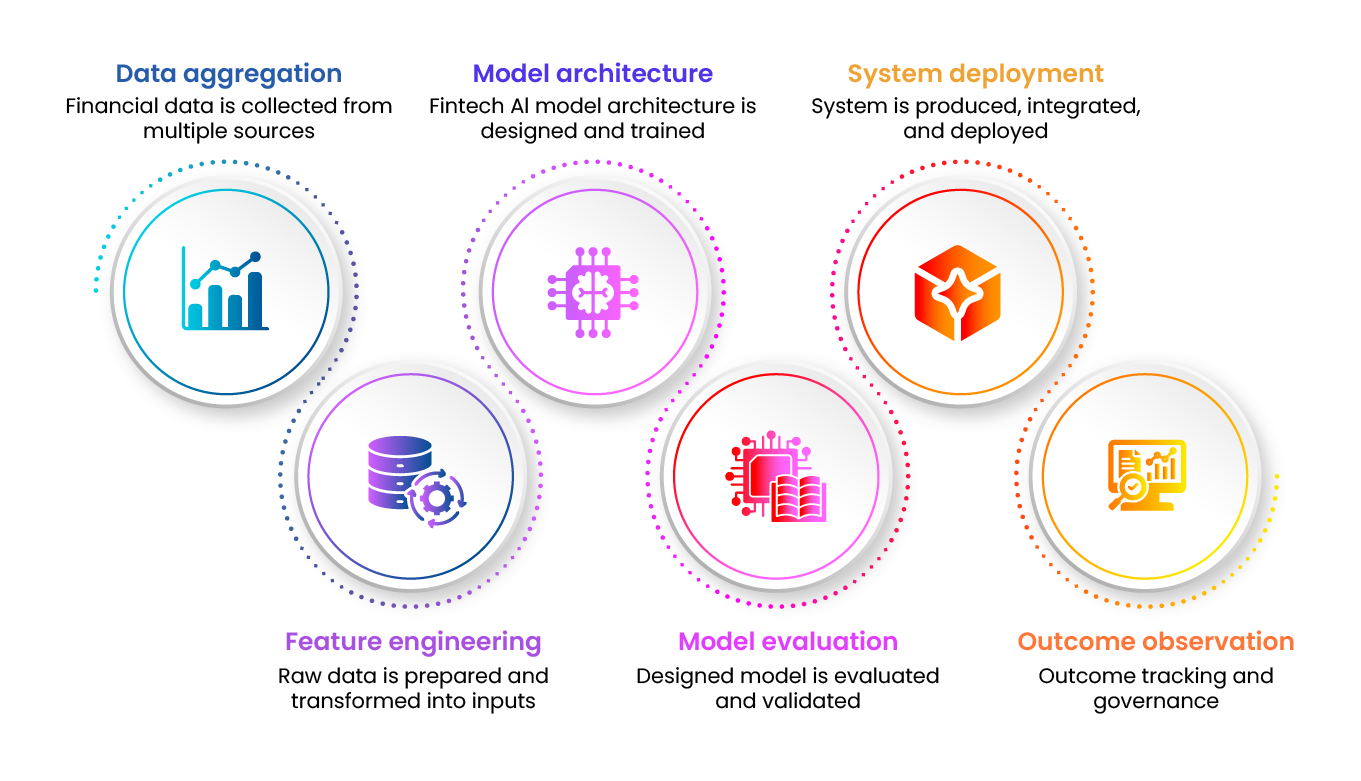
1. Identification of High ROI Use Cases
Select an organizational issue with quantifiable benefits, such as fraud detection or transaction monitoring. Clarify the goals and risks associated with wrong predictions.
2. Assessment of Data Integrity
Analyze the quality, completeness, accessibility, security, and rights of use of data. Solve the financial data issues before developing a solution.
3. Establishing Success Metrics
Determine the baseline figures and quantifiable targets and align them with the governance requirements and the associated risks.
4. Choosing Appropriate AI Approach
Identify whether to create a system from scratch or use existing solutions. Choose the option that delivers the best performance at the lowest cost while meeting regulations.
5. Model Development and Integration
Examine the system for accuracy, fairness, safety, and reliability. Connect existing financial systems with appropriate APIs or middleware and human control.
6. Deployment in Stages
Start with a controlled pilot test against current systems before letting AI impact decision-making. Measure performance, false positives, experience, and costs incurred.
7. Monitoring and Improvement
Ensure accountability of the built AI model for the financial sector and have an update, incident response, and a rollback plan.
Following these guidelines will ensure that your financial institutions have a measurable, secure, reliable, and scalable AI platform.
How AI Balances Compute Costs and Production Value for FinTech?
To optimize AI expenditures and financial ROI, AI FinOps services play a crucial role. Artificial intelligence projects appear affordable during pilot tests. However, they become expensive when factors such as data storage, monitoring, analytics, security, compliance, and governance are involved.
In such cases, AI financial operational services help businesses track costs, optimize resource allocation and usage, and measure financial returns for value.
Measuring ROI Value
AI-based financial operations system tracks expenses represented by the models or predictions being used and matches them to the actual business benefits, such as profits as a result of fraud prevention, speed in completing processes, and cost reduction.
While calculating ROI, you should take into account the ongoing costs, including the costs of computing, upkeep, model validation, monitoring, and compliance. The formula is:

The generic cost parallel involves:
| Solution and Scope | Estimated Financial Value |
| Proof of concept with AI (Single use case, limited data with basic validation and controlled model testing) | $40,000 to $75,000 |
| Production-Ready FinTech AI Platform (Custom model with secure API and integrated workflow and dashboards with industry compliant) | $ 75,000 to $ 200,000 |
| Enterprise-Grade AI Platform (Multiple cases, embedded with existing legacy systems, govenrance, and continuous monitoring) | $ 200,000 to $ 500,000 |
Common Cost Drivers and Their Financial Impact
These are as follows:
- Data organization: Low-quality or unavailable data raises the costs of usability.
- Model density: Custom-built models and their assessment require expert knowledge.
- Platform integration: Connecting legacy banking systems with payment systems increases labor costs.
- Security and compliance: The scope of financial information affects its privacy, confidentiality, and compliance.
- Transactional volume: Certain payment volumes lead to increased infrastructure expenses.
- Financial maintenance activities: Certain steps are needed to identify models and monitor them, creating additional budgets.
What is the Future of Financial AI Architecture?
The adoption of artificial intelligence in the financial services sector will put more emphasis on:
- Fraud Prevention: Identification of emerging forms of fraud, while reducing the rate of false positives.
- Predictive and Prescriptive Analytics: Improvements in risk assessment and financial forecasting.
- Responsible AI: Focusing on transparency, fairness, and accountability during financial transactions.
- Integration with Existing Systems: Secure connection between AI and current financial systems.
- Proven ROI: Ability to bring measurable cost benefits to business and customers.
What is Xcelore’s Strategy for AI Adoption in FinTech?
The application of AI in financial services demands coordination of business goals with data, engineering, security, and ongoing operation of IT systems as well.
Xcelore, as a leading AI development company, assists companies in finding applicable AI solutions, creating machine learning systems, implementing financial systems, and assessing efficacy according to business needs, with security and governance.
Besides, our AI development capabilities allow you to create financial workflows according to particular needs with use case scoping, flexible engagement, and explainable designs. AI FinOps lets organizations monitor IT costs and utilization of resources against anticipated financial output.
Furthermore, conducting a dedicated feasibility study will indicate if and how AI technology can be implemented in a FinTech organization and what its success criteria will look like. With us, your financial institution can discover AI application areas, create reliable systems, and bring ideas into reality. Get in touch with our financial AI experts to discuss the path forward.
FAQs
1. Is it more cost-effective to invest in custom AI or use an existing AI in a Fintech model?
Pre-existing models are good enough to accomplish basic tasks, while specifically designed models support working on unique financial activities. Fintech firms often rely on a combination of basic and unique implementations by making use of some standard models together with proprietary data, business rules, integrations, and safety measures.
2. What is the generic timeline to develop and implement a fintech AI model?
A pilot deployment might take weeks, whereas the system may be up and running months later depending on the availability of data, the involvement of complicated models, integrations, security measures, and regulatory checks or workflow features.
3. What is the cost of adding AI in financial institutions?
AI technologies require an investment ranging from $40,000 to $500,000 and higher, based on the complexity of a project undertaken.
- Prototypes will cost around $40,000 to $75,000
- Production solutions will demand nearly $ 75,000 to $ 200,000
- Enterprise platforms will not be cheaper than $200,000.
It varies depending on the project complexity and required technologies, security measures, and infrastructure.
4. How secure is it to use AI technologies in the financial sector?
AI in Fintech is secure when built with strong data protection, privacy, governance, encryption, access controls, monitoring, and audit trails in compliance with industry regulations such as FinCEN, cryptocurrency regulations, and more.
Related Blogs

More Than a Development Partner. A Partner in Progress.
We stay with your product beyond launch. From modernization and optimization to platform upgrades, security improvements, and continuous evolution, we help your solution keep moving forward.