
How Conversational AI Is Transforming the Customer Buying Journey
Sunil Yadav
Key Takeaways
- Conversational AI enables personalized recommendations to easily push customers to act in the market.
- AI can help customers compare, recommend, and ultimately make the best decisions for themselves when analyzing or purchasing a product or a service.
- The entire process, from payment to processing returns to placing orders repeatedly, has been simplified for customers.
- It is noticed that the document abandonment rates vary between 55-85% as stated in studies by different groups like Baymard, Solo Media, Retention Edge, etc.
- Retail businesses greatly benefit from measurable business performance, transparency, easy integration into CRM, catalogs, inventory, payments, and dealing with safety measures for people involved.
Consumers can explain to AI agents their requirements and have it identify suitable products based on their needs. Rather than manually searching for, filtering, and analyzing products, consumers benefit from an AI that can recognize customer needs, suggest appropriate items, answer queries and advise on buying. Conversational AI is therefore revolutionizing e-commerce by facilitating more tailored and engaging shopping experiences, utilizing natural language processing, machine learning, and automation.
Baymard Institute analyzed 50 studies and identified that, on average, 70.22% of customers abandon their shopping trolley. Consumers may be put off from completing a purchase if they are unclear regarding whether an item will meet their requirements, its stock status, cost, or delivery and returns information. Conversational AI effectively overcomes such issues by offering real-time replies, facilitating easy navigation of a range of products, and advising consumers. It also integrates different elements of the customer experience, including both pre- and post-sales support, alongside personalized product suggestions.
The importance of the product goes beyond its automation of queries and also allows for higher overall conversions, engagement rates, customer retention, and operational efficiency. Notably, having an AI chatbot will not produce these results unless certain additional conditions are met. Thus, businesses must have accurate product information, simplified connections between inventory, CRM, order, and payment systems, and contextual intelligence to have the competitive edge. Read through this guide and find out more about how conversational AI is making a difference by transforming the journey of customer purchases in eCommerce.
Evolution from Static Search to Conversational Commerce
E-commerce in retail industries, as we know it today, is a means of constant scrolling through product catalogues and websites, and knowing what specifications to check, such as processor, memory, battery, screen, quality, and price when buying laptops, clothes, home goods, and food.
Among these, conversational AI emerged as a game-changer. With it, customers communicate normally, and the assistant uses that previous context, asks follow-up questions, engages in product searches, does comparative online shopping, explains complicated product specifications in simple terms, and assists in making final purchases, checking supply and delivery options through any applications, websites, social media, and messaging platforms.
Gone are the days of linear purchasing activities, as customers move about in a far less predictable manner across their mobile devices, WhatsApp, laptops, and emails. While most businesses are primarily relying on 5-6 different marketing channels, the absolute minimum requirement has become 24*7 contact with clients. In addition, the most crucial aspect in that respect today is the effectiveness of communications.
According to the Salesforce State of Commerce Report for September 2026, agentic search has become the latest trend in purchasing behavior. 86% of commerce leaders are confident that the expectations of customers are driven by AI developments nowadays, while 41% of them state that it has become even more demanding. The number of shoppers everywhere in the world has reached 1.5 billion people, while the development of AI communication reaches 150-428% year over year. As a result, enterprises create conversational experiences in their own channels and ensure that high-quality structured product data is available to all.
How Conversational and Agentic AI Surpasses Traditional Chatbots?
While all 3 technologies, i.e., traditional bots, conversational AI, and Agentic AI can provide automated customer engagement, they have different levels of intelligence, memory, and capability to perform. The distinction table below between the three gives a more clearer overview:
| Basis | Conventional Bots | AI Agents | Agentic AI |
| Functionality | Provide predefined information to the users | Understand and engage with customers | Perform tasks to achieve desired outcomes |
| Engagement | Rule based | Context sensitive | Outcome driven |
| Intelligence | Keyword oriented | AI enabled | Strategic |
| Memory | Restricted | Retains context | Uses context and customer information |
| Product Search | Keyword based search | Contextualized suggestions | Structured discovery |
| Personalization | Restricted | Based on preference | Context and structured based |
| Performance | Already definite actions | Connected tasks | Multi-step operations |
| Restrictions | Lack of adaptability | Relies on correct data and integration | Strong security and control mechanisms are essential |
| Use Cases | Solve informational and simple information queries | Offer personalized product suggestions and shopping support | Handle refunds, returns, customer support, and order amendment |
Depending on business needs, businesses can use a blend of all 3 technologies.
- Traditional chatbots are used for simple information provision.
- Conversational AI is used for personalization and customer engagement.
- Agentic AI is used for performing structured tasks by authorized users in integrated business systems.
Often the optimal business solution is achieved by integrating all of them together with suitable human involvement.
How Conversational AI Agents Guide Customers Through E-Commerce Funnel?
Business opportunities are achieved when supporting customers across different markets are aligned together and not just limited to AI interactions. The framework followed is like:
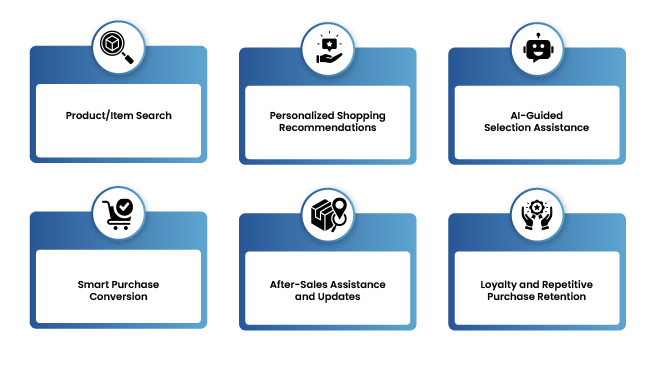
Product/Item Search
Natural language queries such as ‘good quality, supportive, < $300 office chair’ cannot currently be processed. AI agents understand user intent and find similar results using different technologies and models like NLP, deep learning, and machine learning. It also asks clarifying questions, suggests options, is multilingual, and voice-enabled, which is particularly beneficial for extensive and diverse product ranges. Thus, adding to effective and efficient search values with suitable conversion rates.
Personalized Shopping Recommendations
Information including data, user preferences, behavior, and transaction history is analyzed to provide highly targeted recommendations through conversation. This could include details such as type, price range, color, sizing, quality, etc. Besides, packages and supplementary goods can also be suggested, offering increased interaction and transactional facilitation.
AI-Guided Selection Assistance
Digital support for high-involvement goods such as technology, furniture, and more is achieved feasibly with AI agents. It provides comparison functionality, easy-to-understand information, compatibility and warranty details, plus review analysis and recommendations based on defined parameters. This helps reduce confusion and improves decision-making, reducing the cart abandonment rate.
Smart Purchase Conversion
Facilitates end-to-end processes for product fulfilment, delivery, promotions, exchanges, and payment. Conversational AI restores users’ shopping baskets, applies discounts, and advises on payment methods using secure channels. WhatsApp and SMS enable continuation of the entire conversation history, rather than sending a new, potentially unwelcoming email, streamlining the process and cart restoration, and increasing the cart recovery rate.
After-Sales Assistance and Updates
Conversational AI for customer service links to ordering or logistics systems for queries related to “Where is my order?”, changes of address, refunds, or returns. This can initiate processes or handle escalated matters with faster resolution of complaints and reduced volume of support work at a higher rate.
Loyalty and Repetitive Purchase Retention
Reordering through a single reply, delaying or skipping a subscription, requesting help for loyalty and delivery reminders, and complementary suggestions are all complex issues. With conversational AI development services, it gets easy to manage it resulting in increased lifetime value and comfort and better repurchase conversion from customers.
How Leading Industries Utilize Conversational AI in ECommerce to Upgrade?
Depending on a company’s products, consumers, and buying habits, there are numerous ways conversational AI can be utilized. Within eCommerce, it can be implemented to assist with a range of processes, including product search, personalized suggestions, and decision-making. Here’s how it assists in different industries:
| Type | Application | Measurable Value |
| Fashion and Apparel | Size advice, styling options, and ideal outfit suggestions | More accurate product matching and cross-selling of apparel |
| Electronics | Item specifications, compatibility checks, and technical advice | Informed buying of electronic gadgets like tablets, air purifiers, etc. |
| Retail | Shopping lists, alternative products, and repetitive order management | Easy shopping and higher customer retention in a streamlined way |
| Beauty and Personal Hygiene | Ingredients information, custom routines, and specific product suggestions | Personalized product search according to the preferences and skin requirements |
| Furniture and Home Decor | Space-oriented recommendations and material check | More informed decision-making when deciding to finalize the items |
| B2B eCommerce | Product configurations, budget quote help, technical documentation assistance, and order support | Simple and absolute procurement ensuring that all the business commerce operations go smoothly without risks |
| Automotive | Spare part searching, compatibility checks, and suitable accessory recommendations | Reliable product choices in the long run without losing extra money or time and effort |
To say, AI assistants in business source relevant products, retrieve product information, analyze features, monitor orders, and obtain quotes. This streamlines a business’ procurement process and eases workload. Furthermore, it is highly beneficial for sales and leads to more effective buying processes for both an organization and its customers.
How Conversational AI Proves Beneficial in eCommerce Industry?
This technology is beneficial because it provides consistency across platforms due to the same customer history. The following states the common advantages of using conversational AI in eCommerce sector to enhance the buying journey of the customers:
- Intelligent Discovery: Customers receive timely information about the fulfillment of their needs and requirements as a result of proper communication with the platform.
- Improved Conversion Rates: Due to the timely response time, information, and assistance provided when purchasing, customers are helped in making correct decisions.
- Enhanced Customer Services: The measures taken are evaluated via assisted conversion rate and number of completed transactions after using artificial intelligence.
- Better Omnichanel Status: Conversational AI helps not to worry about trivial issues like discounts, specifics, order status, returns, etc. allowing people to devote their time to more complicated responsibilities.
- Strong User Retention: With the help of personalized assistance, smooth ordering, and communication after delivery to the customers, the clients are kept loyal to the enterprise.
Challenges and Solution of Conversational AI in eCommerce Units
The common AI chatbot implementation challenges are stated below with their particular solutions for effective performance of the industry:
- Poor quality, fragmented and out-of-date data leads to poor outputs. So, ensure good quality data is available, and that systems are synchronized. Also, define data owners and access properly before finalizing any transactions.
- Models can return unverified information if underpinning data is not trustworthy. For this, leverage verified data sources, well-structured product information, validation, and confidence levels with control on output production with the use of AI agents.
- Systems handle customer information, accounts, purchasing and preferences. So, there pertains a risk with the sensitive information being accessed by the conversational AI agents. Implement user verification, access management, data encryption, protection, and locally appropriate compliance protocols to maintain data safety.
- Integration of AI with existing commerce, stock, payment and CRM systems can be challenging. Focus on API capability, integration design, system inter-dependencies and validation at a transactional level.
- Customers are discouraged by both unhelpful and inaccessible outputs provided by the AI agents. Gartner recent study discovered that 87% of 3,566 B2B and B2C customers deem it vital to be able to interact with an entity via a human agent where businesses employ generative AI to provide a service. In such a case, define methods of transferring interaction between entities and maintain continuity of context when doing so. Even allow human agents to step in where required, for instance, for more intricate or delicate issues.
- Customers face slower service and increased expenditure due to multi-channel interactions. Tailor search, model choice, caching, integration and infrastructure to suit demand with the conversational AI bots.
Enterprise Framework to Build Conversational AI for eCommerce Stores
Enterprises must start with the initial requirement analysis and not directly put the technology in use. A simple process to use AI agents in retail and eCommerce is as follows:
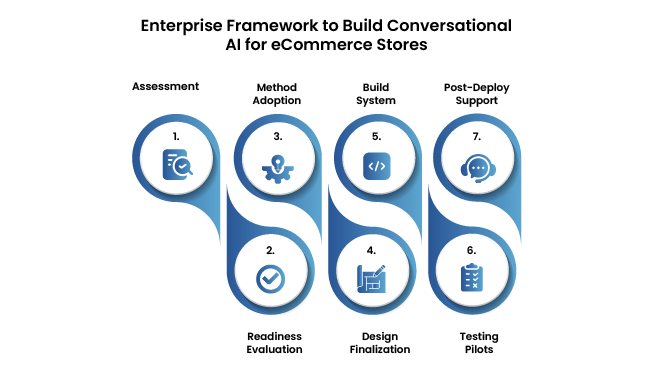
To explain more briefly, it is:
- Assessment
Identify key digital engagement areas which can be described as high volume opportunities.
- Readiness Evaluation
Analyze the data on products, sales and customers and formulate procedures for interaction and security for a specific system. - Method Adoption
Decide on whether to use a chatbot, virtual agent or automation based on an understanding of their attributes, ways of interacting and information they have access to, together with the budget for each. - Design Finalization
Formulate rules for the engagement, information provision, and further procedures. Also, form procedures for delegation to people. - Build System
Develop the system and connect it to existing systems by formulating procedures for data retrieval and authorization. - Testing Pilots
Pilot the system on an area such as product search or order status and assess its accuracy, together with its interaction and security related properties. - Post-Deploy Support
Following a successful pilot, progressively roll out the system at a wide level. Check for upgrades and maintenance optimization.
Core Architecture Behind Enterprise Conversational AI in Customer Journey
Good platforms require functionality that enables accurate search, contextual awareness, and security. Further, there should be processes in place to effectively manage an AI agent’s workflow. The technologies utilized here are:
- NLP and LLMs to understand and help achieve a user’s objective and to enable easy, simple, and informative communication.
- RAG to respond to clients using live data such as pricing, catalogues, stock, company and supporting documentation.
- Conversational Analytics to store an agent’s previous interactions and details of verified users in line with defined data retention rules.
- Enterprise integration, including, but not limited to, enterprise resource such as CRM, product information management, e-commerce, payment and analytics, and further resources.
- Agent Workflow to complete a range of service provision actions and to manage user verification, data search and checking together with different audit procedures.
- AI Governance using user verification, access controls, standard checks and also ongoing surveillance.
Where is the Future of Conversational AI in eCommerce Headed?
The next phase will further integrate AI agents, product information, and both customer and trading information so that commerce can be understood and managed by smart interfaces.
- AI agents developed by a trusted AI agent development company will manage processes such as research, evaluation, stock checking and authorized trade. Here, businesses must define what authorizations are permitted.
- Consumers will interact using text, speech and visual media. For instance, they may submit an image of furniture and request alternative options at a suitable price.
- Mobile led services will benefit from speech recognition, multilingual facilities, data security, and methods of verifying trading activity.
- There will also be closer links between business systems, consumer profiles, and commerce information so that appropriate cross-channel service can be provided together with the ability to recognize and then progress consumer dissatisfaction, with full contextual awareness.
- Conversational AI agents move beyond chatbots and are used for information retrieval and decision making, so, businesses must provide precise and harmonized information about products including details, costs, stock and information on policy so that it can be correctly analyzed by AI.
- With chat and agent technologies become more independent, there is increasing importance placed upon reviewing and managing any potential prejudices and ensuring data security.
- Businesses will require robust governance arrangements so that their conversational AI systems operates fairly, openly, and in compliance with regulations.
Why Hire Xcelore For Conversational AI Agents in ECommerce Sector?
Alongside the knowledge of AI, data management, integration and handling business’ operations, an enterprise must also have a stable solution for Conversational AI. We at Xcelore, create business focused, operationally relevant and goal driven AI solutions. Our AI agent development services include:
- Conversational AI agents with intention and contextual awareness
- LLM’s grounded in business data using RAG
- Controlled functional AI agents to execute operations on behalf of an enterprise
- Integration to e-commerce, CRM, stock and order processing along with other systems
- Customer engagement and contextual personalization
- Feasible, secure, and governed systems with controlled analytics
Typically, users already seek assistance in areas such as after-sales and cart resurrection. These are also areas which remain less automated, according to 2026 data. So, we recommend starting there as data is the highest quality point. Our following two solutions are specific to meet this requirement:
- Exei, Xcelore’s AI-driven platform for customer care which enables the use of agents across websites, telephones, social networking, WhatsApp, Instagram, and Facebook. It has voice and text options available in 80+ languages and is able to send notifications to customers who left a product at the online store with “free shipping” or cash-on-delivery payment option.
- AI agent development for automated answering of customers queries, issuing tickets, and scheduling orders through existing processes, including maintenance and support after launching the solution.
To sum up, conversational AI is no longer an issue of “whether or not to use”, but how to properly interface. Brands that are ahead and use real-time data, implement strict regulations on the operations of the AI, communicate the fact of using AI to their customers, and guarantee prompt assistance from the live agent grow higher.
It is said that “customer intent is the next key differentiator within e-commerce.” So, identify a high impact process first, then analyze and assess both budget and issue resolution and accordingly, scale your efforts to the end product for measurable values.
FAQ’s
Q. Can conversational AI systems improve an eCommerce business?
A. Yes. It can reduce search time, support consumers in purchasing and even recommend products based upon their requirements or preferences. The final success depends on effectiveness, data quality, how the consumer interacts, and the general shopping experience with the agents.
Q. Can conversational AI fully replace human interaction?
A. No, and it should not. Although 52% of companies claim that chatbots can resolve every consumer enquiry, humans are still required to address more intricate issues. Furthermore, the presence of a human opinion doubles consumer trust in a company.
Q. How long does it take to create a conversational AI chatbot?
A. Depending on the level of intricacy and the systems which are incorporated in the AI agent development, an estimated timeline for basic Chatbot is 2-4 weeks, AI Chatbot is 1-3 month and an advanced Chatbot is 3-6+ months.
Q. How to evaluate the ROI of using conversational AI within an ECommerce business?
A. Cost and revenue savings can be compared with the budget associated with both the set up and ongoing management of the conversational AI. Important areas for analysis include deflection, cost per interaction, CSAT, aided conversion, and customer loyalty when compared to previous periods.
Q. How Xcelore continually enhance conversational AI in eCommerce units?
A. Feedback is gathered from customers and escalated issues and errors relating to the understanding of customer intent are analyzed to further enhance a business’ conversational AI. Through the analysis, response gaps are identified and actions are taken to reduce them, enhance conversation processes, and improve problem solving.
Q. How long does it take to realize ROI from implementing conversational AI?
A. The realization of return on investment can be affected by several factors including the level of sophistication of the AI, the amount of interaction, data quality and ease of integration. Nevertheless, the initial 30-60 days can often be seen as a settling in period and therefore provide an opportunity to fine tune the conversational AI agents.
Related Blogs


More Than a Development Partner. A Partner in Progress.
We stay with your product beyond launch. From modernization and optimization to platform upgrades, security improvements, and continuous evolution, we help your solution keep moving forward.