
Enterprise AI Infrastructure: How to Build a Scalable Foundation for Production AI
Sunil Yadav
Key Takeaways
- Only 4 of every 33 AI proofs of concept reach production. That is IDC and Lenovo's finding. The gap is rarely the model. It is the compute, data, networking and security layer beneath it, which must scale together.
- Don't chase the biggest GPU cluster. Size compute for today's training and inference needs, then leave headroom for tomorrow, so growth means adding capacity rather than re-architecting the entire platform from scratch.
- Cloud, on-premises or hybrid is a workload decision, not a company-wide habit. Let data sensitivity, utilization and cost decide where each AI workload runs, and revisit the choice as demand shifts.
- Define the workload before you buy the infrastructure. Training or inference, real-time or batch, ten users or ten thousand: these answers shape your architecture and prevent expensive capacity you will never actually use.
- Judge AI by cost per request, not the monthly bill. Real TCO includes engineering, security, monitoring and optimization, not just GPUs, and FinOps ties every workload's spend to measurable business value.
- Build in phases and expect to adjust. Start with priority workloads, embed governance early, and keep the roadmap iterative, because generative AI and agents will demand new infrastructure, from inference capacity to secure tool access.
Enterprise AI initiatives often face their biggest challenges after the proof of concept. IDC research with Lenovo found that only four of every 33 reach production, and Gartner predicts that through 2026, organizations will abandon 60% of AI projects that lack AI-ready data. Infrastructure built for experimentation rarely survives production demands, especially when compute, data accessibility, networking, and security must scale together.
Enterprise AI infrastructure comprises compute, data, storage, networking, software platform, and security capabilities required for developing and running AI workloads. This infrastructure design determines not just application reliability and efficiency but scalability too. The challenge for a CTO is to support today’s workloads and still have enough capability headroom for tomorrow. Largest available computing power does a poor job of addressing that challenge.
What Is AI Infrastructure and Why Does It Matter for Enterprises?
AI infrastructure encompasses the resources required to develop, train, deploy and then manage AI applications. In addition to hardware, it will include software and data. While standard IT infrastructure is predominantly concerned with enabling effective business and database functionality, AI infrastructure needs to be able to process significant computational work, data and models together with providing system oversight.
- Data preparation: Collecting, processing, validating, and organizing information for AI applications.
- Model development: Providing computing resources and environments for training, fine-tuning, and experimentation.
- Model deployment: Making trained models available through applications, APIs, and enterprise platforms.
- Inference and execution: Processing user requests, generating predictions, and executing AI-driven tasks.
- Monitoring and optimization: Tracking performance, resource utilization, security, and operational costs.
Traditional IT Infrastructure vs. AI Infrastructure
Diverse environments require diverse considerations. Whereas conventional IT environments may be preoccupied with guaranteeing efficient application performance, optimized databases and networks, and controlled usage, AI environments require that high-performance computing, large-scale data processing, and model delivery be considered as well. Moreover, there may be vastly varying needs depending on the purpose of the environment.
| Evaluation area | Traditional IT infrastructure | AI infrastructure |
| Compute | Primarily CPU-based workloads | CPUs, GPUs, and specialized accelerators |
| Storage | Application and database storage | Large datasets, model artifacts, embeddings, and vector storage |
| Data processing | Structured business transactions | Structured and unstructured data, including real-time streams |
| Workloads | Applications, websites, and databases | Training, inference, generative AI, and AI agents |
| Operations | Application and system monitoring | Model monitoring, resource utilization, and AI workload management |
| Scalability | Application and transaction demand | Variable compute, memory, data, and inference requirements |
Extending an organisation’s IT infrastructure is also relevant for enabling AI. While existing systems can form the basis for AI, extra functionality may be required to ensure that these are effectively utilised for AI.
Core Components of Enterprise AI Infrastructure
A production-ready AI environment depends on multiple components working together. A limitation in one layer can affect the performance of the entire system.
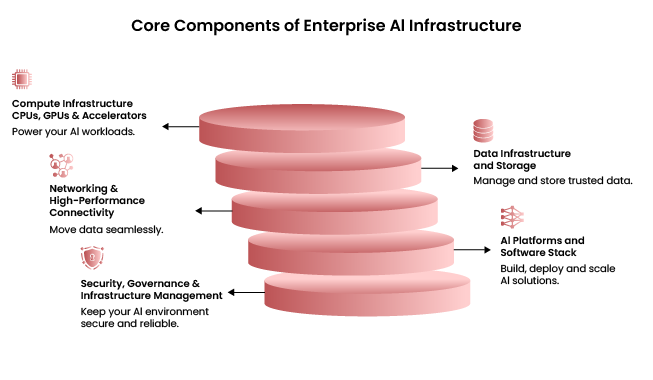
1. Compute Infrastructure: CPUs, GPUs, and Accelerators
Compute infrastructure provides the processing capacity required to execute AI workloads. Central processing units (CPUs) handle general-purpose processing, data preparation, application logic, and orchestration. Graphics processing units (GPUs) accelerate parallel computations, making them particularly useful for training and running large AI models. Specialized AI accelerators can support specific workloads with different performance and efficiency characteristics. Enterprises should distinguish between two major compute requirements:
- Model training: Requires substantial computing resources to process datasets, adjust model parameters, and train or fine-tune models.
- Model inference: Uses trained models to generate predictions or responses when applications receive requests.
Inference requirements can become significant as more employees, customers, and business applications begin using AI. Rather than purchasing hardware based on estimated future demand alone, organizations should evaluate model size, expected request volume, latency requirements, and resource utilization before deciding on compute capacity.
2. Data Infrastructure and Storage
Good quality, pertinent and trustworthy data is fundamental for AI application. Typically, enterprises implement a combination of data lake, data warehouse, database and object stores to manage varied data. For generative AI, additional data stores such as vector databases can be used to store and access data in the form of ‘embeddings’. This is used in conjunction with semantic search and RAG, so that language models can access suitable business data to inform their generation of content. A good data environment should:
- Data ingestion from enterprise applications and external sources.
- Data quality, transformation, and validation.
- Access to structured and unstructured information.
- Storage capacity, backup, and recovery.
- Data lineage, ownership, and access governance.
The objective is to make the right information available to AI systems without creating additional data silos or compromising existing security controls.
3. Networking and High-Performance Connectivity
Good network functionality is an important part of an AI environment to ensure effective interaction between computers, data stores, software and business systems. In distributed environments several computers for example, computer graphics cards or computer nodes may need to constantly share information. Even where there is enough computer power, networks can become a limiting factor.
Furthermore, business system access and external service interaction can also influence AI software performance due to lag time.
Businesses should analyse the data transfer rate, network lag, network connection and both physical and cyber security. When developing distributed AI, network functionality should be integrated with computer and data store functionality. Source
4. AI Platforms and Software Stack
Whilst hardware and data are fundamental, software is used to enable and control an organisations AI set-up. This includes areas such as modelling, deployment and control. Key functions include:
- MLOps: Applies software engineering and automation practices to machine learning development, deployment, testing, and monitoring.
- LLMOps: Extends operational practices to large language models, including prompt management, model evaluation, inference monitoring, and usage tracking.
Containerisation and orchestration technologies like Kubernetes can be used for application deployment and also for distributing computing power. Alongside this, organisations can transition from ad-hoc AI experimentation to structured and standardised production deployment.
5. Security, Governance, and Infrastructure Management
Enterprise data has to be secured within an AI environment. AI infrastructure needs to ensure appropriate access control, data encryption, network security and secure API links. Alongside this, Enterprise AI Security ensures control around model access, data processing, assessment and ethical AI.
Alongside infrastructure, organisations must analyse AI system performance and monitor asset and behaviour metrics. The NIST AI Risk Management Framework advises on how to integrate trust and risk considerations within AI. Furthermore, AI governance must be embedded at an early stage within infrastructure planning for enterprise applications.
Cloud vs. On-Premises vs. Hybrid AI Infrastructure: What Should Enterprises Choose?
After establishing key requirements, organisations must consider the appropriate environment to execute their AI workloads. Cloud, on-premise and hybrid provision provide differing degrees of agility, management and accountability. There is no one-size-fits-all solution. Appropriate environments will be influenced by workload type, compliance and current and future expenditure considerations.
Cloud AI Infrastructure
Cloud AI infrastructure provides computing, storage, and AI services through cloud providers. Organizations can provision resources when required without purchasing and maintaining all the underlying hardware.
Advantages:
- Flexible access to computing resources.
- Faster infrastructure provisioning.
- Easier experimentation with different models and configurations.
- Managed services that reduce infrastructure administration.
Considerations:
- Variable consumption-based expenses.
- Data transfer and storage costs.
- Dependence on cloud provider services and pricing.
- Data residency and compliance requirements.
Cloud infrastructure can be a good solution for companies who have variable workloads, lack infrastructure expertise or wish to rapidly implement AI.
On-Premises AI Infrastructure
An on-premises infrastructure belongs to and is hosted in an organisation’s own data centre or secure environment. This enables more control over the physical infrastructure, and where data is stored.
Advantages:
- Direct control over infrastructure and data.
- Greater flexibility for specific security requirements.
- Predictable access to dedicated computing resources.
- Potential cost advantages for consistently high utilization.
Considerations:
- Significant initial hardware investment.
- Responsibility for maintenance and upgrades.
- Infrastructure capacity planning.
- Requirements for specialized technical teams.
It could also be appropriate where an organization has a strong need to control data or has existing investment in a data centre.
Hybrid AI Infrastructure
A hybrid AI infrastructure utilises an organisations existing on-site facilities and also links to either a public or private cloud.
Advantages:
- Flexible workload distribution.
- Greater control over sensitive information.
- Access to cloud resources when demand increases.
- Ability to use existing infrastructure investments.
Considerations:
- More complex integration and management.
- Consistent security policies across environments.
- Data movement and connectivity requirements.
- Monitoring and cost allocation across platforms.
Hybrid infrastructure can be appropriate when enterprises need to balance data control, workload flexibility, and existing technology investments.
Comparing Enterprise AI Deployment Models
| Criteria | Cloud | On-premises | Hybrid |
| Scalability | High, subject to provider capacity and limits | Depends on installed capacity | Flexible across environments |
| Control | Provider-dependent | High | Shared |
| Cost structure | Primarily consumption-based | Higher upfront investment | Combination of both |
| Maintenance | Shared with provider | Organization-managed | Shared |
| use cases | Variable workloads and rapid experimentation | Sensitive or consistently intensive workloads | Mixed workloads and data requirements |
The decision should be based on actual workload needs rather than assuming that one deployment model will support every AI application.
How to Choose the Right AI Infrastructure for Enterprise Workloads
Selecting infrastructure requires more than understanding the amount of computing power a company need. Technology leaders should evaluate how AI workloads will behave in production and how those requirements will change over time.
1. Define AI Workloads and Performance Requirements
Start by identifying the applications the infrastructure must support. Different AI applications have different processing and operational requirements. Consider:
- Training versus inference requirements.
- Real-time versus batch processing.
- Expected request volume and concurrent users.
- Model size and response-time expectations.
- Integration with internal applications and services.
This assessment helps prevent unnecessary infrastructure investments.
2. Evaluate Scalability and Compute Requirements
Identify your current and future computing needs. For AI workloads, analyse the memory, GPU, computational and distributed systems requirements. Determine if shared or specialised resources are appropriate. Ideally, a system will be able to expand its resources so that additional AI systems can be incorporated, without necessitating a complete re-architecture of the system.
3. Assess Data Readiness and Integration Needs
AI needs to integrate with technology where organisational data is held. Assess data availability and its associated attributes including data integrity, and ownership. Information can be found on legacy software, within a cloud environment, in storage and on external sites. Integration should recognise data security; an AI solution must be able to identify and then only gain access to data that an individual or another system has permission to view.
4. Prioritize Security, Compliance, and Governance
Identify security needs. Data location, data encryption, authentication, authorisation, logging and regulatory compliance are all key areas to think about. When using Generative AI, further consideration is needed regarding prompt entry, model response, confidential data and integration of third party tools. These will then in turn affect the type of infrastructure that is implemented.
5. Calculate Total Cost of Ownership
Infrastructure costs extend beyond GPUs and cloud computing. A realistic total cost of ownership (TCO) assessment should include:
- Hardware acquisition or cloud consumption.
- Compute, storage, and networking.
- Software licensing and platform subscriptions.
- Integration and engineering.
- Security, monitoring, and maintenance.
- Infrastructure administration and ongoing optimization.
Compare these expenses against expected business outcomes. For inference-heavy applications, evaluate the cost per request or completed task rather than looking only at monthly infrastructure bills.
Common AI Infrastructure Challenges at Enterprise Scale
No matter how carefully planned the infrastructure is, there could be problems of an operational nature arising during the adoption of AI technologies across different departments.
- High Compute Costs: GPU-intensive training and increasing inference requests can raise infrastructure spending. Poor resource allocation makes the problem worse.
- Infrastructure Fragmentation: Separate development environments, cloud platforms, and AI tools can create inconsistent deployment processes and increase operational complexity.
- Data Silos and Integration: Enterprise information often resides in disconnected systems. Limited access to relevant data can reduce the usefulness of AI applications.
- Performance and Latency: Insufficient computing capacity, slow data retrieval, and network bottlenecks can affect application response times.
- Security and Governance Gaps: Inconsistent access policies and limited visibility into model interactions can expose sensitive enterprise information.
- Limited Operational Visibility: Without centralized monitoring, technology teams may struggle to identify resource inefficiencies, performance issues, and unexpected cost increases.
As we can see, the challenges listed above are related and require specific architectural solution.
Building an AI-Ready Infrastructure: A Practical Enterprise Roadmap
A phased approach allows organizations to improve infrastructure based on business priorities instead of attempting a complete technology overhaul.
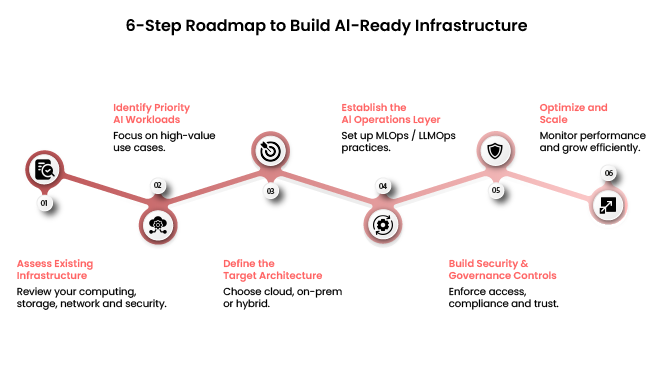
1. Assess Existing Infrastructure
Review current computing capacity, storage systems, cloud environments, networking, data platforms, and security controls. Identify which existing investments can support AI workloads and where additional capabilities are needed.
2. Identify Priority AI Workloads
Classify planned applications by workload type, expected usage, performance requirements, and business value. Separate experimentation, training, inference, and production requirements.
3. Define the Target Architecture
Select cloud, on-premises, or hybrid deployment based on data sensitivity, scalability, integration requirements, and cost considerations. Define how compute, data, networking, and application layers will interact.
4. Establish the AI Operations Layer
Implement MLOps and LLMOps practices for model deployment, versioning, testing, monitoring, and lifecycle management. Standardize deployment processes to reduce operational inconsistencies.
5. Build Security and Governance Controls
Establish identity policies, data access controls, encryption, monitoring, and audit mechanisms. Define ownership and accountability for AI systems across development and production.
6. Optimize and Scale
Track computing utilization, inference performance, application reliability, and infrastructure spending. Use these insights to adjust resource allocation and expand capacity as adoption grows.
This roadmap should remain iterative. Infrastructure decisions made for an initial AI application may need adjustment as additional workloads, models, and business requirements emerge.
The Future of Enterprise AI Infrastructure
The infrastructure requirements of enterprise AI will continue to evolve as organizations move toward more complex applications. Three developments deserve particular attention.
Infrastructure for Generative AI and Large Language Models
Generative AI introduces additional requirements for model hosting, inference capacity, and enterprise data retrieval.
Organizations deploying large language models must account for model size, GPU memory, concurrent requests, and response times. RAG architectures also introduce dependencies on document processing, embedding generation, vector storage, and retrieval pipelines.
Inference optimization will become increasingly important as organizations expand access to generative AI across business functions.
Infrastructure for AI Agents and Multi-Agent Systems
AI agents introduce a different set of infrastructure requirements. Unlike conventional AI applications that respond to individual requests, agents can execute multi-step tasks, interact with APIs, retrieve information, and coordinate with other agents. Their infrastructure must support:
- Secure access to enterprise tools and APIs.
- Execution environments and workload isolation.
- Persistent context and memory management.
- Agent orchestration and communication.
- Monitoring of actions, resource consumption, and execution outcomes.
Multi-agent systems can also generate multiple model calls during a single business task. Infrastructure planning must therefore account for variable execution patterns and the additional costs associated with agent interactions.
Edge AI and Distributed Intelligence
Some AI applications require processing closer to where data is generated. Processing information locally can reduce communication delays and limit the need to transfer all raw data to centralized cloud environments. However, organizations still need to coordinate edge devices with central infrastructure for model updates, monitoring, and data management.
AI Infrastructure Optimization and FinOps
As AI adoption grows, infrastructure management must become more closely connected to financial accountability. AI FinOps helps organizations track and optimize spending across computing resources, model usage, inference, and supporting platforms.
Practices such as GPU utilization monitoring, workload scheduling, model selection, caching, and dynamic resource allocation can improve infrastructure efficiency. The FinOps Foundation also identifies AI optimization as an area requiring resource efficiency, cost allocation, and ongoing workload optimization.
For enterprise leaders, the objective is not simply to reduce infrastructure expenditure. It is to understand what each AI workload costs and whether that investment delivers measurable business value.
Building Scalable Enterprise AI Solutions with the Right Engineering Partner
Enterprise AI infrastructure decisions involve several interconnected areas, including architecture, data engineering, application development, cloud environments, and ongoing operations.
Organizations with limited internal capabilities may find it difficult to coordinate these requirements, particularly when extending legacy systems or introducing AI across multiple business functions.
When Should Enterprises Consider External AI Engineering Expertise?
External engineering support can be valuable when organizations:
- Lack specialized expertise in AI architecture and production deployment.
- Need to integrate AI applications with complex legacy systems.
- Want to develop custom AI platforms or enterprise applications.
- Require MLOps and LLMOps capabilities for managing production workloads.
- Need to scale engineering capacity across multiple AI initiatives.
The right engineering partner should understand both the AI application and the enterprise environment in which it will operate.
How Xcelore Supports Enterprise AI Infrastructure Development?
Production AI needs an architecture that fits your workloads, data systems that connect across the business, deployment practices your team can trust, and engineers who can scale all of it as demand grows. At Xcelore, our enterprise AI services cover AI-ready platforms, data modernization, MLOps, LLMOps, and cloud engineering.
We use most of all technologies to turn Enterprise AI initiatives into production-ready solutions that connect to your existing business systems and keep performing as workloads change. If you are weighing where AI could return measurable value in your business, talk to the Xcelore team about your requirements and plan an implementation that fits your goals.
FAQs
Q. What is enterprise AI infrastructure?
A: Enterprise AI infrastructure is the combination of computing resources, data systems, storage, networking, software platforms, and security controls required to develop, deploy, and operate AI applications within an organization.
Q. What are the key components of AI infrastructure?
A: The main components include CPUs and GPUs, data pipelines, storage systems, networking, AI development platforms, MLOps and LLMOps tools, security, governance, and infrastructure monitoring.
Q. What is the difference between AI infrastructure and cloud infrastructure?
A: Cloud infrastructure provides computing, storage, networking, and other services through cloud platforms. AI infrastructure includes these resources along with specialized capabilities for model training, inference, data processing, deployment, and AI workload management. AI infrastructure can run in the cloud, on-premises, or across hybrid environments.
Q. Is cloud or on-premises infrastructure better for enterprise AI?
A: Cloud infrastructure offers flexible provisioning and easier access to computing resources, while on-premises infrastructure provides greater control over hardware and data. Hybrid infrastructure combines both approaches. The right choice depends on workload requirements, security policies, existing investments, and operating costs.
Q. How much does enterprise AI infrastructure cost?
A: Enterprise AI infrastructure costs depend on model complexity, GPU requirements, data volume, deployment architecture, storage, networking, and operational needs. Cloud-based implementations may start with consumption-based expenses, while on-premises deployments require hardware and setup investments. A detailed TCO assessment is necessary before committing to an architecture.
Q. How much GPU capacity does an enterprise need for AI?
A: GPU requirements depend on the model being used, its size, training or inference requirements, memory needs, and expected request volume. Not every enterprise AI application requires dedicated GPUs. Smaller workloads may run efficiently on CPUs or managed AI services, while large model training and high-volume inference may require specialized GPU resources.
Q. How can enterprises scale AI infrastructure for generative AI?
A: Enterprises can scale generative AI infrastructure by evaluating inference demand, optimizing model deployment, improving data retrieval, using GPU resources efficiently, and introducing workload orchestration. Caching, batching, and appropriate model selection can also improve performance and cost efficiency.
Q. What role do MLOps and LLMOps play in AI infrastructure?
A: MLOps and LLMOps provide operational processes for developing, deploying, monitoring, and maintaining AI models. They help standardize releases, track model performance, manage versions, and support reliable production operations.
Q. How can organizations optimize AI infrastructure costs?
A: Organizations can optimize costs through workload monitoring, GPU utilization analysis, resource scheduling, model optimization, caching, and appropriate cloud or on-premises resource allocation. Tracking cost per inference or completed business task also helps connect infrastructure spending to outcomes.
Q. How long does it take to build an AI-ready infrastructure?
A: The timeline depends on existing infrastructure, data readiness, integration complexity, security requirements, and the number of AI workloads involved. A focused infrastructure setup for a specific application may take weeks, while enterprise-wide modernization can require several months or longer. A phased implementation helps organizations establish a usable foundation before expanding.
Related Blogs

More Than a Development Partner. A Partner in Progress.
We stay with your product beyond launch. From modernization and optimization to platform upgrades, security improvements, and continuous evolution, we help your solution keep moving forward.