
Monolith to AI-Native Architecture: Why Enterprise Modernization Needs a New Blueprint
sunil.yadav@xcelore.com
Key Takeaways
- Modernizing the enterprise is no longer just about improving application performance. It's about creating an intelligent, connected, and AI-ready business environment.
- Whilst microservices and cloud native technologies can provide greater flexibility, they do not necessarily ensure your enterprise data and applications are ready for AI.
- An AI-native architecture ensures that enterprise data, business logic, models, orchestration, and governance come together to create a cohesive architecture.
- Often the main challenge of deploying AI in the enterprise is not having the right models, but making sure you have reliable data, business context and control.
- Modernization should come from business drivers. You want to make sure you retain your valuable legacy investments whilst giving yourself the right architecture capabilities to allow you to utilize AI.
Traditionally, enterprise technology investments have concentrated on application safety, infrastructure extensibility, and operational effectiveness. Businesses have updated obsolete systems, transferred their workloads to cloud computing systems and started using distributed architectures to adapt to an ever-changing market situation.
However, artificial intelligence is changing what enterprise architectures must deliver. Applications are increasingly expected to interpret operational data, connect information across systems, support contextual decision-making and execute approved actions within established business controls.
This shift exposes limitations in existing technology environments. Fragmented data, tightly coupled dependencies and disconnected workflows often prevent Organizations from introducing intelligence across enterprise systems.
For technology leaders, the challenge extends beyond improving application development or infrastructure scalability. It involves establishing architectures that connect enterprise systems, coordinate intelligent capabilities and meet security and governance requirements. An experienced technology partner can help Organizations assess existing systems, identify architectural gaps and plan a structured transition towards intelligent enterprise environments.
AI-native architecture addresses this shift by rethinking how enterprise systems connect, share information and support intelligent operations. It does not necessarily require replacing existing applications but modernising how they work together to enable intelligence across the organisation.
Understanding Monolithic Architecture and Its Limitations
Monolithic architecture is a type of application design where there is only one deployment unit. The application UI, application business logic, application data access and application functionality are typically developed and managed in a single, well integrated code base.
This can make development, management and deployment much simpler at first however as requirements change little and the application becomes large, complex and has many dependencies many companies will have important applications using a monolithic architecture. This can cause problems with the limitations of this type of architecture becoming apparent.
Where monolithic systems create constraints
- Tightly coupled Components: There is a shared code-base, resources and dependencies throughout the application. Any changes made to one component will cause changes to others. This therefore increases testing and co-ordination during the release.
- Low scalability of individual components: If certain aspects of the application experience a high volume of demand, the whole application must be scaled.
- Complex integration: Integrating the application with other applications or new technologies may cause companies to modify different parts of the application.
- Long development cycle: Due to the large code-base and common deployment processes, it can be difficult to develop components individually especially when multiple teams are involved.
- Inaccessible business data: The business data is spread across different databases and modules within the application.
However, monolithic architecture is not inherently incompatible with AI. Organisations can integrate machine learning models, intelligent features and external AI services into well-designed monolithic applications.
The challenge arises when existing dependencies, limited integration interfaces or fragmented data access prevent these capabilities from operating effectively across business systems.
The decision to modernize should therefore depend on the limitations of the existing architecture and the business outcomes an organisation wants to achieve, rather than the assumption that every legacy application must be replaced.
How Enterprise Architecture Has Evolved
Enterprise architecture has evolved with advancements in software engineering, infrastructure, and the expectations of businesses. Each architectural model was developed to solve problems in previous models and raise new issues.
| Architecture | Primary focus | Enterprise advantage | Key consideration |
| Monolithic | Unified application development | Centralized development and deployment | Tight coupling as complexity grows |
| Microservices | Independent business capabilities | Modular development and scaling | Distributed systems complexity |
| Cloud-native | Flexible infrastructure and deployment | Elasticity, resilience, and automation | Requires operational maturity |
| AI-native | Intelligence across applications and workflows | Context-aware decisions and intelligent operations | Requires strong data, governance, and orchestration |
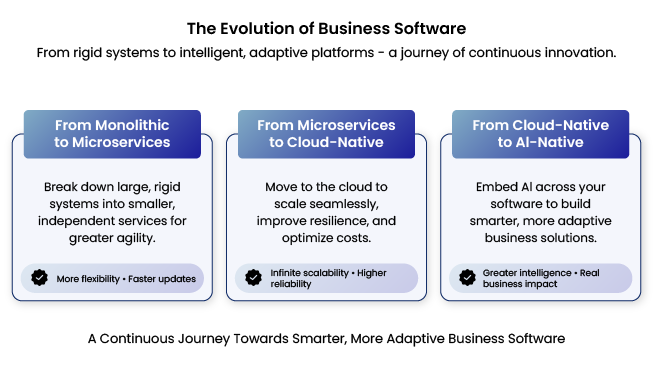
From Monolithic to Microservices
In Microservices, a huge and monolithic application is split into smaller and independent pieces of application, which each provide their individual business value. So in the instance of an eCommerce platform, for example, your catalogue, payment processing, and user accounts will run independently.
However, there are tradeoffs for decomposing applications in this way. One such thing would be that coordinating services, synchronizing data, and handling failures become very complex. As highlighted by AWS Prescriptive Guidance, monolithic architecture and microservices architecture need to work together in order to co-exist.
Microservices therefore improve modularity, but they also require stronger coordination and operational practices.
From Microservices to Cloud-Native
The modularization concept within software was enabled by using Containerization, Orchestration and Deployment pipelines. The cloud-native approach enables the system to be resilient and observable while using flexible infrastructure to scale as needed. (Cloud Native Computing Foundation)
While cloud-native solutions do look at how the software is run, they do not take into account the intelligence that the software has. Even if an organisation has a great setup for their infrastructure, they won’t be able to implement AI due to them having silos.
From Cloud-Native to AI-Native
When looking at AI-native solutions, the engineering aspect of the solution changes. Instead of focusing on the flexible infrastructure, we now need to focus on the intelligence of the system. Apps now need to gather context from various sources, work with models and make safe decisions using business logic.
This is a big change for executives when evaluating technologies. We are now looking at not just the scalability of the application, but also the ability to gain insights from enterprise data.
AI-Native Architecture, Explained for Decision-Makers
An AI native architecture implies that AI is embedded into your software solution. Rather than adding AI as a bolt-on feature, the architecture is designed so your AI can easily access data, set up models, perform searches, manage tasks, ensure security and receive feedback. The AI native application will understand what the user wants to do, get the relevant company data, consider the options available and make suggestions or carry out actions that have been approved. The intelligence is fully internal and will only operate within the companies systems, processes and security.
The Difference That Defines Competitive Advantage: AI-enabled vs. AI-native architecture
AI-enabled vs AI-native refers to the degree to which intelligence is woven into the fabric of an application.
| AI-enabled architecture | AI-native architecture |
| Adds AI capabilities to an existing application | Integrates AI into the application architecture |
| Often relies on isolated AI features | Connects intelligence across business workflows |
| Uses predefined processes with AI assistance | Supports context-aware and adaptive workflows |
| May depend on separate AI integrations | Uses shared orchestration and intelligence capabilities |
| Treats AI as an additional capability | Treats intelligence as a core architectural consideration |
AI-enabled refers to applications where there are some useful features of AI in the application. AI-native take it a step further. It links search with enterprise knowledge, business controls, contextual search and the right processes. As organisations get to a more connected state, with multiple production grade applications, the difference becomes increasingly important.
A Layered Blueprint: How AI-Native Systems Are Built
There isn’t one standard design for an AI native architecture, but considering 7 key layers will help you understand how it works. The actual design will depend on your specific business requirements, industry regulations, existing systems and complexity of AI tools.
1. User Experience
This provides an interface for your staff, customers and business applications to interact with the AI in the tools. This can include chatbots, dashboards, voice assistants and embedded intelligence tools.
The objective is to make intelligence accessible within existing business environments rather than requiring users to work across disconnected tools.
2. Application and Business Logic
This ensures that your AI functionality can be tied up with your company’s software, policies and processes. The AI recommendations should adhere to your company policies.
For example if the AI recommends an offer to a customer, the offer given must follow your pricing and approval policies. Keeping business logic separate from probabilistic model outputs helps maintain consistency and control.
3. AI agent and orchestration layer
Orchestration coordinates models, APIs, enterprise tools, and workflows. It determines how tasks are routed, which capabilities are required, what information needs to be retrieved, and when human intervention is necessary. For agent-based applications, this layer also manages permissions and controls the actions an agent can perform.
4. Model & Intelligence Layer
This layer contains large language models, machine learning models, predictive models and specialised AI models. Models can be provided via API (commercial), open source or in a controlled environment. The type of model used should be based on the required performance, security, latency and requirements of the business use case.
5. Data & Knowledge Layer
Data within this layer comes from enterprise databases, data warehouses, documents, knowledge bases and vector databases. This layer will enable data to be prepared, searched, indexed, managed, secured and quality managed. For applications using retrieval-augmented generation (RAG), this layer helps retrieve relevant enterprise information and provide additional context to model responses. If this information is not reliable, even the best models will provide incomplete and potentially misleading results.
6. Infrastructure and integration layer
Cloud platforms, containers, APIs, event-driven systems, storage, and computing resources support application execution and communication between different components. This layer provides the technical foundation for operating AI applications across enterprise environments.
7. Security, governance, and observability layer
Security and governance extend across every layer. They include identity and access management, encryption, data protection, model evaluation, audit trails, monitoring, policy enforcement, and incident management. These controls help organizations understand how AI systems behave, protect sensitive information, and maintain accountability for decisions and actions.
The value of these layers lies in their integration. Investing in a model without addressing data access, application connectivity, or governance may create an isolated capability rather than a dependable enterprise application.
Rethink your architecture for the next phase of enterprise growth.
Discover how strategic modernization can help your enterprise build scalable, intelligent, and future-ready systems.
CTA: Explore AI-Native Modernization services
4. Why Enterprises Need to Rethink Legacy Architecture for AI
Understanding AI-native design is only one part of the equation. Technology leadership teams also need to understand why they can’t implement AI-native design on their existing tech stack.
Removing legacy components which house years of vital business rules and data can be very expensive and disruptive. However, if you don’t remove the bottlenecks in the architecture then your AI roadmap will be set back.
From an engineering perspective at Xcelore we like to think of modernization as a way of enabling your existing investments to integrate with intelligent applications.
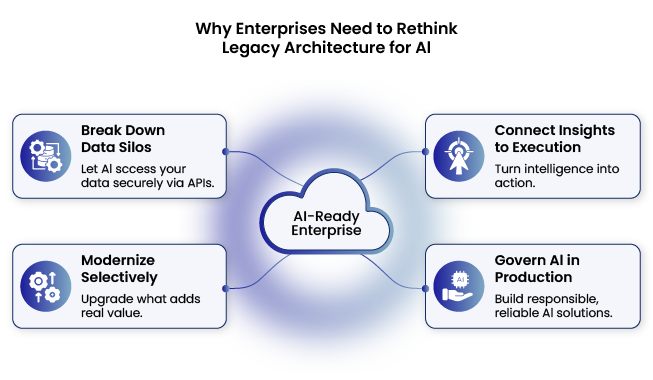
Breaking down data silos
When data is trapped in disparate applications, AI will provide incomplete results or require manual intervention between different teams. We don’t need to put all of our data into a single monolithic repository. We just need to provide secure access to all the data with controlled access through APIs and modern search interfaces so that AI can find and gather the data it needs.
Connecting insights to execution
Traditional applications are rule based. This is great for compliance and consistency, but can cause challenges when decisions need to be made which take into account various factors from different departments. While AI can be used to understand these changing factors, it doesn’t matter how clever the insight is if it isn’t being used. If you can’t use the demand forecast to update your procurement or stock systems then you have a very expensive dashboard. AI native solutions enable you to integrate the intelligence within your approved processes.
Modernizing selectively, not destructively
Many legacy applications perform well and are performing core business functions. There’s no point migrating them just because there is new technology available. A better approach is to modernize selectively. Only modernize the parts of your core systems that add value. Add APIs to expose the core functions and add new AI capabilities. It’s important to note that moving workloads into the cloud using lift and shift techniques is not modernization (Microsoft Cloud Adoption Framework). Modernizing means upgrading only what you need to achieve a particular business outcome.
Governing AI in production
The pilot will be very different to your production environment. Pilots will have clean data samples and lots of manual oversight. In production you’ll need tight security, accuracy, cost control and availability controls.
As soon as your AI solution starts working with sensitive data or initiating real world transactions, you’ll need governance. Using the NIST AI Risk Management Framework (Govern, Map, Measure and Manage), security and monitoring can’t be added at the last minute. You’ll need to design observability, auditing and traceable accountability into your solution from the start.
Modernize with Intent: Strategic Considerations for the C-Suite
As you move toward an AI native architecture there are some changes to the way in which capital will be spent, risks introduced and the engineering strategy. As part of the roadmap development process, you’ll need to answer these six questions:
Where can we improve?
Focus on reducing operational friction. Where are the areas where improved prediction or automation will deliver real improvements? Don’t include processes where it won’t make a difference.
What systems do we really want to rearchitect?
Not all old applications should be thrown out. Identify those that are holding you back through maintenance and technical debt. Only rearchitect the systems that are blocking you from growing.
Do we have a good foundation?
AI is only as good as the data. Have clear ownership, governance and clean data paths in place.
Can we use AI?
If you are using autonomous agents interacting with live systems you’ll need to be very strict about what they can do. Define strict permissions, audit and approvals for any high impact activities.
Can your teams scale with the new stack?
While pilots are easy, operating AI at scale requires strict coordination between your Engineering, Data, Cloud and Security teams. Consider if your team have the capability to do this over time.
Where is the value?
Ensure investments made into your architecture will deliver tangible benefits like reduced unit costs, faster cycles or greater resilience.
This will help ensure any modernization work you do connects to your business priorities and won’t invest in complexity within your architecture that doesn’t have an operational benefit.
How Xcelore build Enterprise Architecture for Intelligence?
The transition from monolithic to AI-native architecture represents a change in how enterprises think about their technology foundations.
Traditional architecture helped organizations build reliable applications, manage transactions, and scale business operations. Microservices and cloud-native approaches improved modularity, deployment flexibility, and infrastructure management. AI introduces another requirement: systems must be able to use enterprise information to support decisions and participate in business workflows.
This does not make existing architectures obsolete. It changes how organizations should evaluate their limitations and future capabilities.
For enterprise leaders, the priority should be to preserve what works, address what restricts progress, and establish the data, integration, intelligence, and governance capabilities required for AI adoption.
At Xcelore, we believe enterprise modernization should be driven by business outcomes, not technology replacement. An AI-native approach brings together product engineering, enterprise data, cloud infrastructure, and intelligent capabilities to help organizations build systems that are ready for real-world deployment.
The next generation of enterprise software will not be defined by how many AI models an organization integrates. It will be defined by how effectively its architecture connects information, supports better decisions, and translates intelligence into measurable business value.
FAQs
Q. What is AI-native architecture, and why does it matter for enterprises?
A. AI-native architecture is an approach to designing enterprise systems with intelligence built into their core. It connects data, applications, AI models, and workflows so businesses can move beyond isolated AI use cases toward intelligent, scalable operations.
Q. How is AI-native architecture different from cloud-native architecture?
A. Cloud-native architecture focuses on building and operating applications using cloud capabilities, such as microservices, containers, and automation. AI-native architecture builds on these foundations by integrating data intelligence, AI models, model orchestration, and governance into the system design.
Q. Can enterprises move from monolithic to AI-native architecture without replacing existing systems?
A. Yes. Enterprises can modernize incrementally by identifying high-impact workloads, exposing legacy capabilities through APIs, improving data accessibility, and introducing AI-enabled components. Xcelore’s approach focuses on evolving existing technology investments rather than replacing systems unnecessarily.
Q. What are the key components of an AI-native enterprise architecture?
A. An AI-native architecture typically includes connected data infrastructure, API-driven applications, cloud-native infrastructure, AI and model orchestration, intelligent workflows, observability, and governance. These components work together to support reliable AI deployment across enterprise environments.
Q. How should enterprises assess their architecture before adopting AI?
A. Enterprises should evaluate their application landscape, data quality, integration capabilities, infrastructure readiness, security controls, and governance practices. Xcelore recommends connecting this assessment to specific business priorities to identify where modernization can deliver measurable value.
Q. Why do legacy systems create challenges for enterprise AI adoption?
A. Legacy systems often operate with fragmented data, tightly coupled applications, limited integration capabilities, and inconsistent governance. These constraints make it difficult to access reliable information, connect AI models with business workflows, and scale AI initiatives across the organization.
Q. What role does data engineering play in AI-native architecture?
A. Data engineering provides the foundation for reliable enterprise AI. It helps integrate data from multiple systems, improve data quality, establish accessible data pipelines, and make information usable for analytics, AI models, and intelligent applications.
Q. How can enterprises ensure security and governance in AI-native architecture?
A. Security and governance must be built into the architecture from the beginning. Enterprises need controls for data access, model validation, privacy, explainability, monitoring, and regulatory compliance. Xcelore emphasizes responsible AI practices throughout the development and deployment lifecycle.
Q. How can enterprises measure the success of AI-native modernization?
A. Success should be measured through business and technology outcomes, including reduced operational costs, faster workflows, improved decision-making, better application performance, higher system reliability, and measurable returns from AI investments. The metrics should align with the business objectives defined before modernization begins.
Q. How can Xcelore help enterprises transition to AI-native architecture?
A. Xcelore helps enterprises assess existing technology environments, identify modernization opportunities, strengthen data and cloud foundations, and engineer AI-ready applications and platforms. Its approach combines AI-native development, product engineering, and disciplined delivery to help organizations build systems prepared for evolving business and technology needs.
Related Blogs

More Than a Development Partner. A Partner in Progress.
We stay with your product beyond launch. From modernization and optimization to platform upgrades, security improvements, and continuous evolution, we help your solution keep moving forward.