
How to Hire a Mobile App Development Company: Strategic Guide to Quality, Security, and Delivery
Gopesh Verma
Key Takeaways
- Pick a development partner that has an understanding of your objectives, needs, and long-term scope.
- Make security a key criterion for your partner selection. Evaluate their engineering expertise with practical evidence.
- Assess the delivery maturity while considering risks, threats, and other obligations. Also, assess their ability to stay consistent in a changing ecosystem.
- Find the total ownership costs and eliminate extra pricing with a reliable partner that avoids rework, poor plans, and production delays.
- Opt for a development company that supports building new apps, modernization of legacy apps, post-deployment support, and ongoing updates and maintenance.
Businesses often wonder “how to hire a mobile app development company” that can shape organizational growth. Therefore, they need to make a strategic decision to rely on someone who can support smooth workflows, manage how customers interact, handle security, and how successful the project can be made.
A recent study by Grand View Research states, mobile application market is projected to sore high by 2030. Among this, businesses fail to realize the importance of security risks. If your app has poor architecture, user experience, or support after launch, it can cost your organization a lot of money for redevelopment. Collaborating with a good partner who can think strategically, knows the technology, designs with users in mind, maintains security, follows delivery, and owns the product over time helps eliminate these risks.
This guide outlines the facts that decision-makers in large companies need to check when they choose a mobile app development agency. A prominent one brings lasting value to the business, reduces risks, and supports growth.
Standard Benchmarks of a Resilient Mobile Application Development Company
There are several factors to take into consideration while assessing possible app development service providers:
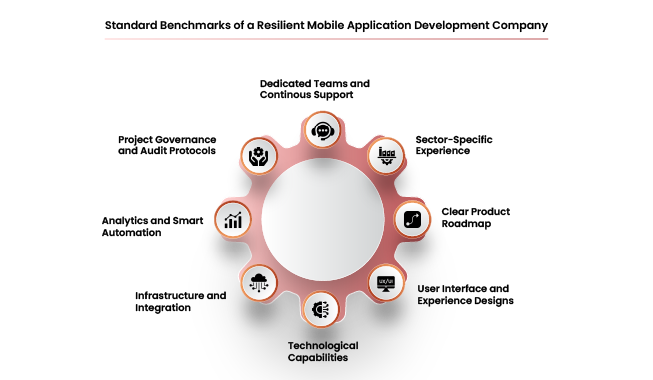
1. Sector-Specific Experience
The company you are ready to put your trust in must match the needs of the project. Therefore, first analyze:
- Have any similar projects been completed in the past, and what was their extent of participation in them?
- Have they achieved any results, and will they be able to offer further assistance or not?
2. Clear Product Roadmap
Next, identify if they align with your business or not by asking:
- Are they in a position to completely grasp your business objectives?
- Are they able to figure out customer demands, classify features, and analyze how feasible the project is?
3. User Interface and Experience Designs
The interface of the application is what makes it engaging to the customers utilizing the app. Therefore, verify:
- Are they good at user research, journey mapping, prototyping, design systems, and usability testing?
- Do they take into account accessibility, responsive design, and the rules imposed by the platforms and standards such as WCAG?
4. Technological Capabilities
Moving ahead, you must also ask the mobile app partner:
- Do they have sufficient experience in appraisal?
- Have they done any work in creating native ios/android applications, cross-platform, databases, and APIs?
- Do they direct their clients towards using the most suitable technologies for the software you need?
5. Infrastructure and Integration
The engineering approach of the application matters as much as its design. So, don’t skip confirming the following:
- Can they create architecture that is both scalable and sustainable?
- Are they capable of connecting with enterprise systems, which include CRMs, ERPs, payment gateways, and IDPs?
- Are they also capable of connecting with legacy systems, offline capabilities, and ensuring data reliability?
6. Analytics and Smart Automation
To ensure that your chosen mobile app development ally is appropriate, evaluate:
- If your application is data-centric, do they possess know-how in analytics, real-time technologies, personalization, AI, and recommendation engines?
- Are they capable of ensuring that data is of high quality, private, uses secure APIs, and has solid models to be monitored in production?
7. Project Governance and Audit Protocols
Security is a key concept whether building an application or software. Therefore, check:
- Do they have processes in place for systematic code reviews, automated, regression, compatibility, and performance testing, and release checklists?
- Verify whether they can manage development processes, deadlines, dependencies, risks, and changes in scope. This should include transparency, sprint planning, documentation, and escalation.
8) Dedicated Teams and Continous Support
What makes an application successful is the effort and effectiveness of the team behind it.
- Ensure AI-native engineering teams are available with the right skills in the architect, developers, designers, QA, and management roles.
- Are clear communication channels and decision-making processes in place for ongoing work, bug fixes, updates, compatibility improvements, and upgrades?
- Is documentation related to how incidents will be handled, how quickly they will be dealt with, escalation processes, and SLAs available?
“Choosing the right partner is more than looking at development skills.” The criteria that determine whether a business can sustain your app are business sense, engineering capability, delivery responsibility, and product ownership.
Framework to Select the Right Mobile App Development Company
Start by identifying what your application should be able to do for your business in advance, and have a structured selection process so you can choose the right partner to develop mobile application for your business. It will help you avoid companies that make false claims and ensure you are picking the right company for your long-term goals. The process is as follows:
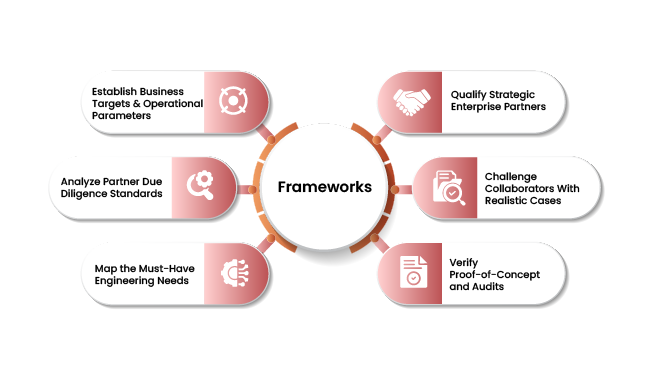
Establish Business Targets and Operational Parameters
When choosing a partner, be clear about what the developed application:
- Should do (tasks to perform)
- Who it is for (target audience)
- What features and UI/UX are required
- Which platforms it should work on
- What systems it needs to integrate with or modernization of legacy apps
- Security and scalability requirements (such as NDA)
Define what features are essential and what can be added as an enhancement.
Analyze Partner Due Diligence Standards
Start by creating a standardized project brief and, within this document, include:
- Business goals and objectives
- Technical requirements to build the app
- What deliverables you expect from the app
- Timeline, budget, support, and security requirements
By giving all vendors the same information, it will make it easier to compare proposals.
Map the Must-Have Engineering Needs
You should define what type of development you need. Your requirements can be:
- Native development or cross-platform development
- Cloud engineering
- API integrations like payment gateways
- AI or integration with enterprise systems
Focus on the features that are relevant to your requirements and whether they will comply with the data protection and security standards or not.
Qualify Strategic Enterprise Partners
Businesses can consider companies with experience in the:
- Right industry (mobile app development, Android app development, iOS app development, and so on)
- Portfolio (proven use cases of one-time builds, active, how they handle complexity, etc.)
- Technical skills (relevant skills in modern tech like Flutter, React, Native, etc.)
- References and availability of people (a reliable mobile app developer team)
You should now have a shortlist of 3-5 appropriate app development associates.
Challenge Collaborators With Realistic Cases
You can ask companies to talk about their capabilities, which should include:
- Discovery process (how they assess the need for app development)
- Architecture choices (the UI/UX they plan for your app; do they just execute or plan and refine too)
- Development process (entire lifecycle of their custom building or app modernization)
- Testing approach, security, project management, and post-deployment support
Ask them how they ensure risks are identified, assumptions challenged, and requirements that are unclear?
Verify Proof-of-Concept and Audits
Always make sure to check references for the:
- Project with the use of AI for application development for data transfers, integrations, failures, and consistency
- Qualifications of the proposed team
- Delivery plan (duration for the deployment of the mobile app)
- Cost, trade-offs, security, and support
You can pay for a discovery phase or the complete roll-out with post-launch support and ongoing upgrades and maintenance.
The final goal should be to choose an ally based on their expertise, commitment, technical feasibility, and accountability, and not merely based on the lowest cost or support offered.
Which Mobile App Service Delivery Approach Suits Your Business Best?
The delivery model is what explains how a development company allocates resources, manages scope, and charges for its development services. The choice of model depends on factors such as how clearly the project is explained and how much flexibility you need during implementation. The models are explained in the table below:
| Approach | Function and Suitability | Considerations |
| Definitive Pricing | Projects with fixed requirements agree upon a common price and deliverable | Any changes in the needs may result in modifications of the final application delivery |
| Resource and Time Based | Cost depends on the use of material and time; ideal for changing project needs | A strong check on the final delivery timeline, budget, and output is essential |
| Dedicated | For long-term projects where the team acts as an addition to your business | Product direction and priority must be clear and validated continuously |
| Outcome Based | Payment is finalized after completion for projects that have clear plans | Businesses must verify the measurable outcome and acceptance of the project |
| Flexible | Combines all the approaches for projects that are predictable yet evolving | Clarification of boundaries and accountability is important at the initial phase only |
Through this, we can summarize that the fixed-price model provides predictable costs when requirements are well defined. However, in rapidly changing product roadmaps, hiring dedicated staff or engaging in time-and-material projects may be a better option.
The hybrid method, on the other hand, works when initial requirements need to be fixed, while later modifications require more flexibility.
Before picking a collaboration model, make sure to determine what resources are available, how they will be replaced, how billing works, what change management system is implemented, how acceptance of deliverables is organized, and how the termination process takes place.
Also, for dedicated teams, it is important to identify how knowledge will be accumulated and sent from one engineer to another in case someone leaves the project.
Technical Reviews When Choosing an Application Development Partner
The competency of the right development ally cannot be just evaluated on the basis of their technology representations. Application architecture, choice of technologies, performance, testing, and reliability in production process preferences are also important.
To understand better, check the evaluation criteria and what you must verify as an organization seeking a trustworthy app-building company:
- Modular, scalable, data-oriented, API integrated, fault-tolerant, and maintainable infrastructure.
- Native or cross-platform, backend technologies, and cloud as per the usage
- Responsiveness in a few seconds, startup, crash handling, efficient resource usage, offline access, and absolute device compatibility
- Unit, integration, regression, and performance testing, CI/CD, approval & rollback
- Crash analytics, API failures, logging, alerts, incident responses, app diagnostics, and recovery
Review application architecture, API integration, or implementation to ensure the mobile app engineers have made the right decisions and can solve your complex issues. To ensure they are platform-specific, you should check that they are using Android Vitals to ensure quality on Android and have an understanding of Apple Platform Security for iOS.
In more complex or high-investment projects, you should do a focused technical assessment. This will help you understand how the engineers make their decisions, mitigate risks, and turn requirements into reliable solutions.
Security Checklist Before You Hire a Mobile App Development Company
Security and compliance must be considered as a key criterion when selecting partners for your application(s), especially when storing personal, financial, or sensitive information. Verify the following before proceeding with the payments:
- Enterprise Governance
Ensure that the team has good practices around secure development (secure coding, code reviews, and vulnerability checks), authentication, authorization, encryption, dependency, credential management, and incident management.
- Complete Data Safety
Guarantee that your mobile application, API, backend, database, cloud infrastructure, and third parties have proper security. Refer to OWASP MASVS for mobile requirements and data safety standard checks.
- Compliance Requirements
Make sure the team is aware of any compliance requirements such as GDPR, HIPAA, PCI-DSS, and local data protection requirements.
- Secure Data Maintenance
Ask whether they know how data will be stored, processed, retained, deleted, integrated with third parties, and how security incidents are handled.
- Data Ownership
Maintain clear ownership of source code, design files, documentation, and bespoke components. Clarify the licensing of third parties, access to repositories, credentials, and restrictions on using proprietary components.
Ensure that security, compliance, and ownership are clearly defined within a contract before the development of your application is initiated.
Common Pitfalls to Consider When Hiring a Mobile Application Development Partner
It isn’t really necessary that your development ally struggles to deliver a dependable application. Some early warning signals explain, at the initial stages, what possible challenges can impact your final application delivery. With some of them explained here, you can easily identify the wrong development partner at an early stage and prevent business loss. These are:
- Project completion timelines are guaranteed before the full discovery of the project needs and deliverables. This implies that the partner may not exactly understand the level of complexity or dependencies of the app project.
- Low budget estimates without scope definition. It indicates that important activities, such as testing, security, or maintenance, might not be included.
- Lack of architectural and decision transparency. This impacts the evaluation of the company’s engineering judgment and appropriateness for long-term usage.
- Displayed use cases without clear evidence. It implies that the previous experience of the company you tend to collaborate with for your app development project doesn’t prove their actual capability and capacity.
- Information for team structure is unclear. This indicates that the people shown in the sales process won’t be present for the delivery of the product.
- Details about testing and security processes are not provided. It shows that it may be treated as an afterthought in terms of quality and risk management.
- Limited access to code or documentation. It creates vendor lock-in and makes switching harder.
- Info about the post-launch support and SLA isn’t offered. This makes the expectations regarding operations and incidents unclear.
- Restrictions on documenting the project assumptions and exclusions. It causes commercial disputes and additional costs during development.
- Full dependency on proprietary tools with no scope for changes. This limits the business’s capacity to maintain or transfer the build or modernized application.
The dedicated development partner doesn’t need an equivalent solution to every problem. But it should be honest about restrictions and consider the risks before starting to build a product. A reliable partner will always first:
- Validate the scope and offer a clear breakdown of the budget
- Explain the tech trade-offs and showcase their realistic contributions
- Introduce your organization to the entire delivery team
- Maintain proper documentation that is accessible to all
- Define the SLAs post-launch and even offer ongoing support and maintenance
What Right App Development Company Brings to Your Project?
An application is good because of all its functionalities and performance. But having the right partner for your development stages means you achieve expert guidance, informed decision-making, and technical knowledge to ensure that the designed app meets your business goals and can evolve with your requirements. Some common benefits include:
Business Impact and Not Just Feature Delivery
It means understanding what the actual business problem is that your application has been created to solve. An experienced partner will know what functionality is required to create maximum value for your business.
Proactive Judgement Eliminating Costs
The right development team identifies architectural issues, suggests correct technologies, and makes the right decisions early on.
Cross-Functional Engineering Pods
App development requires multiple different skills, from UI/UX to backend development and testing. With a competent partner, the team will have all of these skills covered.
Risk and Data Privacy Handling
A good partner will handle data safety, system vulnerabilities, compliance needs, and technical dependencies during the development stage throughout the development lifecycle.
Continuous Partnership for the Long Run
A reliable development partner will continue to invest in the performance of the app after it goes live, assisting with technical issues, upgrades, and future maintenance.
Why Hire Xcelore Mobile App Development Firm For Your Enterprise?
When choosing a trustworthy partner for your mobile app development services, businesses consider whether they can really understand their objectives and develop solutions accordingly. One should be able to build resilient applications that meet the changing requirements.
At Xcelore, we provide commitment to developing bespoke application, iOS & Android solutions, and cross platforms applications with integration, modernization and maintenance after the deployment.
Besides, our main aim is to ensure that the built applications are primarily business-oriented, have an integrated architecture, are AI-ready with clean and interactive designs, compliant with industry standards, and continuously modernized for enterprise delivery. This means we take responsibility for deploying applications that will integrate well, perform well, be secure, and adapt to your changing requirements.
If you are considering a mobile app development partner, then ensure you consider one that matches the architecture, engineering, security, and long-term commitment to design your product to the best standard.
Frequently Asked Questions
Q. In order to hire a mobile app development company, what must I ask?
A. You must ask them about past projects, the team, technologies they use, structuring of the software, testing, and security. Even ask them to provide you with credible examples and documentation.
Q. What is the cost for hiring a mobile application development partner?
A. The cost for hiring depends on the complexity, platform, design, architecture, integration, security, and testing of your to-be-built business application. For a clear evaluation of the budget, request a pricing breakdown from the partner at the start so you can check what the overall cost of ownership is.
Q. What must a post-launch mobile application agreement contain?
A. It must contain the standards for resolving issues based on the severity, support offered for iOS & Android, standards maintained for security updates, active monitoring in production, classification of bugs or features, and accountability for security escalations.
Q. What does a mobile app development contract contain?
A. It contains the process, deliverables, timeline, acceptance criteria, payments, change process, IP, confidentiality clauses, security, support, SLA, and termination or transition clauses.
Q. An In-house mobile application team vs. a mobile app development company. Whom to hire?
A. If you’re working with an internal team, it will give you much more control over the process and knowledge of your product. However, it will also require ongoing investment. If you go with an external company, they will have the expertise and flexibility, and it will be a one-time investment until your product is deployed, with ongoing support and maintenance. Choose one that suits your budget, skills, project, and ownership plans.
Related Blogs

More Than a Development Partner. A Partner in Progress.
We stay with your product beyond launch. From modernization and optimization to platform upgrades, security improvements, and continuous evolution, we help your solution keep moving forward.