
AI-Native Software Development: The New Blueprint for Building Intelligent Products
Gopesh Verma
Key Takeaways
- AI-native development goes beyond faster coding. It requires rethinking how software is specified, engineered, tested, and governed.
- The performance gap is in how AI is applied. McKinsey found top-performing software organizations achieved 16–30% productivity gains and 31–45% improvements in software quality by using AI across the development lifecycle.
- Architecture is what takes AI from pilot to production. Strong data foundations, contextual retrieval, orchestration, and governance make intelligent products reliable at scale.
- The real advantage lies in engineering discipline. Clear specifications, continuous evaluation, and accountable governance turn AI capabilities into measurable business value.
Software engineering is entering a phase where product complexity is defined not just by its codebase, but by the intelligence, context and decision-making capabilities embedded within it. As AI becomes part of core product functionality, conventional engineering principles alone are no longer enough. Software must account for probabilistic outputs, dynamic context, autonomous actions and continuous evaluation alongside performance, security and scalability.
This shift is driving AI-native software development, an approach that embeds AI into both the software development lifecycle and the architecture of the products being built. Unlike AI-assisted development, which primarily enhances coding productivity, AI-native engineering makes intelligence a foundational part of how software is designed, developed, validated and operated.
The focus moves beyond executing predefined instructions towards building systems that can interpret context, make informed decisions and adapt to changing conditions without compromising control.
For technology leaders, the challenge is no longer simply integrating AI into products, but establishing an engineering foundation that makes intelligence reliable, measurable and sustainable in production.
What does AI-native software development mean?
AI-native software development embeds the AI technology into both the software being developed and the process used to develop it. Instead of relying on deterministically written code and then trying to fit AI assistance somewhere along the way, developers are designing non-deterministic systems from the get-go.
Unlike AI-assisted development, which involves the addition of a tool to the process of coding, or AI-enabled products, which represent apps with built-in features enhanced through artificial intelligence, these methods can be considered a natural starting point but face the limitations due to the lack of a different approach to decision-making and verification.
The industry experts pay attention to this trend. As per the predictions by Gartner, the AI-native development platforms belong to the major trends in technology for the year 2026, as in 2030, 80% of organizations will shift towards compact and AI-enabled development teams.
Defining the Core Shift: AI-Assisted vs. AI-Enabled vs. AI-Native
To build software that scales reliably, technology executives must clearly distinguish between three distinct paradigms:
| Dimension | AI-Assisted Development | AI-Enabled Products | AI-Native Software Development |
|---|---|---|---|
| Primary Definition | Plugging inline completion tools (e.g., Copilots) into existing IDEs. | Adding an AI feature (e.g., a chatbot or wrapper) on top of legacy software. | Designing AI directly into both the product architecture and the engineering lifecycle. |
| Workflow Impact | Localized to individual developer workstations; workflow stays linear. | Bolted onto existing deterministic rules engine and data stores. | Fundamental transformation of discovery, architecture, testing, and operations. |
| System Behavior | Deterministic code written slightly faster. | Static business logic with isolated probabilistic side-calls. | Probabilistic logic by design, governed by dynamic context and evaluation layers. |
| Primary Risk | Backlogged code reviews and hidden technical debt. | High latency, brittle model calls, and un-governed API costs. | Complex failure modes requiring continuous evaluation and context control. |
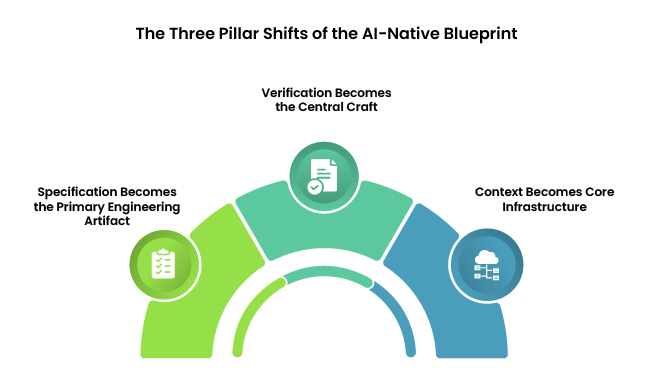
The Three Pillar Shifts of the AI-Native Blueprint
Moving from localized AI assistance to an enterprise-grade AI-Native Engineering Model requires three structural pivots across the organization:
1. Specification Becomes the Primary Engineering Artifact
Where raw code is cheap, what becomes rarest, most valuable in software engineering is an unambiguous specification of desired behavior. The software development happens much earlier in the process in an AI-native world. Before any code is generated, teams need machine-checkable specifications, executable acceptance criteria and a worked-out list of edge cases. A team that can state its intent exactly can hand work to AI systems with confidence. A team that cannot will get fluent code that hides muddled thinking..
2. Verification Becomes the Central Craft
Existing unit testing tools rely on the premise that the same input always results in deterministic output. Machine learning algorithms, agent-based processes, and probabilistic systems defy this principle. Testing must become continuous testing. Enterprises need:
- Rigorous testing suites based on actual workloads faced by their users.
- Regression testing for model drift, hallucinations, and prompt safety.
- Boundary testing tools permissions for autonomous agents.
- Measurement of cost-per-successful-operation metrics in fine-grain.
3. Context Becomes Core Infrastructure
For an AI model to be intelligent about its decision making process, it must have access to relevant information that it can understand and believe. Context is not just any collection of documents to be fed blindly into the process. Context is high-quality enterprise infrastructure. Creation of a unified knowledge graph, new RAG pipelines, semantic code indexing and fine grain data access are prerequisites to this end.
The Architecture Behind an AI-Native Product Engineering
Building an AI-native product requires more than selecting an appropriate AI model. Organisations need an architecture that connects enterprise data, intelligence, application workflows and governance into a reliable operating environment.
Each architectural layer plays a specific role in ensuring that AI capabilities can integrate with existing systems, respond to business context and operate securely at scale. A working system would generally be comprised of six main components:
- Data infrastructure: Data is prepared and provided in a well-organized manner using controlled pipelines. Clear data is key to getting accurate results.
- Modeling layer: Different systems make use of different algorithms or language models depending on the particular task. The decision is made based on the aspects of accuracy, efficiency, costs of operation, and the aspect of privacy of the data; bigger models aren’t required for all tasks.
- Context and information lookup: Context, filters, and organizational policies are employed for establishing links between the models and corporate data to keep results up-to-date and aligned with corporate data.
- Agents/Orchestration Layer: The agents can schedule and execute sophisticated multi-step processes whereas Orchestration is responsible for handling such process steps including employing certain models and tools and getting approval from humans. Only permissions should provide access to the actions for the agents.
- Application & experience layer: The capabilities of AI become a part of the customer experience itself via recommendations, conversational interfaces, predictions and automation.
- Governance & observability layer: Monitoring, access policies, evaluation, auditing and cost monitoring allows the team to get an understanding of how the released system works.
The above-described layers should not be treated as a definite list of technologies to implement. According to business challenge, regulatory and environment factors, their composition and complexity can vary considerably. Knowledge assistant for internal users will be mainly concerned with search and access policy management. Fully autonomous workflow application will need more complicated orchestration, testing, and approval capabilities.
Architectural principle is quite simple: select a technology according to the behavior the product needs to provide, not according to some popular models or frameworks.
How AI-Native Development Changes the Software Development Lifecycle
The transition to AI-Native product engineering becomes more significant when it alters the way teams collaborate during the whole software development lifecycle (SDLC).
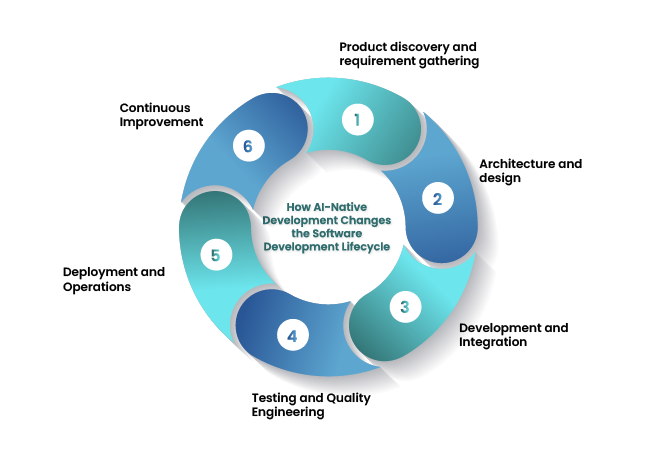
Product discovery and requirement gathering
AI helps teams analyze customer feedback, operational data, support tickets, and existing product documentation to uncover recurrent issues. Product managers leverage such analysis to build and compare use cases. Human discretion is required to understand what problems require addressing and what constitutes success.
Architecture and design
Engineering teams assess AI requirements together with application logic, integrations, data flows, and security concerns. They decide what tasks are to be handled by AI, what can be resolved autonomously, and what requires a human decision. Here also it is important to establish fallback logic in case a model does not provide an answer or provides a bad one.
Development and Integration
Coding assistants and agents can help with development, documentation, refactoring, and integration tasks. Engineers will still be responsible for architecture, code quality, dependencies, and consequences of their decisions.
Testing and Quality Engineering
Conventional testing is necessary, but there will need to be additional testing of AI products. Teams will need to test accuracy, relevance, consistency, bias, resistance to prompt injection, and behavior with unusual input. In addition, agentic products will need to be tested for permissions to use tools, task completion, and unintended consequences.
Deployment and Operations
Considerations for deployment include versioning of models, access control, monitoring, rollback capabilities, and budgeting. Teams will need to do more than just monitor application availability; they will need to monitor model behavior and output quality.
Continuous Improvement
User feedback, production-level testing, and performance metrics are part of changing prompts, retrieval, models, and workflows.
McKinsey’s November 2025 research found that top-performing software organizations achieved 16–30% productivity gains and 31–45% improvements in software quality. Their edge? Using AI extensively across the product development lifecycle.
This is important because it implies that coding help will have positive impacts on specific tasks, while more value will come from process redesigning.
The Business Case: Measure Outcomes, Not Code Generation
The business case for AI-native software development for CIOs and CTOs must go well beyond improving developer productivity. Fast implementation is great, but it does not necessarily mean fast product release or better experiences for customers or reduced operating costs. The more compelling business case links engineering innovations to important business outcomes.
| Business priority | What to measure |
| Faster delivery | Lead time from approved requirement to production release |
| Better software quality | Defect escape rate, change failure rate, and production incidents |
| Engineering efficiency | Rework, review time, cycle time, and effort per delivered feature |
| Product performance | Adoption, task completion, user satisfaction, and retention |
| AI reliability | Evaluation scores, grounded response rate, and task success rate |
| Financial control | Cost per successful task, inference cost, and total cost of ownership |
One important measure that could be considered is cost per completed task with the help of AI.
While a product may generate thousands of responses based on cheap average token cost, it does not make sense because users would need to edit and re-submit their requests. Cost in the context of completed tasks will give executives an opportunity to calculate the efficiency correctly.
Productivity is measured in a similar fashion as well; one should look at the amount of time required to complete some feature before and after the AI was involved in it, including testing and implementation of it. It is necessary to measure only the time that was saved during the code generation process.
The same goes for Bain’s 2025 Technology Report where coding is only one part of work from the point of an idea emerging to the product release. Improvement of this stage alone will not resolve problems at other stages.
The Challenges Enterprise Leaders Must Address
Engineers working on native AI will encounter technical and organizational challenges which are not resolvable through better tool selection.
Data readiness
Enterprise data is frequently stored in legacy apps, documentation, databases, or separate systems. Without proper accessibility, ownership, and permissions, AI-based system might provide wrong or partial answers. Engineering and governance of data needs to be considered an essential investment for the product.
Reliability and evaluation
Artifacts provided by AI solutions are probabilistic. System which demonstrates great performance under showcase conditions might exhibit other behavior due to ambiguous queries or inputs made by end users. Evaluation, representative datasets, human oversight, and fallbacks are critical here.
Security and privacy
AI solutions create additional risks from prompts, document retrieval, model integration, and external services connections. Enterprises require ai governance capabilities to manage secure handling of sensitive data, identity and access management, third-party integrations, and agent permissions.
Legacy integration
Most enterprises cannot afford replacement of their existing systems just for the sake of implementing AI. Product needs to integrate with existing apps, APIs, databases, and enterprise workflow. It needs to be evaluated at the early stage because it determines actual cost of implementation.
Operating cost and infrastructure
Model choice, the amount of inference performed, context size, orchestration, and infrastructure have an impact on operating costs. Teams should compare models to actual workloads and use smaller and specialized models wherever they suffice.
Accountability
As AI systems become capable of performing actions, there is a need for accountability in the owners of the decisions and their results. A structured approach to risk identification and management during the design, development, use, and evaluation of generative AI systems.
Thus, the final conclusion can be stated: engineering discipline is required from native AI software as never before. The higher the degree of autonomy given to the system, the more the system’s boundaries, dependencies, and possible failures should be taken into account.
How Enterprises Can Move Toward AI-Native Software Development
A successful transition does not involve completely rebuilding applications or switching to a different set of technologies. Rather, a conscious process of decision-making is required.
- Evaluate the product and engineering readiness: Analyze the current architecture, data access, development process, security measures, and skills of the team to identify limitations that will hinder the deployment of AI solutions.
- Prioritize business problems: Choose use cases by considering the impact, technical possibilities, availability of data, and risks. Repetitive and measurable business processes are good examples of a starting point since the results of such projects can be easily measured.
- Build the solution with production in mind: Develop the architecture, integration, requirements for models, security, evaluation, and operations beforehand. A successful PoC should show not only a functioning interface but also a reasonable pathway to production.
- Adapt engineering practices: Integrate AI at certain stages of SDLC with a proper standard of code reviews, tests, documentation, and approval by a human. Teams should also develop unified development practices, allowing for improvements for all members, not just the tool users.
- Validate with evidence: Compare the pilot to its business goals. Extend the effort only when the product exhibits satisfactory performance, reliability, adoption, and economic metrics.
- Implement continuous governance: Define responsibilities for behavior of the model, access to data, security, costs, and evaluation. Governance must develop along with the product as the users, capabilities, and degree of autonomy evolve.
This way of proceeding steers clear of two expensive alternatives, either viewing AI as a series of isolated experiments or making an organizational-wide transformation without laying the groundwork.
The Xcelore Point of View: Intelligence Must Be Engineered
We design and operate our own AI products. Operating AI products is different from consulting on them in terms of concerns.
Based on our experience, we consider the model to be the most interchangeable component of any AI product. Models get updated, prices fluctuate, and vendors change their terms. The thing that remains is the evaluation suite that proves whether the update was beneficial, the pipeline that keeps the context correct, the guardrails that prevent the system from doing certain actions, and the workflow where the output appears. The team that owns all of the above is ready to switch the model whenever needed. The team that does not is one vendor away from a regression it will never notice.
That is why we consider AI-native engineering to be a question of an operating model rather than tools. Our approach to AI-Native product development begins with identifying the point of delivery delay and redesigning the corresponding step with architectural considerations, engineering decisions, and human involvement. Intelligence is earned in a product when it solves a certain business problem better than conventional software does, economically and reliably.
FAQs
Q. How is AI-native development different from AI-assisted software development?
A. AI-assisted development uses AI tools to accelerate tasks such as coding, debugging, and testing. AI-native development goes further by integrating intelligence across the product architecture and software development lifecycle, influencing how applications are designed, built, evaluated, and continuously improved.
Q. How does AI-native development change the software development lifecycle?
A. AI-native development integrates AI across discovery, architecture, development, testing, deployment, and continuous improvement. It shifts engineering teams toward specification-led development, continuous evaluation, and context-aware workflows while retaining human oversight for critical decisions.
Q. What are the biggest challenges in adopting AI-native software development?
A. The main challenges include fragmented data, unreliable model outputs, limited evaluation frameworks, security and privacy risks, legacy system integration, and unpredictable operating costs. Organizations also need clear accountability and governance before deploying AI applications in production.
Q. How can enterprises measure the ROI of AI-native software development?
A. Enterprises should evaluate outcomes beyond code-generation speed. Key metrics include time to market, cost per completed task, software quality, defect rates, operational efficiency, customer experience, and AI infrastructure costs. These measures help determine whether AI investments are producing sustainable business value.
Q. How does Xcelore help businesses adopt AI-native software development?
A. Xcelore helps businesses integrate AI into product strategy, architecture, engineering, and deployment. Its AI-native approach combines product engineering, data capabilities, AI integration, and governance to help organizations build intelligent products aligned with business objectives and production requirements.
Q. What is Xcelore’s AI-Native SDLC approach?
A. Xcelore’s AI-Native SDLC approach integrates AI across the software development lifecycle, from product discovery and design to development, testing, deployment, and continuous improvement. It combines AI-driven engineering with human oversight, quality controls, and structured delivery practices.
Q. Can Xcelore modernize existing software systems with AI?
A. Yes. Xcelore helps organizations introduce AI capabilities into existing applications and technology environments. This includes modernizing workflows, integrating AI models, connecting enterprise data, and enhancing application capabilities without requiring a complete replacement of existing systems.
Q. Why choose Xcelore for AI-native software development?
A. Xcelore combines AI product engineering, enterprise AI capabilities, data expertise, and its AI-Native SDLC approach to help businesses move from AI experimentation to production-ready products. Its focus is on building intelligent systems that integrate with existing environments, address business priorities, and deliver measurable outcomes.
Related Blogs

More Than a Development Partner. A Partner in Progress.
We stay with your product beyond launch. From modernization and optimization to platform upgrades, security improvements, and continuous evolution, we help your solution keep moving forward.