
Intelligent Process Automation: Why Enterprises Need to Automate Workflows at Scale
Sunil Yadav
Key Takeaways
- Intelligent Process Automation (IPA) combines RPA, AI, machine learning, and workflow orchestration to automate tasks across several business systems and functions.
- Scaling automation requires more than just deploying more bots. Clear ownership, trustworthy data, interconnected systems, and effective governance are all essential.
- Businesses can use IPA to improve accuracy, increase compliance, save processing costs and time, and free up employees for higher-value work.
- Real operational improvements, not just projected savings, are essential to a strong business case.
- Human control, auditability, and ongoing performance monitoring remain essential as automation increases.
Enterprises continue to face repetitive loads, rising costs, fragmented systems, and a need to operationalize at a large scale efficiently, accurately, and flexibly. This is where enterprise intelligent automation becomes important. A large number of organizations have already adopted automation. However, only a few of them have gained the level of know-how that will allow them to apply automation effectively, thus causing the difference between trial and transformation when it comes to such performance parameters as cost-saving, speed of processes, and risk management.
Organizations aim to cut down on their operational costs, speed up the processes, increase accuracy, minimize business risks, and reach new markets. However, many of their processes still involve manual labor, routine tasks, and no system integration. Pure Robotic Process Automation (RPA) is capable of optimizing basic processes, but it cannot work with unstructured data, exceptions, and complex processes.
The recent National Law Review study states that growing demand for IPA helps businesses in the banking, healthcare, manufacturing, and retail sectors grow, reduce labor costs, and accelerate digitization. Common business examples include IBM, UiPath, SAP, and Automation Anywhere.
Discover how companies, partnering with a specialized intelligent process automation company, improve their process efficiency and reduce exceptions in their workflows.
The Shift From Traditional RPA to Enterprise IPA
Established robotic process automation handles defined, rule-based tasks, while IPA connects processes and utilizes intelligence to handle more complex scenarios. Here’s how the two methods vary:
| Robotic Process Automation | Intelligent Process Automation |
| Inputs only structured and predictable data | Can input both structured and unstructured data |
| Has fixed, predefined rules to handle operations | The rules are combined with AI, ML, and NLP models to automate tasks |
| Works for individual tasks with one bot monitoring | Offers end-to-end workflow with full audit trails and decision-making |
| Stops midway and at times requires human intervention | Resolves and escalates complexities with context |
| Useful to move data from spreadsheets into ERP systems and similar tasks | Used to read complaint or enquiry mails, sort them, and draft responses |
Redesigning processes has consistently been fundamental to IPA. The advancement of AI agent development in enterprise automation is what has changed, enabling the management of more intricate workflows. Nevertheless, organizations must differentiate authentic agentic abilities from conventional RPA or chatbots merely promoted under updated names.
Challenges of Scaling Enterprise Automation Beyond Pilots
It is observed that automation efforts yield satisfactory achievements; however, the issue of scaling up encounters obstacles such as:
- Disconnected Systems: Different applications and legacy systems are separated from one another, forming gaps in integration.
- Automation at Task Level: One specific bot tackles one specific task, but the transfer between tasks necessitates human involvement.
- Weak Control System: If the responsibility is not clear and the access restrictions to information are weak, then management becomes impossible.
- Absence of Operational Model: In case exception handling, monitoring, and maintenance are not adequate, scaling becomes problematic.
ht has no capacity to handle unstructured data and make decisions that are difficult to complete.
By putting in place the foundations, IPA lets companies cut cycle times and lower operational costs while boosting accuracy and compliance rates. It also builds resilience and spreads operations without adding more staff in the same proportion.
In the end, successful automation is about more than adding some bots. Automation relies on integrated processes, solid governance structures, and the capacity to grow operations.
How Intelligent Process Automation Unlocks Value In Enterprise Functions?
By linking workflows, reducing manual involvement, and enhancing operational performance across enterprise functions, IPA provides value beyond task fulfilment. It can be understood more clearly with the table mentioned below:
| Functions/Industries | IPA Application | Results |
| Finance | Financial reporting, validating expenses, reconciliations, processing invoices | Rapid operations, reduced expenses, and improved precision of business tasks |
| BFSI | Fraud notifications, onboarding of customers, KYC, and claim applications | Strengthen compliance and governance and provide reliable service to respective organizations |
| Logistics | Creating purchase orders, tracking shipments, updating inventory, and exception handling | Improved coordination, effective and resilient operational workflow, and visibility to them |
| Human Resource | Onboarding of employees, verifying documents, payrolls, and request handling | Reduced workload on the administration and better performance and productivity |
| Customer Workflows | Classifying queries, use cases, and requests for service | Rapid problem solving and effective responsiveness by users |
| IT Workflows | Routing tickets, classifying incidents, routines, and requests for access | Quicker handling of services and less human-in-the-loop |
IPA offers advantages to businesses, including reduced cycle times and service costs, improved accuracy and compliance, strengthened operational resilience, and enhanced capacity for processing functions. Optimal advantages arise when linking business processes across various departments.
For instance, Benzinga’s latest study states that Leverate’s new CRM uses AI and intelligent workflows to help MT4 and MT5 brokers simplify their repetitive tasks, enhance customer engagement, and boost operational efficiency.
Also, invoice automation can serve not just for document extraction, but for matching purchase orders and approvals, updating financial records, and resolving discrepancies.
IPA can additionally be integrated with Agentic AI development services for flexible decision-making, AIOps for tech monitoring, and data engineering for a dependable information foundation.
The exact advantages depend on the suitability of the processes, the quality of the integration, the level of staff involvement, and the presence of the governance system. Companies must evaluate the improvements on the basis of costs, cycle time, accuracy, and problem-solving rates instead of simply calculating how many processes were automated in total.
How to Build Intelligent Process Automation Systems for Organizations?
The effectiveness of IPA for businesses is evaluated based on its performance across organizational processes, structures, and controls rather than its volume. A scalable IPA system needs the following five basics:
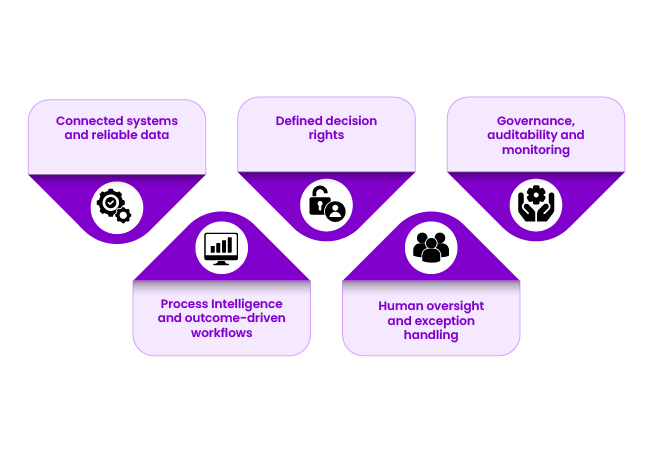
- Integrated systems and reliable data
Link enterprise applications, APIs, databases, and legacy systems through controlled connections to make sure information moves smoothly between them.
- Process insights and outcome-focused workflows
Look at processes to find problems, extra steps, and chances to use automation before changing workflows to focus on clear business results.
- Clear decision ownership
Use rules for tasks that are risky and predictable, and use AI models for more complex decisions with clear limits on what can be decided, approved, or sent up for help.
- Human supervision and issue management
Identify cases that are unusual or risky, move them to the right people, and offer enough information so they can verify and fix them.
- Governance, auditability and validation
Manage who has access, what decisions are made, and how things function. Also, track where actions come from, including what AI agents do and what permissions they have.
Business automation follows a path of progress from the process of task automation to intelligent automation over time. The understanding of your own stage of development can help your organization utilize IPA in project management to enhance workflow efficiency and invest with the intelligent process automation service provider appropriately and prepare to scale accordingly.
What Issues Businesses Must Address For Scaled Automation?
Businesses must overcome five major obstacles to scale automation beyond isolated use cases. This includes:
- Integration: Adapt dependable connectivity and API-led interaction between legacy and new systems.
- Quality issues: Improve accessibility, ownership, standardization, and data validation to achieve high levels of automation.
- Controlling flaws: Clearly distinguish approvals, audit trails, access control mechanisms, and governance accountability matters.
- Out-of-control agent and bot: Bring lifecycle management, monitoring, orchestration, and discovery in one place.
- Limited Workforce Engagement: Early process owner involvement, communication of workflow modifications, and role-based training are all important.
These aren’t just generic concerns. All of them must work well in their specific environments, but altogether they might struggle in a complex ecosystem. To extend the automation of workflows, overcoming all of the above is equally important.
How to Develop Intelligent Process Automation Cases For Stable Financial Review?
To create an IPA business case, actual costs and metrics must be considered rather than anticipated gains. The IPA business case should outline the initial metrics related to:
- Cycle times and manual input
- Type of transactions
- Costs incurred per transaction
- Number of errors and repairs required
- Exceptions using autonomous systems and process mining whenever feasible
Furthermore, rank workflows by importance in terms of innovation and value-added, considering level of data availability and difficulty of integration. When considering the IPA business proposal, total cost of ownership, covering costs of the system development and implementation as well as its operation and support, should be taken into account.
Besides, one should differentiate between expected ROI and the actual return on investment. The results received should be measured against the returns expected while factoring in risk-adjusted benefits such as increased audit readiness and compliance.
What are the Key Metrics for Successful Intelligent Process Automation Systems?
Assess automation efficiency by taking into account the following six characteristics, which go beyond just completing regular enterprise tasks:
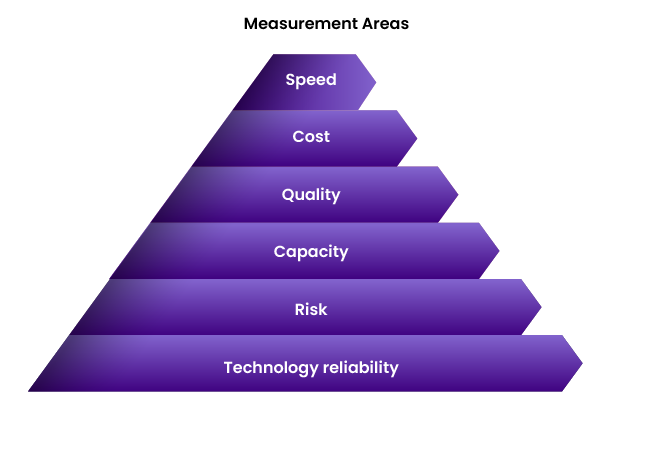
- Speed: Overall duration required to finish the complete cycle of tasks, average duration for a single transaction, and percentage of total process completion automatically.
- Cost: Fees for a finished process, execution expenses, transformation fees, and extra expenses for automating the process.
- Quality: How errors happen and how likely it is that the whole task will be done correctly the first time.
- Capacity: The number of work hours that workers have because of automation. It also includes how many transactions one worker can handle, the adjusted hours, and how much automation is used.
- Risk: The number of times people don’t follow the rules and the number of times they don’t meet the compliance standards during an audit.
- Technology Dependency: The percentage of times automation works well, the total hours of work done, how well the system is maintained, and how long it takes to complete tasks when changes are made to the process.
Link these factors to the business plan. Make sure the process manager and finance experts look at the results every month during the year. If the number of exceptions goes up, the company needs to check the process. The goal should be to make sure there is efficiency, quality, capacity, and business value. Don’t just focus on finishing tasks.
How Xcelore Drives Intelligent Automation Across Business Workflows?
To provide sustainable automation at scale, we, as a dedicated intelligent automation company, view IPA as an engineering and operating-model issue that combines process design, AI, integration, and governance. There are six steps in our methodical approach:
- Process Exploration
Examination of the existing work processes to identify those that are repeated frequently and are complex, assessing methods for improvement, establishing performance objectives, and determining where automation can be implemented in the process.
- Operations Development
Building a framework for the processes that will be enhanced and describing the characteristics and how the various components of the workflow are linked.
- Intelligent AI Systems
Use tools like automated document management, language models, and robotic process automation to simplify the tasks.
- Integrating Business Processes
Ensuring various systems, software, and data platforms function together through common connections that support the new work models.
- Safeguards and Oversight
Establishing guidelines regarding process access, designating responsibilities, monitoring activities, maintaining documentation, and managing the process from its inception.
- Improvise Automation
Ensuring value for money by placing the appropriate individuals in charge of the procedure that produces reusable parts, monitoring expenses, and continually improving the process.
The goal is not to automate everything or bring in AI unnecessarily. Instead, we want to make work move smoothly across the organization by connecting processes that are currently separate and give employees time to focus on more important tasks. By using intelligent process automation services with clear ownership and measurable results, we help companies go beyond small pilots to big, lasting improvements in enterprise operations.
Frequently Asked Questions
Q. How does Xcelore help enterprises embed IPA without the replacement of existing autonomous systems?
A. Our IPA services utilize the existing RPA robots, software, APIs, and workflow tools. By identifying areas where integration and clever thinking are needed, businesses can make use of what they currently have with what they want to develop.
Q. What is the role of process mining in intelligent process automation?
A. Process mining reveals the true nature of the workflow, provides suggestions for areas where things are not functioning properly, where they stop, and where tasks are completed more than once. It assists businesses in improving their procedures and monitoring the effectiveness of automation.
Q. Are errors handled by IPA, or is manual intervention needed?
A. Enterprise Process Automation can identify discrepancies between records, exceptions, and missing items. If a decision is required, it can request information, assign duties to the appropriate team, or raise concerns to the relevant human-in-the-loop for appropriate resolution.
Q. How long does it take to implement business process automation?
A. A diligent pilot intelligent automation project can yield measurable outcomes within a few weeks, depending on data integrity and system integration. However, greater deployments may take longer, subject to ongoing project and process assessment.
Q. Is it possible to use intelligent process automation services on legacy systems without APIs?
A. Yes. File exports or data connections are still preferred compared to the use of screen-based bots. If screen-based bots are included in a project, make sure to plan their replacement along with switching to new legacy solutions.
Q. Should enterprises invest in a unified platform or a modular toolset?
A. The use of a single all-in-one platform allows for more straightforward integration and governance processes, while using multiple tools offers more flexibility but necessitates some extra integration efforts. In any case, ensure open standards, APIs, unambiguous decision controls, and workflow exports remain a priority.
Q. What difference does IPA make in reducing the operational costs for businesses?
A. Operating costs are decreased by IPA due to automation of time-consuming activities, eliminating errors and the need to redo work, and increasing efficiency of resources. It also enables companies to cope with more workloads without increasing the costs on human resources.
Related Blogs

More Than a Development Partner. A Partner in Progress.
We stay with your product beyond launch. From modernization and optimization to platform upgrades, security improvements, and continuous evolution, we help your solution keep moving forward.