
The Cost of Unprepared Data: A Practical Guide to Enterprise AI Readiness
Gopesh Verma
Key Takeaways
- For each AI use case, assess the data readiness because it's not just model adoption but building them.
- Data quality, governance, and accountability are crucial components of AI readiness.
- Review access permissions and security, and identify gaps early to eliminate or reduce risks and costs.
- Prioritize business investments based on business value and data readiness.
- With evolving systems, ensure the AI readiness assessment takes place on an ongoing basis for improvements and measurable outcomes.
A large volume of enterprise AI tests provides successful outcomes; however, as soon as the systems are moved into the production stage, the real issue begins. Outdated and fragmented data and unclear access rules result in stalled AI operations. Such issues don’t cause the breakdown of the automated models; rather, they point to underlying problems at the data-processing level, which threaten increased application expenses and chances of implementation failures.
According to Gartner’s recent survey, about 22% of organizations have adopted the AI approach, 11% had no idea of their functional spending on AI, and around 85% of leaders are reluctant to increase their spending on AI. IBM and McKinsey have similar findings, which show an increased gap between AI implementation, expansion, and monetary scope.
Poor data quality is still a challenge that results in project failures and reduced ROI. Therefore, to ensure that your data and AI investments provide measurable business outcomes, organizations must prepare data as a priority, maintain effective governance, and integrate workflows alongside models. In this handbook, we cover all of it: the cost of unprepared data, causes, and readiness.
Intended Gap: AI Adoption Outpacing Data Readiness
An organization adopting AI doesn’t necessarily mean it can take it up at a large scale. While organizations may have AI tools, experienced team members, managerial support, and successful pilot projects, many of them lack support for appropriate data infrastructure and AI governance services that are essential for measurable outputs.
As compared to pilot projects, implementing AI in businesses requires using accurate, reliable, and secure data across multiple systems. Some of the main variables for it are:
- For accurate results, the data used by the AI models must be precise and clear.
- Terms, definitions, and records embedded in the AI must be consistent across departments and systems.
- AI needs access to relevant information needed for its functioning from documents, customer interactions, and other sources.
- The information must be accessible to AI in compliance with the permissions, rules, and privacy policies.
- AI should be integrated into the existing applications to ensure it functions efficiently.
- Organizations using AI must have clear accountability and ownership, access controls, and monitoring before the final delivery.
Traditional reporting here is often considered inadequate because it accepts some data inconsistencies as human analysts analyze the data, identify issues, and fix them. Since AI doesn’t have this ability, it flags even a small error as a big concern. For instance:
- Active customers for several departments may mean different things.
- Outdated and duplicate documents may contradict information for AI.
- Inconsistent data formats may impact decision-making for customers.
- Unclear permissions may allow AI to access private, sensitive, and confidential information it must not have access to.
Henceforth, it is clear that to ensure AI readiness assessment for enterprise-wide application of automated technologies, businesses should not only get useful and operational technologies but also build and work on trustworthy data.
Key Barriers That Limit Enterprise AI Data Readiness
The volume of data possessed by an organization doesn’t determine data readiness. Instead, the accessibility, validation, contextualization, and governance are what support AI readiness. Businesses may have large data volumes, but they still experience issues due to fragmentation, inappropriate management, or access restrictions. Such issues affect and degrade the performance of AI systems, complicating their implementation and exposing them to compliance and governance risks. Some common factors are as follows:
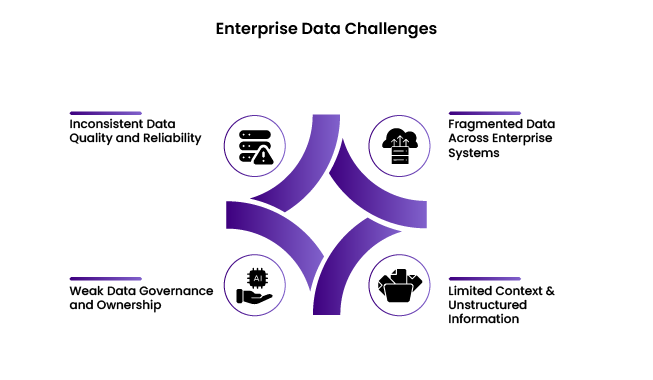
Unreliability and Consistency Issues
Absence of records, actual facts, duplicate entries, and misleading labels generally result in the inaccuracy of the final AI outputs. Hence, it is important to evaluate data quality depending upon use cases and aspects such as its reliability, scalability, completeness, accuracy, and freshness.
Data Silos Across Business Ecosystems
Business data is usually divided across CRM, ERP systems, operational applications, and document libraries. If these aren’t interconnected, developing an understanding of the business processes becomes difficult for AI. Consequently, this leads to data integration, duplicate records, and the complexity of the pipeline.
Context Gaps and Disorganized Information
A huge volume of critical business data resides in your contracts, policies, tickets, interactions, and technical documents. If not indexed, tagged, verified, and retrieved correctly, AI methods such as RAG (Retrieval-Augmented Generation) can return outdated, repetitive, and irrelevant information.
Unclear Data Control and Accountability
Uncertainty over data ownership, inconsistent controls, and poor data lineage put your organization at risk. Thus, enterprises must ensure that they know who has access to the data, how, and why they have access.
Check your data on these five aspects to determine whether it is prepared or not:
- Suitability: Is the information correct and complete for the decision to be taken?
- Data Context: Are the definitions and business terminology consistent across systems and departments?
- Rules Enforcement: Is the data accessible to the organization and compliant? Do they have the permissions?
- Data Lineage: Is the critical data traceable to the source and updated?
- Accountability: Does someone own the data to preserve its high quality, and can any challenges be resolved?
With increased regulatory expectations, all of the above factors become increasingly important. For instance, the EU AI Act introduces a risk-based framework with some high-risk AI systems needing to meet requirements around data quality, documentation, and human oversight.
Overall, for an enterprise to truly have data ready for its AI systems, they need to ensure that the data is fit for purpose, reliable, well governed, and clearly owned.
What is the Business Cost of Unprepared Enterprise Data Readiness?
The costs incurred by unprocessed data usually surpass the planned technology expenditures, having a negative effect on the cost of project implementation, time of execution, operational efficiencies, business decisions, and security.
Complex, intermittent, or poor-quality data forces specialists to spend more time on cleaning data, establishing accurate links, and correcting errors, which leads in the delay of beginning the projects and thus, increased costs and lost users’ trust. The main consequences include:
- Increased developmental expenses: A rise in labor inputs for cleaning data, solving problems, developing interfaces, and maintaining personalized pipelines affects costs at a high rate.
- Implementation delays: Issues with validating data, integrating, and controlling access leads to the delay of AI application.
- Lowered trustworthiness and dependability: Outdated and contradictory data results in incorrect results, an increased amount of manual validation, and less AI popularity.
- Safety and compliance risks: Lack of appropriate access rights and poor data management lead to the exposure of confidential data using AI systems.
AI offers greater transparency into current security threats. Businesses must consider how they are accessing data, classifying sensitive information, and identifying any unauthorized AI usage that teams are already using. Also, ownership across the organization is just as important. If each department has responsibility over data, it causes confusion between definitions and multiple changes.
A good approach is to have significant information such as customers, products, and suppliers standardized, allowing each team to manage their own data within the set industry standards and governance guidelines. Besides, companies must also evaluate how prepared their data is and use specific criteria rather than a single score for assessment. Accountability, monitoring, good governance, and ownership will help reduce risk, control costs, and deliver sustainable AI outcomes for your business.
How to Evaluate Data Readiness Among Barriers For Enterprise AI?
Organizational goals combine data quality, technology, governance, and operational skills when it comes to a successful data readiness assessment. To find loopholes in the business process and also prioritize AI investments, businesses may apply these six key approaches:

1. Goal Definitions
Define which operational tasks or decisions you need to improve with the help of AI. Also, specify success indicators such as lowering costs, improving productivity, etc.
2. Data Inputs and Connections
Identify all external factors, databases, applications, and sources that are relevant while analyzing lineage, ownership, integration, and update frequencies.
3. Integrity and Usage
Examine data from structured and unstructured sources for correctness, completeness, freshness, context, and relevance. Offer enterprise AI systems complete data access.
4. Data Privacy and Regulations
Check scopes for business data classification, access controls, governance, compliance, retention, and any related audit trails.
5. AIOps and Technology
Examine architecture, APIs, integration, flexibility, monitoring, servicing, and accessibility to trained team members for AI operations.
6. Data Tractability
Categorize AI opportunities and consider the expected impact, data readiness, implementation complexity, dependencies, and associated risks.
Through all of it, businesses can evaluate the major gaps and manage the risks while staying confident in embarking on their AI projects successfully.
Measuring the Value of Unready Enterprise Data
Organizations tend to set standards that can be measured to address issues related to data visibility, availability, and their effect on AI performance and business outcomes. Some significant indicators that display the real cost of delaying AI adoption in competitive markets are mentioned as follows:
- Validation: Data completeness, accuracy, freshness, and redundancy failures.
- Development Productivity: Data preparation efforts, integration times, redo, and pipeline failures.
- Excellence: Retrieval relevance, output accuracy, exceptions, and edits with human-in-the-loop.
- Results: Data processing, operational pricing and budgets, decision turnaround, quality of service, and performance.
Measuring these means that businesses can make improvements in data quality, reliability, productivity, and organizational value with optimal use of AI technology. It can ideally be managed with an AI readiness firm that understands what your business values are and processes things accordingly while maintaining all the standards.
How Xcelore Transforms Enterprise AI Readiness Into Value
Xcelore, as a dedicated enterprise data readiness evaluator, ensures that businesses can bridge the gap between their application and opportunity for production. Our AI readiness assessment services allow you to instantly evaluate all the possibilities for AI projects with measurable outcomes, and assess methods that combine goals with technology, security, and operational skills that the team requires for AI applications.
Furthermore, we can help you with:
- Determination of the objectives, workflow, and potential applications depending on the use cases, budgets, risks involved, and business feasibility.
- Verifying the quality, availability, architecture, and system compatibility, and analyzing any governance gaps based on the NIST AI RMF, ISO/IEC 42001, GDPR, and the Indian DPDP Act standards.
- Turning your engineering, governance, and security challenges into scope for improvement.
- Establishing clear priorities and shifting from pilot projects to practical implementations.
Through this, businesses generally achieve three outcome types, i.e., use cases to proceed with, cases to prioritize, and those that must be dropped to save the extraordinary costs.
At last, it must be noted that the unready data costs are not something new and data readiness is a key consideration for businesses for any AI initiatives. This is strictly because they have a direct impact on pricing, quality, and ROI you achieve with automation. With complete focus on each use case, we support organizations completely in intelligent and strategic investments in AI with reduced risks and threats and a realistic pathway to system production.
For any other assistance, you can reach out to bring your ambitions into an actionable plan driving results and business growth at scale.
Frequently Asked Questions
Q. What does enterprise AI readiness mean, and why is it essential?
A. Data opportunity assessment is a method of analyzing whether the business has the strategy, technological capabilities, engineering methods, investment order, dedicated team, and resources to scale AI efficiently. It also helps address what’s urgent, how things must be processed, and where the costs invested will offer the best returns.
Q. How does AI strategy differ from AI opportunity assessment?
A. AI readiness assessment shows a clear picture of the existing baseline and the potential gaps, whereas the AI strategy uses these findings to establish the priority use cases, funding, governance, sequencing, ownership, and expected business outcomes.
Q. How much time is required for data readiness assessment and does it offer any results?
A. Depending upon the complexity and depth of the AI project, the timeline for opportunity assessment can vary from a few days to several weeks. Roughly, it can be 3 days to 4 or 8 weeks, especially in the case of multiple business unit portfolios.
However, through this assessment, businesses may achieve a maturity rating, risk classification, gap assessment, prioritized measures, and a clear plan for their AI operations and systems.
Q. Is AI readiness considered only a technical analysis, or is it something more?
A. No, AI data readiness isn’t limited to technical analysis; instead, it also covers aligning business vision, capabilities, leadership, workforce, security, governance, user experience, and responsible AI, along with other operational workflows.
Q. Is hiring an external firm for enterprise AI readiness appropriate or using an internal team a better choice?
A. In general, internal teams do have better clarity over the system, understanding, business culture, and the way things operate. However, an external AI opportunity assessment team brings in their own organized approach and an impartial view. But for the best case, often the collaborative model is most trustworthy for larger enterprises.
Related Blogs
Enterprise Architecture Modernization: The Roadmap from Monolith to AI-Native Systems
16 min read
Monolith to AI-Native Architecture: Why Enterprise Modernization Needs a New Blueprint
13 min read

How to Hire a Mobile App Development Company: Strategic Guide to Quality, Security, and Delivery
13 min read

More Than a Development Partner. A Partner in Progress.
We stay with your product beyond launch. From modernization and optimization to platform upgrades, security improvements, and continuous evolution, we help your solution keep moving forward.