
Enterprise Architecture Modernization: The Roadmap from Monolith to AI-Native Systems
Sunil Yadav
Key Takeaways
- Start your Enterprise AI journey by understanding business priorities and application dependencies, rather than immediately breaking things down into microservices.
- Taking a staged approach will ensure you are able to start delivering some AI capabilities without impacting critical applications.
- Data preparation, application integration, orchestration & governance must be considered as part of a modernization strategy.
- Depending on your application, re-hosting, re-factoring, re-architecting and replacing will be needed. This will depend on the business value, technical state and future requirements of your applications.
- Success is measured against improvements in operations, performance of AI and financial benefits.
Modernizing legacy systems for an AI native environment can be a delicate process. Enterprise applications are often used for critical functions such as transactions, customer data, financial management and inventory. These applications often build up a complex amount of business logic, integrations and dependencies that have not always been fully documented. If you replace these systems without knowing the role they play you may add unnecessary complexity.
Before AI can transform your business, you need an architecture that supports it. Gartner predicts that 60% of AI projects that don’t have AI-ready data will be abandoned by 2026. 63% of organizations don’t feel confident in their data practices. If your systems don’t support data access, integration and scalability then AI will fail to deliver. A modernization strategy that focuses on your long term business objectives will overcome this.
Typically, this involves three interconnected areas of work:
- Application Modernization: Address architectural limitations, simplify dependencies, and introduce modular capabilities where they support evolving business requirements.
- Data Modernization: Establish reliable, governed access to information across enterprise applications and business functions.
- AI Modernization: Integrate AI models, retrieval mechanisms, workflow orchestration, and security controls into selected business processes.
These areas should evolve in parallel rather than operate as separate initiatives. This also changes the way enterprises approach modernization. Instead of beginning with infrastructure upgrades or code restructuring, leadership teams should first identify the business outcomes they want to achieve and then determine the architectural changes required to support them.
A phased approach provides an additional advantage. It allows technology teams to validate architectural decisions, assess operational impact, and address issues before extending changes across the wider organization. This creates a more controlled path toward AI-native systems while protecting the business operations that existing applications continue to support.
A Strategic Roadmap to AI-Native Architecture
Having a real migration plan will help to make your evaluation, priorities, implementation of new features or functionality and measurement clear.
The following 7 steps can be tailored to provide you with a plan based on your speed of need.
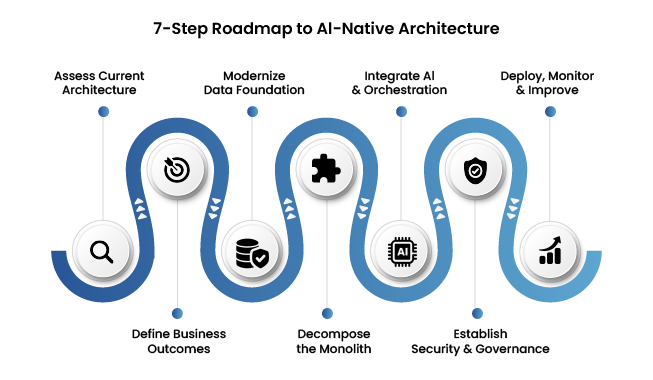
Step 1: Assess Current Architecture
Get an understanding of how your applications support your business operations. This can be done through doing an application discovery exercise. This will help you understand your application portfolio, infrastructure, databases, integrations, deployment and dependencies. This will help you understand:
- Business critical applications and processes
- Highly interdependent components
- Difficult to access or integrate data sources.
- high maintenance costs or recurring performance issues of application.
- Security risks and compliance.
- Existing APIs, integration services and components
You need to identify where is the real business blockers and technical debt lie. You should also understand the complexity that can be left as it is. This will give you a view of your applications and dependencies and show you which applications to keep, modernize, decouple or retire.
Step 2: Define Business Outcomes and AI Use Cases
Once you understand what is going on around you think of where you can apply AI to gain real value from your business. Try to avoid thinking about particular models or technologies to apply. Think of areas where if you have better information, faster processing or have some control you will get improvements. Some ideas could be:
- Use sales and supply chain data to predict stock shortfalls
- Use contextual access to order information to enhance customer support
- Identify anomalies within financial transactions
- Use AI to automate document checking and information extraction
- Provide sales teams with customer and account intelligence
- Enhance demand forecasting using historic and real time business data
Consider the business impact, technical feasibility, data available, effort required and risk for your use cases. Think about what use cases would provide the highest benefit to your business and where the architecture is at a mature stage. If you have a use case that could provide a high business impact but the data isn’t reliable then it won’t be feasible.
A simpler solution may be better to start with. Think about what will give you the best business capability. Don’t just break down an application.
Step 3: Modernize the Data Foundation
This is one of the most important factors to consider within any enterprise as using an integrated model will cause unreliable outputs if the data used is incomplete, out of date, duplicate or inconsistent.
An initial assessment is required to understand the quality, ownership, availability, security and consistency of data. Understanding where vital data exists and how it flows between applications. Modernization can be required depending on the use case to:
- Building reliable data pipelines for structured and unstructured information.
- Establishing API-based access to operational databases.
- Introducing data warehouses or lakehouses for analytical workloads.
- Using vector databases for semantic retrieval.
- Implementing metadata management and data catalogs.
- Creating knowledge graphs to represent relationships across business information.
Within RAG scenarios there may be various processing requirements around document processing, chunking, metadata enhancement, embeddings, indexing and retrieval. The architecture would need to deliver the correct data to the correct applications at the right time with the right permissions.
However, it does not necessarily mean data modernization will need to be moved into a central data lake. Various workloads may have different storage and access requirements. The goal is to ensure consistent and controlled access to business data for use within workloads while ensuring ownership of data.
Step 4: Decompose the Monolith Strategically
Once business requirements and data dependencies are understood then it can be determined how to fragment the application. In most cases a full replacement of the monolith won’t be required as this can be done incrementally. Enterprises can extract certain business capabilities and ensure the application to run.
A well known approach to this is the Strangler Fig pattern. This allows you to move certain functionality out of the legacy application into newer services. This can be done over time and an API Gateway / Routing layer can be used to route requests to the correct part (legacy or modernized). Over time more functionality can be moved over once new services have been proven. Benefits include:
- Reduces the need for a high-risk, all-at-once migration.
- Allows teams to validate new components independently.
- Preserves existing business operations during modernization.
- Creates opportunities to improve deployment and scaling practices.
- Provides flexibility to adjust migration priorities as requirements change.
Ensure that decomposition is done along business lines. Your services should be real business capabilities with clear ownership, roles and interfaces.
Step 5: Integrate AI and Orchestration
Once you have the data and application interfaces you need you can add your AI capabilities to your prioritized business processes. This might include integration of large language models, forecasting Machine Learning models, RAG and AI agents. You will also need to integrate workflow orchestration.
When using these capabilities you must consider how they work with your existing applications. You should never allow your models to be fully autonomous. They need to know their role within the system and how they interact with others within your enterprise using known business rules. Organizations should establish:
- Clear responsibilities for models, agents, and application services.
- Controlled access to enterprise APIs and business data.
- Defined workflows for task execution and exception handling.
- Human approval requirements for sensitive decisions.
- Fallback mechanisms when models or connected services fail.
This provides clear separation of duties which makes the monitoring, assessment and maintenance of AI applications much easier. If needed individual models or services can be modified within the application without having to redevelop it completely.
Read more about: How AI Integration Streamlines Operations for Small & Mid-Sized Businesses
Step 6: Establish Security and Governance Controls
Security and governance processes should be incorporated during the integration of AI. There are new risks associated with AI native systems which may not be addressed fully using traditional controls. This includes data extraction, prompt injection, information leakage, incorrect outputs, and unwanted actions by AI agents.
A consistent control framework should be implemented across the whole application lifecycle within enterprises. Key requirements include:
- Identity and access management: Ensure users, models, and agents access only the resources required for their assigned responsibilities.
- Data protection: Apply encryption, data classification, retention policies, and appropriate handling of sensitive information.
- Model evaluation: Test outputs for accuracy, consistency, relevance, and compliance with business requirements.
- Prompt and input security: Protect AI applications against malicious instructions and unauthorized attempts to influence model behavior.
- Auditability: Maintain records of model interactions, data access, approvals, and actions.
- Incident management: Define procedures for investigating failures, restricting access, and recovering affected services.
The AI Risk Management Framework provided by NIST is an excellent point to refer to. It highlights the four key areas of govern, map, measure and manage. This will help organizations highlight risks, ownership, understand system behavior and manage any issues within the AI lifecycle.
Governance should also be tailored to the specific industry, regulation requirements and risk appetite of an organization. A customer facing recommendation engine will require less governance than an AI system that supports financial approvals.
This aims to ensure security and ownership are embedded into the architecture so that AI capabilities can be expanded without leaving any operational exposure.
Step 7: Deploy, Monitor, and Improve
Migration is an ongoing engineering process. For every migrated component you should validate that it meets technical, security and business requirements before increasing usage. You can start by deploying to your internal users or a small group of customers. You will look to compare the new system to the original application to find any issues and fix them before increasing traffic. This should include monitoring:
- Application availability and response times.
- API performance and integration failures.
- Model accuracy and response quality.
- AI task completion and escalation rates.
- Data access and security events.
- Infrastructure utilization and model consumption costs.
Feedback loops should be set into place so that employees and customers can provide feedback on when the model is providing incorrect answers, missing steps in a workflow, and when human intervention is required.
This can be used to improve your data retrieval, application logic, prompts, model choice and orchestration. By rolling the deployment out in phases alongside automation, parallel validation and rollback, enterprises have more control over the deployment and modernization teams can learn from each release.
Selecting the Right Legacy Application Modernization Strategy
There is a 7 step methodology that gives guidance, however the migration strategy will be tailored per application.
Not all legacy systems will need to be rebuilt. Some may require infrastructural changes while others may require architectural improvements. These decisions will be based upon business criticality, technical status, running costs, integration requirements and future development requirements. 4 common approaches for modernizing include:
| Strategy | What it involves | When it makes sense |
| Rehost | Move the application to new infrastructure with minimal code changes | When infrastructure limitations are the immediate concern |
| Refactor | Improve internal code structure while retaining the core application design | When maintainability and performance need improvement |
| Re-architect | Redesign the application into modular services or a different architectural model | When existing design restricts scalability, integration, or AI adoption |
| Replace | Retire the existing application and adopt or build a new system | When the current application no longer meets business requirements |
Rehost: Move without major architectural changes
Rehosting, often referred to as lift and shift, is the process of migrating an application to another infrastructure while making minimal changes to the code.
It can help with infrastructure limitations, greater flexibility with hosting and consolidation, however it will not fix any tightly integrated components or broken data within the application. Rehosting can be a good option if an infrastructure change is required, however it should not be confused with AI modernization.
Refactor: Improve the existing application
Refactoring is used to improve the structure of the application without changing the functionality. Teams can simplify their code, reduce duplication, improve performance and make code more maintainable.
This is useful if the application is still valuable but difficult to develop due to the implementation. However, this may not solve any issues with the architecture of the application which prevent scalability or integration with AI services.
Re-architect: Change how the application is structured
Re-architecting means re-designing your application so that it meets new business and technical needs. This might mean breaking up business capabilities, using APIs, event-driven communication and cloud native technologies.
This will be necessary when you cannot meet the demands of AI-native systems by using your current application. It can provide increased flexibility but will also require additional planning, engineering effort and managing of dependencies.
Replace: Move to a different application
Replacement involves decommissioning an existing application and either using a commercial product or developing a new solution. This would be suitable if the current technology is no longer supported, cannot be justified due to high maintenance costs or doesn’t have the required capability. Replacement can become very complex when implementing changes such as migrating data, re-designing processes, getting employees to adopt the new technology and ensuring integration with other systems.
In practice, these strategies are often used in combination. AWS’ migration guidance outlines that there will be different strategies to use; re-hosting, re-platforming, re-factoring, re-using and re-deploying. As such, it makes sense to make decisions at an application level.
Addressing the Complexities of Enterprise Architecture Migration
Even with a clear roadmap, migration can encounter technical and organizational obstacles. Identifying them early helps leadership teams plan realistic timelines, allocate resources, and reduce disruption.
Technical debt and hidden dependencies
Legacy applications often have complex business rules which are not documented, old integration and dependencies. If you do not know how one component interacts with others, you would cause issues with business-critical processes.
What helps: Create a mapping of dependencies between applications. Document key business rules. Create automated regression tests. Focus on components that have clear boundaries.
Fragmented and inconsistent data
Different systems in your business may have their own version of customer, product, financial or operational data. This can lead to inconsistencies.
What helps: Data ownership, quality, metadata and controlled access processes are in place. Check the data is validated before using in your AI processes.
Business continuity and migration risk
Core applications are often used for revenue generating and customer facing activities. If you don’t get it right, it can impact on transaction, service and employee productivity.
What helps: Deploy in phases, validate in parallel, migrate traffic carefully, have tested recovery processes and have a rollback plan. Critical functions need to be available.
Integration complexity
A distributed architecture introduces communication between many services, databases, APIs, AI models and external systems. If not well managed, this can introduce additional latency, failure points and maintenance.
What helps: Define clear API contracts, have standard integration patterns, define owner of services and enable end to end observability.
AI reliability and control
AI models may provide incorrect answers, misunderstand business context and may give inconsistent results based on input. If the agent-based systems can also access enterprise tools and take actions, then further risks occur.
What helps: testing models against business specific scenarios, limiting access, validating outputs, keeping an audit trail and requiring human authorization for sensitive actions.
Cost and skills requirements
Modernization requires investment in engineering, cloud, data, security and AI ops. Distributed systems will also require more operational capability.
What helps: Plan for incremental investments, calculate TCO, look for skills gaps and define ownership of application/model maintenance.
Overall the takeaway is that architectural modernization can’t just be handled by the engineering teams. Business leaders, security, data owners and application owners should all be involved in decisions that impact them.
Measuring the Business Value of AI-Native Architecture Modernization
A successful migration to AI-Native architecture will provide much more than a modern architecture. Enterprise leaders need to understand how the new architecture will impact operations, provide reliable AI and improve business outcomes. Measuring before implementing will provide a baseline to measure against.

Technical performance
These metrics indicate whether the new architecture is becoming easier to operate, maintain, and scale.
- Application availability and reliability.
- Deployment frequency and release lead time.
- Mean time to recovery (MTTR).
- API response times and system latency.
- Infrastructure utilization and operating costs.
- Integration failures and service dependencies.
AI performance
AI-specific metrics should reflect the requirements of individual use cases.
- Retrieval relevance and response accuracy.
- Successful task completion rates.
- Model latency and inference costs.
- Human escalation and correction rates.
- Frequency of unsupported or inaccurate responses.
- Policy violations and security incidents.
For agentic workflows, enterprises should also measure whether agents complete approved tasks correctly and remain within their assigned permissions.
Business performance
Ultimately, modernization must contribute to measurable business improvements. Relevant indicators include:
- Reduction in manual processing time.
- Faster business decision-making.
- Lower cost per transaction.
- Improved customer satisfaction and retention.
- Reduced operational errors.
- Increased revenue through better conversion or personalization.
Understanding migration ROI
Migration Return on Investment is a valuable measure. This will include all engineering, infrastructure, integration, training, governance and running costs.
Financial gains should be based on savings or extra revenue. Time saved should not be assumed as financial saving. You will need to understand how time saved has been turned into cost savings, increased output or improved service.
By monitoring these you will have a clearer picture of how you are progressing with your modernization and identify where further investment is warranted.
How Can Xcelore Help Enterprises Move Beyond Legacy Modernization?
Modernizing enterprise architecture for AI does not require replacing every existing application or introducing AI across the entire organization. It requires a clear understanding of where current systems create constraints, where data accessibility needs to improve, which applications would benefit from modernization, and where intelligent capabilities can deliver measurable business value.
A successful migration is typically phased, guided by business priorities, and supported by a well-defined governance framework. This approach helps organizations protect existing technology investments while creating the flexibility to introduce new capabilities as requirements evolve.
Modernization decisions should be grounded in business outcomes rather than driven by technology adoption alone. By bringing together AI-native engineering, enterprise data capabilities, and disciplined execution, organizations can move beyond isolated AI implementations toward systems in which intelligence is embedded into core business processes.
The objective extends beyond moving from monolithic applications to microservices or from traditional infrastructure to the cloud. These may be important steps, but they are not the end goal. The larger priority is to build an adaptable architecture that makes better use of enterprise information, supports more informed decision-making, and responds effectively to changing business needs.
For enterprise leaders, the defining question is not simply what technology will replace the existing architecture, but what the organization will be able to achieve once modernization is complete.
FAQs
Q. How much does it cost to migrate from monolithic to AI-native architecture?
A. The cost of migrating from monolithic to AI-native architecture depends on application complexity, existing infrastructure, data readiness, integration requirements, and the level of modernization required. At Xcelore, we recommend evaluating the existing technology landscape and business priorities before estimating the investment. A phased migration can also help enterprises distribute costs and prioritize high-value improvements.
Q. How long does an enterprise AI-native architecture migration take?
A. The timeline depends on the size of the application portfolio, technical dependencies, data infrastructure, and migration scope. Smaller, focused modernization initiatives may take less time than enterprise-wide transformations involving multiple applications and integrations. Xcelore recommends a phased approach, allowing organizations to validate each stage before expanding modernization across the enterprise.
Q. Can Xcelore modernize legacy applications without disrupting existing business operations?
A. Yes. Xcelore follows a structured modernization approach that considers application dependencies, business-critical workflows, and operational requirements. Techniques such as incremental service extraction, API-based integration, parallel validation, and controlled deployment can help enterprises introduce new capabilities while keeping existing systems operational.
Q. What factors influence the cost of legacy application modernization?
A. The major cost factors include:
- Application size and architectural complexity.
- Technical debt and undocumented dependencies.
- Data migration and integration requirements.
- Cloud infrastructure and technology choices.
- AI model integration and orchestration.
- Security, governance, and compliance requirements.
- Testing, deployment, and ongoing maintenance.
Xcelore evaluates these factors at the application level to help enterprises identify the most appropriate modernization investment.
Q. Should enterprises modernize their entire architecture at once or in phases?
A. A phased approach is generally more practical for complex enterprise environments. It allows organizations to prioritize applications based on business value, technical limitations, and AI readiness. Xcelore recommends modernizing selected capabilities, validating their performance, and gradually extending the approach while protecting critical business operations.
Q. How does Xcelore decide whether an enterprise application should be rehosted, refactored, re-architected, or replaced?
A. Xcelore considers the application’s business criticality, technical condition, maintenance costs, integration requirements, and future scalability needs. Rehosting may address infrastructure limitations, refactoring can improve maintainability, re-architecting can overcome structural constraints, and replacement may be appropriate when an application no longer meets business requirements.
Q. What are the ongoing costs of maintaining AI-native enterprise architecture?
A. Ongoing costs may include cloud infrastructure, API and integration services, AI model consumption, data storage, monitoring, security, and maintenance. Enterprises should also account for model evaluation, governance, and operational support. Xcelore recommends monitoring infrastructure utilization, model consumption, application performance, and AI task completion to maintain cost visibility.
Q. How can enterprises calculate the ROI of AI-native architecture modernization?
A. ROI should account for both modernization investments and measurable business improvements. These may include reduced processing time, lower operational costs, improved application performance, fewer manual errors, faster decision-making, and increased revenue opportunities. Xcelore recommends establishing baseline metrics before migration and tracking technical, AI, and business performance throughout implementation.
Related Blogs

More Than a Development Partner. A Partner in Progress.
We stay with your product beyond launch. From modernization and optimization to platform upgrades, security improvements, and continuous evolution, we help your solution keep moving forward.