
Enterprise Guide to Advanced RAG: Architecture, ROI, and Development Costs
Sunil Yadav
Key Takeaways
- Advanced RAG connects enterprise AI with trusted business knowledge, enabling more accurate responses, controlled information access, and dependable decision support.
- Retrieval quality drives accuracy more than model size, and it is the cheaper lever.
- Gartner expected over 30 percent of generative AI projects to stall after proof of concept; content ownership, permissions, and funded evaluation get you past it.
- Production-grade enterprise RAG typically ranges from roughly $30,000 for a focused pilot to $500,000+ for a multi-source, compliance-heavy platform, plus ongoing run costs.
- Security, evaluation, and observability separate a demo that impresses from a system the business can rely on.
Most enterprise AI application budgets are approved on the strength of a demo. The demo works because it was built on a tidy slice of data, with friendly questions, in front of a patient audience. Production offers none of those conditions.
If you are weighing an investment in enterprise RAG development, the real questions are about money, risk and accountability. What will this cost to build and to run? How long until it pays back? What happens when it gives a wrong answer to the wrong person? And who should you trust to build it?
Here is where lies the essential dilemma for enterprises and business leaders comes up. figuring out whether the additional layers of complexity are indeed justified by costs, how to introduce this process without any hazards, and what kind of benefits they may derive from it. This guide provides an opportunity to do all that.
Advanced RAG: Shift From Basic Retrieval to Robust AI Pilot
Gartner forecasted more than 30% of generative AI projects will fail to scale past PoC by the end of 2025. The problem is not bad AI models but bad data quality, lack of security measures, skyrocketing costs, and unproven ROI.
Grounding models with traditional retrieval alone does not address the problem since commercial legal RAG models have errors of 17-33%. While retrieval decreases incorrect responses, it does not eliminate them.
The risks for executive sponsors are data quality, retrieval mechanisms, and control mechanisms. Basic RAG rely on query processing linearly, an approach that fails beyond clean and narrow datasets. Advanced RAG addresses this problem through control integration at all stages:
- Pre-Retrieval: Query rewriting, query decomposition, and directing queries to the right data sources.
- During Retrieval: Hybrid search and permission, recency, and metadata filtering.
- Post-Retrieval: Reranking, compression, and validation of context prior to execution by the model.
- Post-Generation: Accuracy scoring, source verification, and logging of the entire operation.
The proof-of-concept system showcases search functionality; the enterprise system offers permission management, auditability, and ROI. Upgraded retrieval systems transform experimental AI into core systems.
Advanced RAG architecture: Seven components, end to end
Data ingestion and processing
Ingests both structured and unstructured enterprise data in all kinds of formats, providing normalization and metadata for governance to assure data lineage and compliance.
Chunking and embedding generation
Splits difficult documents into semantic components and creates multidimensional vectors to ensure that the highest level of retrieval precision is reached.
Indexing and knowledge storage
Directs vectors into special databases for semantic discovery while keeping traditional relational search for keywords and structured data.
Query understanding and transformation
Interprets user prompts, automatically rewriting, expanding, or deconstructing complicated prompts into simple sub-prompts prior to search execution.
Retrieval and reranking
Combines both keyword-based and vector search technologies in parallel and applies reranking on top to ensure only the most confident context comes up.
Context assembly and LLM generation
Checks the access permissions, creates a proper background context structure, and delivers it into the LLM for verifiable output.
Evaluation and monitoring
Monitors accuracy scores, latency time, vectors drift, and operational costs to ensure enterprise SLA and predictable cost.
Advanced RAG techniques that improve retrieval accuracy
Nine techniques consistently separate high-performing enterprise systems from average ones.
1. Hybrid search
Vector search understands semantics but fails to capture terms such as part numbers, policy codes, or names. Keyword search (BM25) correctly captures these terms. The hybrid approach uses both and combines the results, delivering improved recall over either alone. Hybrid search should be evaluated in cases where business searches use both semantic queries and terms like part numbers or policy codes.
2. Query rewriting and expansion
Users input ambiguous, short, conversational queries. The second step is to reformulate the query into one or more search queries that address any pronoun problems, expand acronyms, and add context from the conversation.
3. Reranking
Retrieval broadly but ranking narrowly. The cross-encoder reranking system reads the query and each passage together, pulls up the truly relevant passages and discards the near-misses that would otherwise fool the model.
4. HyDE (Hypothetical Document Embeddings)
First, the system writes a hypothetical answer and searches for that. A hypothetical answer is similar to the document of interest, and thus the retrieval process is improved, especially for sparse or technical queries.
5. Multi-hop and decomposed retrieval
Consider a query such as “What was our refund policy changed due to the 2025 contract revision, and which customers does it affect?” This cannot be answered in one go. The system breaks down the question into sub-queries, finds evidence for each and creates an answer.
6. Metadata filtering and access-aware retrieval
Document type, department, date, region or user authorization filters narrow down the scope of the search even before similarity computation begins. Accuracy improves, but, more importantly, users access only what they have the authority to.
7. Contextual compression
Long and noisy context leads to inaccurate answers and increased token cost. Context compression isolates only the sentences relevant to the question, providing a more precise, economical and accurate input to the model.
8. Graph RAG
Where answers are dependent on relationships between entities like suppliers, contracts, products and people, a knowledge graph can work alongside vector search. Graph RAG navigates through relationships to answer questions that similarity search cannot, and its reasoning is easier to explain.
9. Agentic RAG
In an agentic system, retrieval itself becomes a choice. Agentic systems select the appropriate data sources and instruments of retrieval, evaluate the sufficiency of the evidence gathered, and repeat the cycle until sufficient information is retrieved. In workflows that cover documents, databases, and live APIs, this pattern is the most efficient one possible.
Advanced RAG vs. Traditional RAG vs. Fine-Tuning: Which Should You Choose?
These approaches are often framed as rivals. In practice, they solve different problems, and mature systems frequently combine them.
| Factor | Traditional RAG | Advanced RAG | Fine-Tuning |
| Core purpose | Basic grounding in documents | High-accuracy, governed retrieval at scale | Teaching a model style, format, or domain behavior |
| Data freshness | Updated by re-indexing | Updated by re-indexing, often in near real time | Requires retraining to update |
| Accuracy on private data | Moderate, inconsistent | High, with measurable evaluation | Limited for factual recall |
| Citations and auditability | Basic | Strong, source-level | Not natively supported |
| Upfront cost | Low | Moderate to high | Moderate to high |
| Ongoing cost | Low to moderate | Moderate | Retraining cycles |
| Best for | Prototypes, narrow datasets | Enterprise knowledge systems, regulated workflows | Tone, structured output, specialized tasks |
The decision rule: if your challenge is knowledge (facts that change, must be cited, and belong to you), choose advanced RAG. If your challenge is behavior (consistent tone, format, or reasoning style), consider fine-tuning. If it is both, combine them: fine-tune for behavior, retrieve for facts.
How to develop a RAG-powered application: key steps and technologies
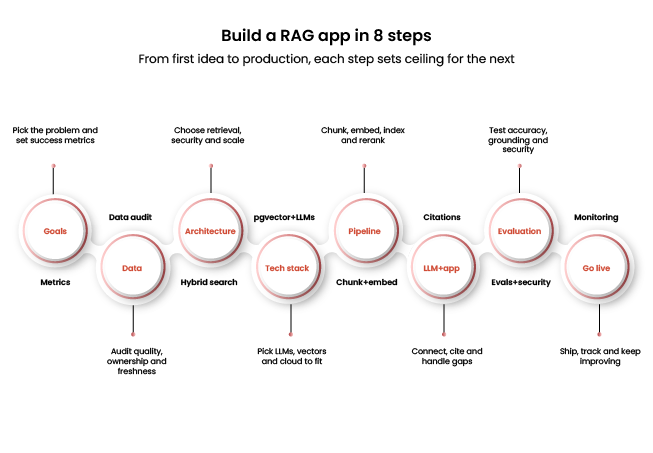
RAG application development runs through eight steps, from business objectives and data preparation to architecture, application engineering and continuous evaluation. The order matters, because each step sets the ceiling for the one after it.
Step 1: Define the business objectives and use cases
First, decide what operational problem should be solved with the help of the platform. Decide who uses the platform, what decisions he should make, from what data assets he makes decisions and what actions will be taken next. Connect the implementation of the platform to business metrics like response accuracy, first contact resolution ratio, time savings in search process or other efficiency of the task execution.
Step 2: Assess data readiness and quality
Analyze all data sources in terms of their format, ownership, refresh rate, access permissions and data quality issues. Discover duplicate records, contradictions, lack of metadata and obsolete files at the early stages. The performance of your search engine is totally dependent on the quality of your input data – there is no algorithm that could make up for bad ingestion.
Step 3: Design the RAG architecture
Choose the retrieval approach the use case calls for: vector search, keyword search, hybrid retrieval, reranking, metadata filters, graph retrieval or agentic orchestration. The same design has to cover integrations, security, availability, scalability and monitoring.
Step 4: Select the technology stack
A typical RAG tech stack has these layers:
- LLMs from providers such as OpenAI, Anthropic or Google, chosen for requirements and availability.
- Embedding models that convert text into vectors for semantic search.
- Vector databases such as Pinecone, Weaviate, Milvus, or PostgreSQL with pgvector.
- Retrieval frameworks such as LangChain or LlamaIndex.
- Search infrastructure for keyword and hybrid search, where exact matching matters.
- Cloud infrastructure on AWS, Microsoft Azure, Google Cloud, or a private environment.
- Monitoring and evaluation tools, plus custom test pipelines covering retrieval quality, answer grounding, latency, security and cost.
The products above are examples. Select the stack against your own data, performance, security and budget requirements.
Step 5: Build the data ingestion and retrieval pipeline
The ingestion workflow parses documents, creates chunks, generates embeddings, stores metadata, and refreshes the indexes whenever source information changes. Add retrieval and reranking on top, then run representative business questions against the indexed data. The test is whether the system returns the correct information. Passages that merely look semantically similar do not pass it.
Step 6: Integrate the LLM and build the application
Connect the retrieval pipeline to the LLM and to the application interface, and build the APIs, user experience, authentication, integrations, citations and error handling around it. Give the system explicit instructions for three situations: information is missing, sources conflict, or a question falls outside its supported scope.
Step 7: Evaluate accuracy, grounding and security
Build the test set from representative queries, their expected answers and the source documents that support them. Measure retrieval relevance, answer correctness, groundedness, completeness and citation quality. Test permission boundaries, prompt injection, sensitive-data exposure and failure scenarios too. A good evaluation also shows where each error originated, whether in retrieval, context assembly or generation.
Step 8: Deploy, monitor and optimize
Deploy into an environment that meets your security and availability requirements, then watch answer quality, usage, latency, model costs, retrieval failures and data freshness. Production feedback should drive changes to chunking, prompts, retrieval settings and model selection. Put regression tests in place before any change ships, so that a gain in one area does not quietly break another.
How much does RAG development cost?
Every buyer asks about RAG development cost, and vague answers are common. The figures below are indicative planning ranges based on our delivery experience, not quotes and not third-party benchmarks. Your data condition, integration needs and compliance obligations will move them.
| Stage | Typical scope | Indicative build cost | Typical timeline |
| Pilot | One use case, limited clean sources, hybrid retrieval | $30,000 to $80,000 | 6 to 10 weeks |
| Production-grade | Multiple sources, reranking, access control, evaluation, integrations | $80,000 to $250,000 | 3 to 6 months |
| Enterprise platform | Many sources, graph or agentic patterns, strict compliance, multi-region | $250,000 to $500,000+ | 6 to 12 months |
Four things push a project up this table faster than anything else.
- Data condition. Scanned documents, tables locked in images, multilingual content and years of near-duplicate files demand heavy preprocessing. Pilots usually avoid this work by choosing a clean subset, which makes the pilot look cheaper than the programme will be.
- Integration depth. Each connected CRM, ERP or ticketing platform adds engineering, testing and a new owner to negotiate with.
- Architectural ambition. Graph and agentic designs cost more to build, tune and operate than hybrid search with reranking. Sometimes the use case justifies it. Often it does not.
- Compliance posture. Regulated environments add audit trails, private deployment and review cycles.
Then there is the cost that follows launch. Many organisations spend roughly 15 to 25 percent of the initial build each year on tuning, support and content operations, with model usage charged on top. A business case that stops at the build price is incomplete, and boards tend to notice when the second-year budget arrives unplanned.
Where the ROI actually comes from
RAG rarely pays back through headline automation. It pays back through accumulated small gains in workflows where knowledge is the bottleneck.
Consider where skilled people lose time today. Support agents searching for the right policy during a live call. Analysts reconciling three versions of a procedure. Sales engineers hunting for the last approved technical response. Compliance teams answering the same internal query for the fifth time that month. In each case the value is measurable before any AI is introduced: handling time, escalation rates, rework, time to a first-draft answer.
That is why we advise sponsors to pick the first use case for measurability, not glamour. If you cannot state today’s baseline in a number, you will not be able to defend the investment in a year, however well the system performs.
Where accuracy is won, and why it matters to your budget
When a RAG system answers poorly, the instinct is to upgrade the model. In most cases we see, the fault lies earlier. The right passage was never retrieved, or it arrived alongside several misleading ones.
This has a budgetary implication. Improving retrieval is usually cheaper than moving to a larger model, and it lowers running costs rather than raising them. Anthropic’s 2024 research on contextual retrieval illustrates the scale of the opportunity. By adding short explanatory context to each chunk before indexing, and combining that with keyword matching, it reported a 49 percent reduction in failed retrievals, rising to 67 percent with reranking. These are the company’s own benchmarks and your results will differ, but they show where leverage sits.
Pushing more text into the model is not a shortcut. Research published in 2024 under the title “Lost in the Middle” found that models tend to use information less reliably when it sits in the middle of a long input. More context can mean more noise and more tokens to pay for.
The techniques that deliver the gains are well established: hybrid search that blends meaning with exact matching, reranking, metadata filtering, query rewriting and contextual compression. What separates good teams from average ones is the order in which they apply them, and whether each addition is justified by a measured failure.
The organisational risks that do not appear in the proposal
Technical plans tend to be thorough. Organisational ones are thin. Four risks recur.
No one owns the content. When two versions of a policy conflict, retrieval will surface both. A named owner and a version rule are cheaper than any engineering fix, and programmes routinely stall on the question of who is accountable for what the system says.
Latency is a business decision. Every extra stage, whether rewriting, reranking or verification, trades speed for accuracy. A compliance analyst will wait ten seconds for a verified answer. A customer service agent mid-call will not. The right design depends on who is waiting.
Evaluation is underfunded. It is the line item most often trimmed and the one most often missed when quality drifts after launch.
The system cannot say “I do not know.” Behaviour for missing, conflicting or out-of-scope evidence has to be designed deliberately. An assistant that declines to answer is worth more than one that always produces something plausible.
How to choose a RAG development company?
Most vendors describe their architecture fluently. Fewer can speak to running a system a year after launch. Ask any prospective partner:
- How will you assess our data readiness before proposing an architecture?
- Which retrieval approach would you start with, and what evidence would make you add complexity?
- How do you enforce permissions, and at which pipeline stage?
- How will we build the evaluation set together, and who signs off the quality threshold?
- Can you separate retrieval errors from generation errors in testing?
- What will year two cost, and which levers reduce it?
- How do you test for prompt injection and unauthorised retrieval?
- What can my team operate without you after the handover?
A partner who answers concretely, including “it depends on your data” where that is the honest reply, is more trustworthy than one with a polished reference architecture and no questions of their own.
Why work with Xcelore for Your next RAG implementation?
A RAG-powered application draws on AI engineering, data pipelines, retrieval systems, software architecture, security and production operations, all coordinated. An experienced partner can translate business requirements into an implementation plan and keep you from paying for technical complexity you do not need.
When you evaluate an enterprise AI development company, look at whether it can:
- Assess data readiness and define a suitable retrieval architecture.
- Build reliable ingestion, indexing and retrieval pipelines.
- Integrate LLMs with enterprise applications and workflows.
- Implement access controls, evaluation and monitoring.
- Optimize quality, latency and operating costs.
- Support deployment, iteration and long-term maintenance.
Xcelore works across RAG-powered products or internal AI applications, the right starting point is a clear use case, a realistic data assessment and an architecture aligned with measurable business outcomes.
Planning an enterprise RAG initiative? Xcelore offers a structured RAG readiness assessment that reviews your data sources, use case, security requirements and success metrics, and returns a recommended architecture, a phased roadmap and a costed estimate. Request your RAG readiness assessment or speak with our enterprise AI team.
Frequently Asked Questions
Q. What is Advanced RAG in AI, and how does it work?
A. Advanced RAG is an enhanced approach to retrieval-augmented generation that improves how AI systems retrieve, rank, and use information. It combines techniques such as query rewriting, hybrid search, reranking, and multi-step retrieval to deliver more relevant, context-aware responses to complex queries.
Q. What is the difference between RAG and Advanced RAG?
A. Traditional RAG retrieves relevant information from a knowledge source and passes it to an LLM to generate responses. Advanced RAG introduces additional retrieval and context optimization techniques, such as query expansion, hybrid search, and reranking, to improve accuracy, relevance, and performance for complex enterprise use cases.
Q. What are the key components of an Advanced RAG architecture?
A. An Advanced RAG architecture typically includes data ingestion, document preprocessing, intelligent chunking, embedding generation, vector indexing, query processing, hybrid retrieval, reranking, and LLM-based response generation. Evaluation, observability, security, and access controls support reliability and governance across the system.
Q. How much does it cost to develop a RAG-powered application?
A. The cost of developing a RAG-powered application depends on data complexity, retrieval architecture, integrations, infrastructure, and security requirements. A focused pilot may cost $30,000–$80,000, while production-grade implementations can range from $80,000–$250,000. Complex enterprise deployments may exceed $500,000, excluding ongoing infrastructure and maintenance costs.
Q. Can Advanced RAG eliminate hallucinations in AI applications?
A. No. Advanced RAG can reduce hallucinations by grounding LLM responses in relevant and verified information, but it cannot eliminate them entirely. Retrieval errors, outdated documents, conflicting sources, and model limitations can still affect response quality. Source citations, continuous evaluation, and human oversight help manage these risks.
Q. Is Advanced RAG suitable for enterprise AI applications?
A. Yes. Advanced RAG is particularly valuable for enterprise applications that require secure access to internal knowledge, context-aware information retrieval, and reliable responses from large document repositories. Common applications include enterprise knowledge assistants, customer support automation, document intelligence, and conversational analytics.
Q. How long does it take to develop a RAG-powered application?
A. A basic RAG pilot typically takes 6–10 weeks, while production-grade applications may require 3–8 months. Enterprise implementations can take longer depending on data readiness, integration complexity, security requirements, retrieval optimization, and performance testing.
Related Blogs

More Than a Development Partner. A Partner in Progress.
We stay with your product beyond launch. From modernization and optimization to platform upgrades, security improvements, and continuous evolution, we help your solution keep moving forward.