
Role of Computer Vision in Enhancing Manufacturing Industry With Automation
Sunil Yadav
Key Takeaways
- The precision level of the system is between 95%-99%, which differs greatly from the precision level of human sampling, which is only between 70%-85%.
- The introduction of computer vision ensures a decrease in defects escaped, refunds, and warranty costs.
- In terms of organizational performance, the technology can lead to a positive result in the indicators that are monitored by executive management: defects/refunds, unexpected downtime, safety, and labor efficiency.
- According to the data released by Deloitte, 84% of the companies are expected to see some positive outcome from AI and computer vision implementation.
- The applicability of Computer Vision platforms is enabled by economic efficiency, trust in the use of AI, strict control, and compliance with the EU’s requirements for using AI solutions in high-risk areas.
Automating processes is done to improve speed, repeatability, and efficiency; however, it does not solve slow Challenge detection within manufacturing processes. While defective parts can go through different phases before their problems are detected, failures in machinery can occur during the time frame when no one notices what has happened.
Productivity, customer commitments, efficiency of assets, safety measures, and competitive edge are influenced. As Sandia National Laboratories mentions, the accuracy of humans in malfunction detection is about 70-85 percent, which decreases when people are tired after working for a long time. This causes returns, rework processes, warranty expenses, losses, and damage to reputation.
On the contrary, computer vision fills this gap, allowing computers to analyze images taken with cameras mounted on production lines, machines, and facilities. Together with OCR, IIoT, MES systems, robots, and other enterprise software, it enables continuous analysis of operations based on real-time observations with just four simple steps:
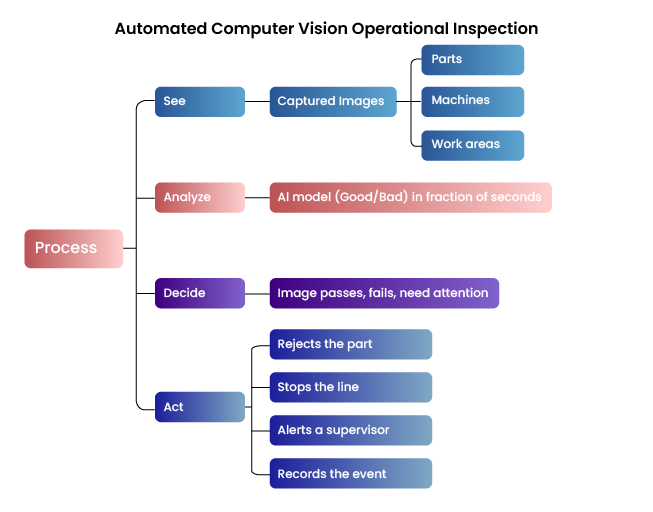
As a result, business leaders in IT systems, technology strategy, operations management, and production processes can view computer vision applications not only in terms of how they could be used but also how they can help the company get the results it needs and what would ensure that. This article discusses business implications, points to consider, pitfalls, and the first steps with measurable effect.
Modern Manufacturing Inculcates Computer Vision and AI
Computer Vision in manufacturing provides AI-powered tools that analyze visual data captured from cameras and vision sensors, allowing computers to identify Challenges, locate objects, measure elements, identify trends, and provide control over processes. It takes images and runs models using positive and negative samples to determine if a product is up to standard. If a component fails, then the process is automatically stopped by the computer, the manager is alerted, and a report is generated.
Moreover, it helps identify missing parts of an assembly in an automobile, defects on the surface, and wrong orientation of components during assembly. It can also be used to monitor the status of equipment to identify any abnormalities. Images are captured using industrial and infrared cameras and then classified into detected objects, segmented, OCR, and identified abnormalities. The results further accordingly are automated to generate reports, schedule inspections, and integrate to enterprise systems.
As assessed, traditional machine vision is rule-based and static and works fine when conditions don’t change constantly. Computer Vision provides AI to learn from observations such as 2D camera models study labels, color, and surface results, whereas 3D sensors figure out depth, shape, thickness, etc.
As manufacturing becomes increasingly automated, there is a lot of data being generated. Using Computer Vision turns this visual data into knowledge with integration to industrial IoT, MES, robots and enterprise systems, continuous quality control, safety, and decisions are made for autonomous productions at a rapid stage.
Benefits of Using Computer Vision in Manufacturing Domain
The positive impact gained from implementing computer vision can be seen in six key areas. Most of them can be tied back to costs tracked by finance teams, including resource usage, rework, downtime, safety Challenges, manual labor, and compliance.
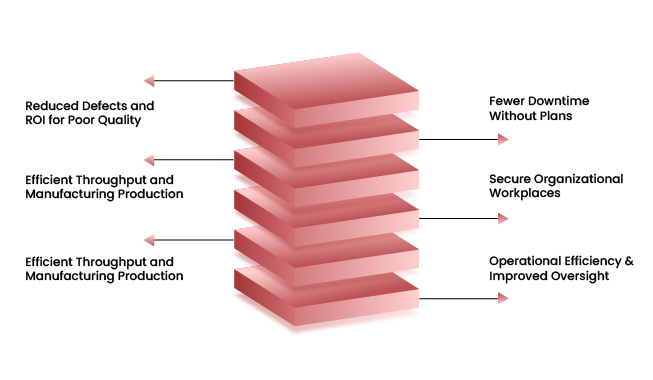
Reduced Defects and ROI for Poor Quality
Computer vision provides a reliable automated system to monitor production in real-time. It helps identify quality challenges at the surface level, dimensional discrepancies, missing parts, assembly, packaging, and labelling Challenges. This helps manufacturers identify challenges early, reduce waste, increase first-time yield, and avoid sending faulty products to end customers. It applies across electronics, pharmaceuticals, and automotive industry parts too, where one missed flaw results in huge losses.
Fewer Downtime Without Plans
Visible signs of equipment deterioration can be identified using vision systems to help identify leakage, corrosion, misalignment, unusual movement, and overheating. This, alongside IoT and maintenance data, can be used to help implement condition-based and predictive maintenance for teams to prevent small challenges from becoming expensive.
Efficient Throughput and Manufacturing Production
Computer Vision can be used to monitor production in real-time to identify Challenges with buildup of material, slow assembly, incorrect part placement, and process Challenges. This can be linked to MES systems to help supervisors identify bottlenecks and improve resource management to increase OEE. A great example of this is Siemens integrating computer vision in its manufacturing ecosystems for precision, automation, and efficiency on the factory floor.
Secure Organizational Workplaces
Vision AI can help identify when staff are not wearing PPE, entering restricted areas, being too close to machinery, dangerous forklift activity, spillages, smoke and blocked walkways. This can help teams act quickly, and auditable records can be maintained as well. According to research by the World Economic Forum, 57% of firms have implemented or are trialling computer vision to improve safety in the workplace. Computer Vision works alongside safety professionals, staff, and current safety measures.
Operational Efficiency and Improved Oversight
Computer vision automates repetitive visual checks, allowing skilled staff to focus on root cause identification, process improvement, and exceptions management. This can help manufacturers overcome skilled staff shortages. It can also be used to scan serial numbers, batch numbers, labels, and QR codes and provide auditable visual records of when checks were carried out. Later, link it to ERP and WMS systems to improve stock accuracy, visibility of materials and work in progress, and audit.
Automation That Is Easily Adaptable
Vision-guided robotics can identify parts, orientation, location, and adapt movements. This can be used for picking, sorting, verification, welding guidance, and inspection of several product manufacturing processes, offering greater flexibility and scalability to organizations.
In short, use computer vision in manufacturing to reduce quality costs, ensure production is not disrupted, improve asset utilization, safety, increase staff productivity and improve traceability.
Read More: AI in Manufacturing: A Game Changer in Industry
Use Cases of Computer Vision in Different Manufacturing Operations
Computer Vision is useful across multiple manufacturing value chains and beyond the commercial stake as described with the applied values in the table below:
| Category | Application | Use and Outcome |
| Quality and Regulatory Checks | Defect detection in products | Identifies surface, structural and dimensional Challenges within products and helps enhance the quality of products to reduce rework. |
| Component verification in assemblies | Evaluates incorrect or missing components and ensures reducing related errors. | |
| Inspection in packaging | Verifies sealing, labelling, and integrity of the package to eliminate or reduce product loss from the factory. | |
| Product tracking | Combines vision AI with product or batch data to improve the traceability of the product processed for the long term. | |
| Operational Improvements and Increased Asset Performance | Predictive maintenance | Detects visual Challenges with equipment to improve asset availability for production. |
| Process monitoring | Monitors the entire process and anomalies in the manufacturing process to increase the efficiency and productivity of production. | |
| Robotic vision | Offers visual indication of the manufacturing operations to facilitate robotic actions for greater flexibility in automated operational processes. | |
| Digital Twin monitoring | Supports visual data inspection of physical processes. Thus, helping improve the simulation of operations at a rapid pace. | |
| Security and Stock Management | Improved operational safety | Identifies incorrect PPE and hazardous conditions to handle risks safely without specific losses. |
| Stock management | Recognizes materials, products and labels, improving stock management for businesses. |
By combining these solutions with a wider digital manufacturing environment, further value can be achieved by manufacturers. Visual inspection, for instance, makes it possible to identify a problem that occurs repeatedly, while production statistics allow engineers to establish whether this problem is related to a specific machine, batch of material, working condition, or shift.
What Embarks Core Need of Integrated Computer Vision Approach in Manufacturing?
Computer vision solutions, while allowing for the inspection of production quality, are limited in their application when not integrated into other production operations. During an industrial production process, the systems are connected to manage quality, processing equipment, materials used in production, and business workflows. By integrating it with other aspects of the production process, the potential of the technology can be successfully realized.
For instance, a vision AI platform may detect defects that occur more than once in a metal part, but the production team still has to determine which machine produced the part, what material the part was made of, whether the defect happens again and what to do to resolve the problem. If the information is not connected, then no practical outcome will be achieved.
Integration with the following systems enables value generation in a manufacturing enterprise setting:
- Manufacturing execution systems (MES): Embedding visual analytics into work orders, stations, work instructions, quality checks, and manufacturing records.
- Enterprise resource planning (ERP): Allows quality reporting, decision-making on stock, materials, production and business reporting.
- Industrial IoT platforms: Provide contextual information by applying visual analytics with data from equipment and environmental sensors.
- PLC/SCADA: Integration of appropriate alerts or signals into industrial control systems via permitted points to trigger alerts during production, and actuation of machines as per the manufacturing unit safety and control requirements.
- Computerized maintenance management systems (CMMS): Trigger maintenance alerts and requests based on abnormal conditions detected by visual analytics.
- Analytics and Business Intelligence (BI) Platforms: Support identification of trends in defects, performance Challenges, and inefficiencies in production lines and sites by aggregating data.
By integrating visual analytics with these systems, investigations can be performed, remedial actions can be taken beforehand, and improvements can be made within operations in a timely manner. This integration aligns with Industry 4.0 principles to effectively integrate visual analytics with production systems and personnel processes for scalability and growth of the ecosystem in the near future.
Computer Vision in Manufacturing: Challenges and Solutions Covered
Major manufacturers have the ability to execute a successful pilot program. However, there are very few instances of Computer Vision being utilized on a larger scale throughout multiple sites. Data indicates that a high number of AI-based vision projects are limited to the pilot stage and are yet to be transitioned to the large-scale operations stage. The Challenges and their resolutions are therefore stated as follows:
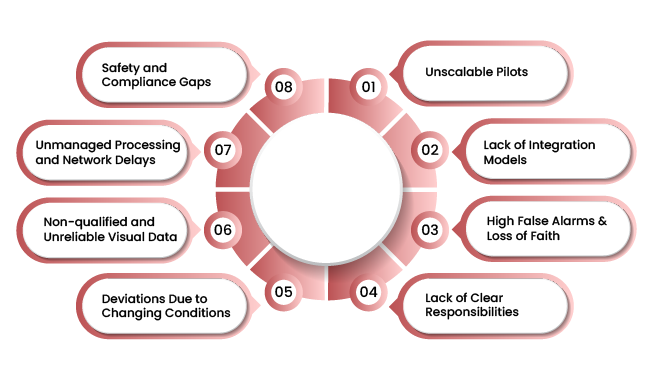
1. Unscalable Pilots
Challenge: Pilots can work on a controlled site, but it is difficult to replicate them in other locations of the manufacturing units.
Solution: Have an integrated vision and design for scalability of the demo models. Develop production KPIs, document vision systems and standards, and treat pilots as the beginning of an integrated process.
2. Lack of Integration Models
Challenge: No communication between the AGV vision data and the MES, PLC, SCADA, or maintenance data is maintained accurately because of existing legacy systems.
Solution: Plan for easy integration at an earlier stage and ensure vision data is connected to production orders with all necessary resources.
3. High False Alarms and Loss of Faith
Challenge: High false alarm levels make the operators lose trust in the system and make them use it inconsistently.
Solution: Ensure models are verified in real-life conditions across multiple shifts and products. Monitor false positive and negative rates and get feedback from operators on the criteria and edge cases.
4. Lack of Clear Responsibilities
Challenge: Pilots initiated by innovation teams make it difficult to assign clear responsibilities for model performance, updates, and maintenance.
Solution: Before deployment, assign clear roles and accountability for manufacturing operations to the team members. Decide on the members who will be monitoring performance, updating models, and maintaining cameras, lighting, and other tasks.
5. Deviations Due to Changing Conditions
Challenge: Changes in lighting, new materials, product upgrades, and contamination cause a gradual reduction in how accurate the manufacturing workflows and product development actually are.
Solution: Build dynamic systems that help you analyze records regularly, collect data, monitor performance, and retrain models in your process. One such example that we built is Xcelight.
6. Non-qualified and Unreliable Visual Data
Challenge: Data accuracy may be affected when fetched from the camera sensors using Computer Vision and AI technologies if any obstruction occurs, lighting is inconsistent, and the pilots used are defective.
Solution: Utilize appropriate datasets for different products, defects, and situations. Besides, natural, good lighting, camera settings, and frequent updates in training sets are essential for ideal outcomes.
7. Unmanaged Processing and Network Delays
Challenge: Cloud processing in the vision AI models may cause delays in environments that are time-bound.
Solution: Use local models to reduce delays, and cloud models for central management and analysis from different locations. Adapt for hybrid models wherever they suit best to your processes without any complexities.
8. Safety and Compliance Gaps
Challenge: Having open ACS with associated cameras and applications means that large volumes of sensitive data are collected from business operations.
Solution: Ensure data security with access permissions and follow best manufacturing industry practices with relevant standards like GDPR, SOC 2, IEC 62443, and so on to prevent security and compliance challenges.
It is important to understand that efficient organizational solutions aim towards lasting objectives of solving a specific problem for long-term liability. Therefore, trusted partners who will help them cope with the problems while paying attention to the requirements of a production unit are required.
How Xcelore Computer Vision Services Assists Manufacturing Industries?
At Xcelore, we offer bespoke computer vision development services to solve real business problems in manufacturing. We assess opportunities for vision AI within your process and:
- Develop custom platforms using object detection, classification, segmentation, OCR, and anomaly detection
- Build AI models and integrate them within existing systems
- Implement models on edge, cloud, or hybrid environments, and
- Optimize models as products and business requirements evolve
Starting from the bottom line, we offer AI readiness assessment for enterprises to identify changes in decision-making. Besides, we ensure that the solutions built are for specific components, lighting, and processes within your plant. One that can be easily integrated from day one to provide early alerts to control and tracking systems. From single-line pilot to multiple sites, we engage computer vision operators at an early stage to understand what real defects look like and how they can be resolved without greater losses.
In the end, computer vision allows manufacturers to perform quality checks, ensure correct assembly, monitor equipment, improve safety, direct robots, and improve inventory visibility. However, the actual value of the technology comes when visual insights are combined with manufacturing processes and data to improve quality, efficiency, reliability, and continual improvement.
The best implementations will have a quantified business problem, be validated in real-world environments, be integrated into everyday processes, and measure business impact. If there is a line in your business where costs are being incurred due to quality, downtime, or safety challenges, this is where you should start.
FAQ
Q. What is the estimated cost of utilizing Computer Vision services in the manufacturing sector?
A. Costs vary depending on camera requirements, data handling, hardware, model development, software, integration, scale of deployment, and maintenance. When calculating the payback period of 12-18 months, refer to your own data about defects, rework, resources, returns, and downtime.
Q. How to choose the right computer vision development company for your manufacturing business?
A. Consider experience in industrial settings, data handling, level of integration, deployment (on-device/ in the cloud), security, and model maintenance. The right partner understands your manufacturing processes, ensures performance in real-world conditions, and defines clear goals for success in pilot and full rollouts.
Q. Which manufacturing segments have the most scope to get advantages by using Computer Vision technology?
A. Inspection, verification of assembly, checking of packaging, and traceability can be gained by many industries, including automotive, electronics, pharmaceutical, food and beverage, and consumer goods, within the manufacturing unit. The value of the services depends less on the industry type and more on volume of production, cost of defects, risk to safety, and requirements for automation.
Q. How does computer vision mark its inclusion in Industry 4.0?
A. Visual intelligence is provided by computer vision in smart factories. With its integration with Industrial IoT, edge and cloud computing, analytics and robotics, automated inspection, visibility in production, monitoring of equipment, tracking of materials, and data-driven decisions in operations can be achieved.
Q. Which vision AI technologies are used by Xcelore for manufacturing sector?
A. Cameras, lighting, and image processing are combined with machine learning/deep learning algorithms to allow detection, classification, segmentation, OCR, and anomaly detection. Depending on requirements, 3D imaging, edge computing, IoT integration, and robotics may be included in the solution.
Q. Is it possible to use the computer vision services with existing CCTV cameras?
A. Yes. If using an IP-based CCTV camera, applications such as PPE monitoring, restricted area detection, and operation monitoring can be achieved. This will depend on resolution, frame rate, camera angle, lighting, and stream accessibility. Furthermore, if very detailed product inspection is required, then specific imaging equipment is a must.
Q. What are the future trends of using computer vision in manufacturing enterprises?
A. Integration with industrial IoT and robotics, increased processing speeds at edge devices, and more flexible AI models allow for improved defect detection, predictive maintenance, and smoother automation and real-time decision-making.
Related Blogs

More Than a Development Partner. A Partner in Progress.
We stay with your product beyond launch. From modernization and optimization to platform upgrades, security improvements, and continuous evolution, we help your solution keep moving forward.