
Responsible AI Development: A Governance-First Approach to Building Enterprise AI
Sunil Yadav
Key Takeaways
- For the sake of safety, ethics, and accountability during risk assessment, adopt a regulated approach from the onset of AI development.
- Concerns about traceability, bias, and robustness should also be addressed through the capabilities of the model.
- Automated workflows, modern technologies, and integration of models into existing systems need stronger governance checks.
- The latest IBM cost of data breach report states that shadow AI incidents have increased to an average of $ 5.39 million due to a lack of AI governance.
- Enterprise AI governance is dependent on initiatives like ISO/IEC 42001 and NIST AI RMF.
- While using the term responsible AI means being cautious and applying controls and monitoring, it is not merely a label.
Enterprises have moved from the pilot phase of AI use in their operations to practical use of the technology. A model that performs well, however, may not necessarily be completely ready for production and may pose challenges in being reliable, secure, and responsible.
In such a case, exposure of privacy, security issues, improper access controls, unclear authority, and lack of human oversight can cause failure of pilot tests. This can result in:
- Damage to the organization’s reputation
- Decrease in trust
- Regulatory risk and compliance failure
- Incorrect and prejudicial decisions made by the AI
- Leakage of confidential information and risk of violation of IP rights
- Decline in the degree of confidence of workers, customers, and business contacts
As AI adoption grows, organisations must ensure that ethical practices, data privacy, security, and accountability are addressed throughout the AI lifecycle. This is where partnering with an experienced AI development company becomes essential.
The right technology partner can help organisations implement responsible AI practices through appropriate governance frameworks, policies, and controls, ensuring AI systems remain secure, transparent, and scalable as business needs evolve.
Why AI Guardrails Matter for Businesses to Scale?
Responsible AI development services are generally considered to be an ethical or compliance issue. However, it is about whether the business AI models are deployed safely, are secure, consistent, and trustworthy. The increasing gap between AI adoption and enterprise readiness may define it better.
It is factual that the complexity for AI governance has increased due to the growing usage of technologies such as agentic AI, generative AI, and more, compared to the adaptability for managing governance risks.
One of the recent studies by OneTrust AI Ready Governance Report states that out of 87% of companies, only around 47% have appropriate and clear governance and human oversight. Besides this, around 86% of organizations have experienced AI-related loss incidents, highlighting how not having responsible AI can expose them to risks with increased adoption.
Several organizations still lack in many aspects, including:
- A complete list of AI tools, models, agents, companies, and data sets
- Clear responsibility for results created by AI
- Set risk and standard steps for approval
- Technical measures to control who can see data and keep it private
- Ongoing checks to spot changes in models, bad outputs, and agent actions
- Records of decisions that can be followed and documented for verification
So it is important for companies to handle AI in a way that follows rules and guidelines to keep their business safe and continue using AI in the long run.
What is the Cost of Neglecting Responsible AI?
Failures in AI implementation move past the technical problems and create several consequences that impact business performance and reputation. Some common risks that create these effects are:
- Customer confidence and brand credibility decline because of biased outputs
- Legal and compliance risks due to inability to meet privacy and industry needs
- Inaccurate business decisions caused by hallucinations, drifted models, poor quality, and unmonitored behaviors
- Exposed property and enterprise data due to information leaks and unauthorized access
- Complicated investigations and decisions because of incorrect audit trails and insufficient ownership
All of the above makes enterprise AI investment difficult, and this is where AI governance services are needed because they not only secure businesses from harm but also build trust, confidence, and accountability essential to adapting AI in regular operations.
Why Early Responsible AI Governance for Enterprise AI?
Let’s understand this with an example:
The AI-powered lending application trained on biased data can produce discriminatory outcomes. It may only reveal the problem after it has already been deployed, and fixing it may require model retraining, architectural changes, and reviews of decisions. Checking data quality and fairness while the application is being developed can prevent these problems from occurring at the final stage.
Using governance-by-design is a more productive method in such a case because the requirements of responsible AI are incorporated into various stages of development. It compels organizations to do the following:
- Consider business value, risks, and affected subjects while the use case is selected.
- Implement responsible practices for data acquisition, classification, and analysis.
- Check whether the models and third-party services comply with the requirements.
- Insert security, privacy, and access issues into the system architecture.
- Determine the conditions of human involvement, accountability, and decision-making power before deployment.
- Ensure continuous monitoring, assessment, and auditing.
This can be considered compatible with the NIST AI Risk Management Framework, which incorporates AI risk management into the four interconnected functions: govern, map, measure, and manage.
Top 5 Pillars of Responsible Enterprise AI Strategy
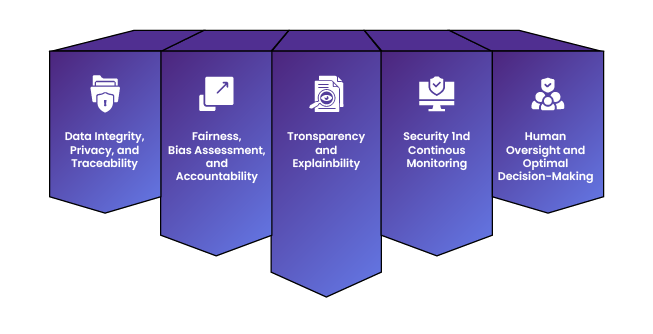
Having principles alone doesn’t ensure governed AI, and it requires more relevant access control over models, operations, systems, and people. The key pillars are explained as follows:
1. Data Assurance
Ensure the origin and flow of data, procedures for quality and representativeness assessment, management of consent and retention, role-based access, PII protection, and traceability are related to the source information, model version, user, and AI-produced output.
2. Ethical AI
Analyze datasets for representation gaps, assess models based on their performance across different user groups, describe model limitations, boundaries of appropriate use, and set up processes to ensure accountability, review, and mitigation of the outcome.
3. Model Auditability
Input descriptions of the evaluation process results that are easy to understand, record interpretations of the output and evaluate it, and communicate the intended use and limitations of the generated output.
4. AI Resilience
Conduct assessments regarding adversarial attacks and AI security, protection from prompt injection, jailbreaks, data leaks, unsafe use of tools, and safeguarding your LLM applications, RAG frameworks, APIs, and agents. Stay vigilant on accuracy, drift, false impressions, lag time, expenses, and unusual use, with incident response, rollback, and recovery protocols.
5. Decision Governance
Identify which tasks can be performed only by AI, and any high-impact decisions must have a human-in-the-loop for review. Formulate all mechanisms of overwriting and escalation, clarify responsibility throughout business and tech teams, and establish “least-privilege” rights and execution records for agentic AI.
These pillars ensure all the important aspects of a responsible and governed enterprise AI model. Besides, for each of these pillars, executives have concerns such as:
- “Is it possible to determine which specific data, model, version, or authorized user contributed to the final output?”
- “Who is accountable if an AI technology produces an irrelevant or wrong output?”
- “Is it possible to provide an explanation of the results of the output to a customer or an auditor?”
- “What happens when changes in the model, data source, user behavior, or threat landscape occur?”
- “What decisions can AI make, and which decisions have to be approved by humans?”
If you can navigate them feasibly, you can ensure that your AI model is responsible for enterprise AI security.
Responsible AI Governance Lifecycle Across Enterprise AI
Governance is effective when it is responsibly embedded throughout the entire lifecycle of the AI model development process. It must not be included as an individual or separate task and must go through several stages.
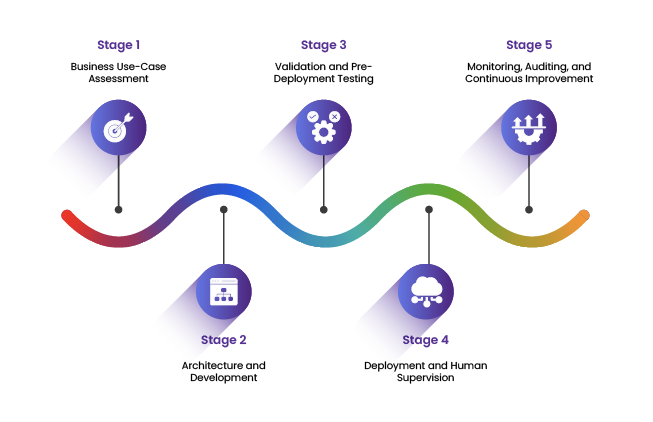
The above-displayed stages are explained as follows:
- Assess value, metrics, stakeholders, data sensitivity, regulations, risks, and controls. Offer a documented report with clear risk classification and an appropriate decision.
- Employ governance in data architecture, vendor selection, pipelines, RAG designs, documentation, and workflows. Prepare an infrastructure that clearly defines accountability, traceability, and access controls.
- Verify the performance, reliability, flexibility, scalability, fairness, cost, and privacy of the AI models. This lets you document the test results, limitations, and approvals for the final deployment.
- Allow least-privilege access and manage operations of high-risk with proper human review, ownership, and related procedures. Deploy an accessible AI environment with absolute safeguards.
- Test the quality, safety, hallucination, rollback, privacy, KPIs, costs, changes, and more. Audit the progress, assurance, and evidence process that validates what AI does responsibly.
*All these 5 stages must be retained across the entire lifecycle of AI model development for the best usage.
Which Legal Frameworks Enterprises Must Consider for Governed AI?
Well-established rules, regulations, and legal frameworks provide a strong foundation for responsible AI practices. But it is compulsory for companies to distinguish between different framework types. The table below defines the classification clearly:
| Guardrail | Type | Goal | Operational Impact |
| ISO/IEC 42001 | AIMS (Auditable AI management system) | Establish, implement, and improve AI governance | Ownership, policy, and access controls are defined clearly |
| NIST AI RMF | Voluntary management system | To govern, measure, map, and manage the models | Useful for identifying risks, data assessment, and monitoring |
| EU AI Act | Risk-based regulation system | Governs legally binding applicable AI models | Safeguard implementation, documenting evidence, and system classification |
| US State Regulation | State legislation system | Match the legal requirements | Monitor change & adapt governance practices to state law |
*These are only general guides, and the rest depends upon the organization’s specific obligations.
How to Build Enterprise AI with Responsible AI Governance?
AI responsibility requires more than just picking the appropriate algorithms and implementing a few discrete security measures. An all-encompassing strategy that connects the organization’s business objectives, governance, data security protocols, risk assessment, technical capacity, and ongoing control procedures should be implemented.
Having this governance-first methodology also creates sustainable business value by:
- Greater stakeholder confidence and trust.
- More predictable deployments with fewer late blockers.
- Lower security, privacy, and reputational risks.
- Scalable and reusable governance practices across AI initiatives.
- Better alignment of AI investments with business objectives.
- Greater operational accountability and oversight.
Furthermore, organizations should also determine whether their potential AI partners can deliver:
- Governance functionalities in place to manage risks, privacy, security, accountability, and similar elements in the development process.
- Stakeholders should have systems to classify data, recognize its origin, acquire consent for using it, administer it, mask it, and regulate access.
- The qualifying trait is the ability to validate models through the application of bias tests, model assessment, red-teaming, and by adhering to criteria associated with their approval.
- Auditability by means of documenting the activities of the model and preserving all the decisions made by it, along with the monitoring and tracking information.
- The capacity to make successful integration possible by evidencing utilization of feasible enterprise solutions such as those for database management, existing cloud infrastructure, identity management, risk management, and others.
- Teams facilitating each of these components combine knowledge related to data engineering, machine learning, risk management, and theories concerning legal compliance.
A key point to note is that governance does not slow down innovation, but rather makes AI adoption repeatable, measurable, safe, and sustainable. The right development partner makes it easier for organizations to combine governance, responsible AI, and enterprise AI capabilities, enabling them to create more innovative products and services.
Why Hire Xcelore Responsible AI Services for Your Enterprise?
At Xcelore, we don’t just build AI systems; we also ensure that your enterprise AI systems are built responsibly with complete privacy, security, governance, and accountability in all stages of model development. With great control and the ability to assess risks, maintain human reviews, and continuously monitor data, we ensure that your business deploys AI systems with confidence.
Key metrics make it easy to distinguish fragmented practices from scalable governance solutions. You will achieve the following with us:
- Comprehensive governance coverage under defined access controls
- Full traceability, auditability, and visibility into models, data, and decisions
- Proactive risk management in real time from the start
- Uniform application of all the rules, decisions, and policies across domains
- Unified lineage, data quality, and governance controls across businesses
- Addressing the skill gaps and organizational readiness complexities
- Designing a governance roadmap that matches your stringent regulations
This creates a governance framework that scales your enterprise with more predictable and value-driven business outcomes. Henceforth, not only improving compliance or control but also the effectiveness of decision-making.
Factually, proper governance of AI systems is realized through the implementation of transparency, accountability, and regulations. By implementing governance in all processes of development, execution, and ongoing monitoring, companies will establish safe and responsible AI solutions and make them reproducible indefinitely and effectively.
Frequently Asked Questions
Q. What does responsible AI governance mean for organizations?
A. A governance-first approach to responsible AI services is considered the practice of incorporating risk assessment, data security, transparency, and ongoing monitoring into the built AI systems from the start till the final production.
Q. Why does AI governance matter at the initial stage?
A. Several risks with AI system development arise in the initial stages of development. This includes use-case identification, data preparation, model selection, configuration, and architecture. Implementing governance later will only result in the consumption of more time, cost, and effort.
Q. How does Xcelore map the responsible AI protocol within the existing frameworks?
A. We integrate AI governance into existing risk and compliance frameworks by classifying AI cases according to risk categories and extending governance methods through the layer of AI systems.
Q. Which industries demand deterministic AI infrastructure and absolute readiness?
A. Verticals like finance, healthcare, insurance, and public services demand more governance due to more stringent oversight from regulators, data sensitivity issues, and important decisions made here.
Q. How often is the update for enterprise AI governance policy necessary?
A. Organizations need to periodically check their governance norms, guided by regulatory changes, new AI cases, and performance assessments.
Related Blogs

More Than a Development Partner. A Partner in Progress.
We stay with your product beyond launch. From modernization and optimization to platform upgrades, security improvements, and continuous evolution, we help your solution keep moving forward.