
Superintelligence Readiness: An Architecture and Governance Checklist for CTOs
sunil.yadav@xcelore.com
As AI systems are getting smarter and more capable, they can now think, plan, and work together on tasks. CTOs are now dealing with challenges when it comes to building the right structures. They need to encourage ideas but also ensure that security, reliability, and responsibility are not ignored in the business systems.
To prepare for this AI usage, companies need more than just the best models. They need data that is controlled, systems that can work together, ways to manage what AI does, how well it is performing, and strong security to keep everything safe when everything gets automated.
Preparation for superintelligence isn’t about believing that it is already here. Instead, it’s about building an AI system that can change and grow as needed.
This guide gives CTOs a six-layer structure to follow, with checks for governance and architecture, matching rules and standards. Besides, it also offers a strategic plan to help companies check how ready they are and get prepared for the step of bringing AI into their systems.
What Superintelligence Readiness Means For Businesses Today?
It is the ability of an organization to implement, manage, and use AI systems with greater abilities and capacities. Being ready for superintelligence depends on the kind of architecture, trustworthy data, practical control systems, and a constant evaluation process.
Artificial superintelligence, or ASI, signifies AI that is smarter than any person in most jobs. Modern AI systems are capable of doing activities, but their performance is not always good, leading to occasional failures. For businesses and enterprises, preparing for superintelligence does not mean that there is a real ASI with simple reference to existing technical standards. It is a kind of action plan aimed at becoming prepared for more capable and independent enterprise AI systems with a guarantee for safety, trust, and governance.
In accordance, users and organizational head leaders deal with three main priorities regarding SI:
- Adaptability: Allow the ability to upgrade models, use data services, and applications.
- Controlled operation: Control access rights and set limits of the operation with adequate supervision.
- Ownership: Carry out constant assessment of results and keep records of responsibility and risks.
In all, the aim is obvious: create AI systems that will be able to continue their development without exceeding the limits set by the organization.
Why Superintelligence Readiness Matters For the Next Era of AI?
Artificial intelligence is growing faster than the ability to manage it. Gartner expected that 40% of business applications will use task-based AI agents by 2026 compared to less than 5% in 2025. The difference is more obvious when only 13% of IT leaders say their companies have the right governance plans for AI agents. It is expected that 40% of AI agent projects will fail by the end of 2027 because of costs, unclear benefits, and weak risk controls.
This gap leads CTOs to focus on being ready when deciding on their architecture. The four common challenges to address with superintelligence are evolving models, enterprise integration at scale, AI agents, and continuous regulatory checks. These are displayed as:
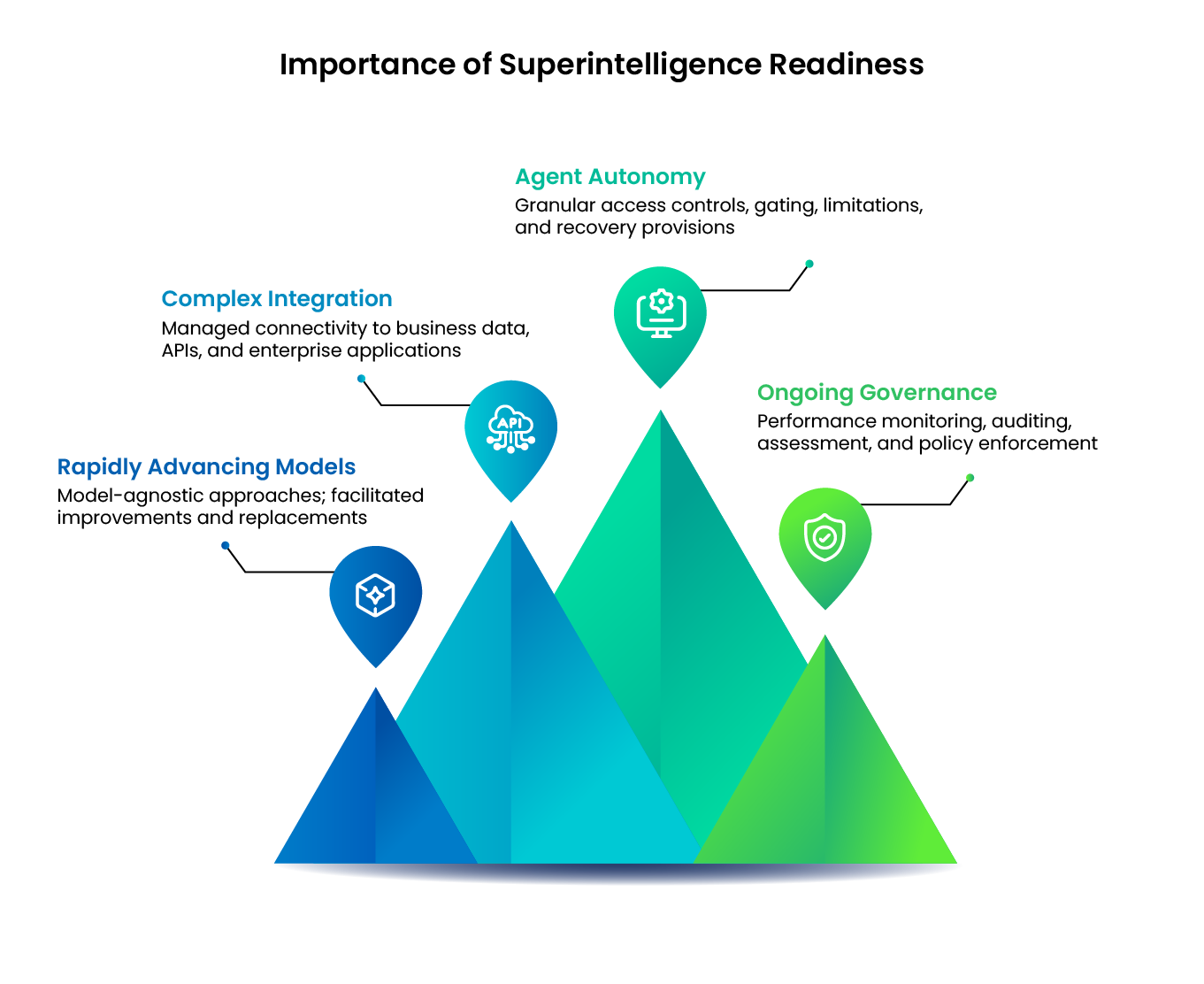
Note that the end goal is not to guess when superintelligence will arrive. Instead, it is to ensure that as AI gets more advanced and independent, enterprise services stay secure, easy to measure, able to change, and responsible.
6 Core Architecture Layers of Superintelligence Readiness
With evolving advanced AI, it’s necessary to have an architecture that integrates enterprise data, models, agents, applications, business intelligence, and infrastructure under implementable controls. Explore the reference architecture presented as a non-specific vendor framework to evaluate AI governance services of enterprises:
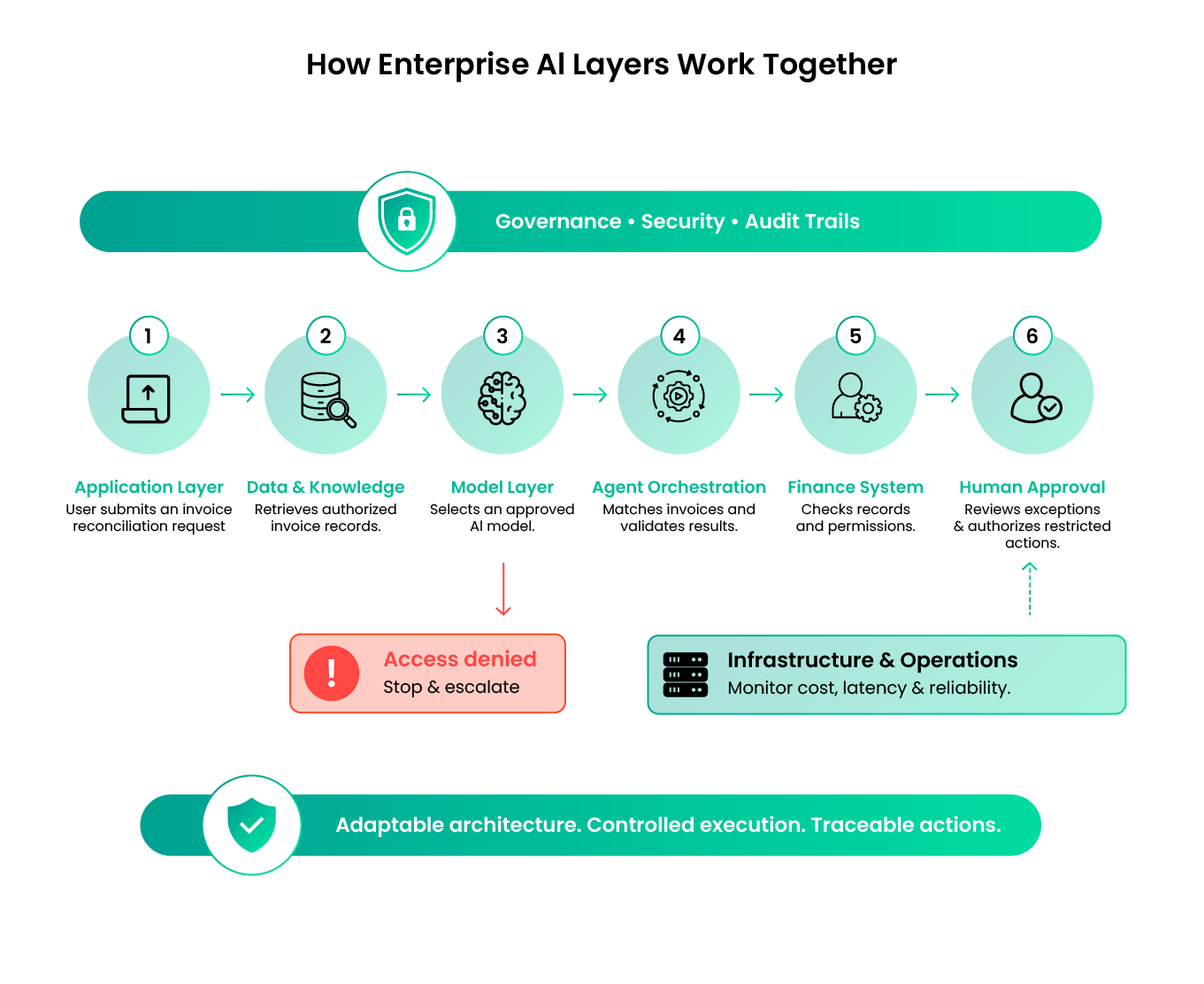
1. Application and Digital User Experience
- The goal of this layer is to ensure successful operation of various AI-based models in organizations through copilots, conversational interfaces, APIs, and more.
- Key features are user interfaces, application services, access management systems, notifications, review queues, and control interfaces.
- Maximum control ensures that users clearly understand the difference between recommendations and completed/existing decisions of AI outputs, find out about possible uncertainties, and undergo human inspections without the necessity to apply unique security protocols in every system.
2. Knowledge and Data Architecture
- This level provides AI systems regulated entry to business information originating from databases, data lakes, files, business programs, and knowledge bases.
- Its primary components include data pipelines, lakehouses, catalogues, history and quality control, semantic layers, vector databases, RAG pipelines, and secured APIs.
- Before retrieving and processing data, permissions, ownership, quality, and provenance must be checked. AI agents must be refrained from getting sensitive data only because it is available in one of the sources.
3. Model Management and Orchestration
- This layer prevents business applications from working with different AI models made by different vendors. Users can evaluate and replace one model with the assistance of any software without profound rewriting of the application.
- The main components here include model gateways, vendor adapters, model registries, task routing, structured-output processing, usage and cost control, fallback systems, and evaluation gates.
- It’s essential to achieve model portability and controlled upgrades without the necessity to assume that different models behave similarly.
4. Agent and System Coordination
- This layer facilitates the successful operation of AI systems within the enterprise while ensuring the foundational principles are observed.
- It includes agent orchestration frameworks, workflow managers, approved tools inventory, agent identities, permissioned credentials, sandboxing, approval points, time limits, retries, and rollback processes.
- Our focus is to employ maximum security controls and predetermined limits of execution. In the event of system refusals, the agent may need to appropriately escalate the situation. All actions necessitate approval depending on the level of risk they present.
5. Architecture, Operations, and Deployment
- This layer handles the computing power. It sets up systems, manages the network, and takes care of the operations needed to run AI tasks in an affordable way.
- Cloud and local systems model hosting, continuous integration and delivery, automation, monitoring, tracking across distributed systems, planning for resources, managing costs, backups, and plans for recovery from disasters are some of its major components.
- Monitor how easy it is to access how much resources are used and what it costs for the entire process, not just for parts that connect to the models. Define service objectives and have plans to get things back if something goes wrong while ensuring you know exactly how the models and data are handled.
6. AI Security, Governance, and Monitoring
- This control plane is different from other layers because it makes rules and controls everything across the whole system with policy enforcement and behavior monitoring across the entire architecture.
- It involves identity and access management, following policies, ranking risks, analyzing models, testing security, keeping logs, handling errors, protecting privacy, and ensuring everything is managed responsibly.
- It states creating rules that can actually be used and not just written down. Track every time someone asks a model something and every time someone analyzes the data.
Key Note: The NIST AI Risk Management Framework is a base for management with its functions of Govern, Map, Measure, and Manage, while the OWASP Top 10 for Agentic Applications helps with specific issues that apply to agents.
What are the Design Principles of Superintelligence Readiness Architecture?
When establishing SI architecture that is capable of dealing with future challenges, one should take into account the following:
- Independence of models: Having applications on different models to assess and try various data processing methods by their integration into real processes.
- Modularity: Use of the links between data, processes, applications, and agents.
- Upgrades driven by evaluations: When implementing changes, it is necessary to ensure that the models meet the requirements and can pass assessments.
- Interoperability: One has to comply with open standards and avoid lock-in with the help of various vendors.
- Oversight by design: The actions of high impact must be checked.
- Operational observability: It is necessary to keep track of the utilization of data, model calls, agent activity, and associated costs.
How Enterprise CTOs Can Adapt Superintelligence Readiness?
The readiness checklist below defines a clear and executive-ready framework to adapt for smarter use of AI by individual users or CTOs. It includes:
The readiness checklist below defines a clear and executive-ready framework to adapt for smarter use of AI by individual users or CTOs. It includes:
1. Data (Intelligent Foundation)
- Verified quality and lineage
- Unified access for users
- Real-time secure pipelines
2. Scalable Design (Infrastructure)
- Modular, interoperable design
- Integrated APIs
- Interface and orchestration
3. Automated Execution (Agents)
- Trusted workflows
- Oversight and guardrails
- Reliability and performance checks
4. Security and Trust (Protection)
- Robust access controls
- Threat safeguards
- Live monitoring
5. Responsible SI (Governance)
- Compliance and accountability
- End-to-end policy traces
- Reviews and improvements
Xcelore’s Take on Enterprise AI Architectures With Superintelligence Readiness
Being ready for SI doesn’t mean you know when modern AI is built. Instant readiness is all about keeping your AI systems open for growth while being secure, reliable, and accountable. The top 5 things to keep the focus on are:
- Ensure models can be easily swapped and their access is separated from business logic.
- Assign ownership, define risks, and adapt approval and audit practices.
- Introduce least privilege access and ensure agents can work in a sandbox and permissions can be revoked, if required.
- Evaluate the combination of AI systems before they go live or get upgraded.
- Assess the productivity, accuracy, effectiveness, and unexpected agent behaviors in real time.
It must be based on your capability and not on any words from the vendor or forecasts regarding superintelligence.
The aim is to construct an AI ecosystem that is capable of growing while remaining in control, transparent, and trustworthy. With us, you can assist your business in developing and designing AI solutions in accordance with data, architecture, integration, security, and operational demands. Even though SI readiness is still in production, your business can speed up with the right steps and dedicated collaboration.
Related Blogs

More Than a Development Partner. A Partner in Progress.
We stay with your product beyond launch. From modernization and optimization to platform upgrades, security improvements, and continuous evolution, we help your solution keep moving forward.