Artificial intelligence moved from experimentation to operational reality faster than most enterprises expected. In just a few years, AI systems went from internal copilots and isolated automation tools to decision-making layers embedded across customer support, sales, compliance, operations, cybersecurity, and product workflows.
That shift created a new enterprise problem. Not an AI adoption problem. A governance problem.
In 2026, enterprises are no longer asking whether they should use AI. They are asking a more urgent question: How do we control AI before it creates operational, legal, financial, or reputational damage? The answer is AI governance.
And for many organizations, this is becoming an AI Governance Wake-Up Call.
The companies winning with AI today are not necessarily the ones deploying the most models. They are the ones building structured systems around AI reliability, data security, accountability, and oversight. Meanwhile, enterprises that ignore governance are already facing costly consequences, hallucinated outputs in production systems, compliance violations, shadow AI usage, data leakage, biased automation, and unpredictable AI behavior at scale.
AI governance is no longer a policy document buried in legal folders. It is now a core business function.
What Is AI Governance in 2026?
AI governance is no longer just about ethical AI policies or compliance documentation. In 2026, it has become a critical operational layer for enterprises deploying AI across customer support, internal workflows, analytics, security, and decision-making systems.
At its core, AI governance ensures AI systems remain secure, reliable, accountable, and aligned with business objectives. It helps enterprises control how AI models access data, generate outputs, make decisions, and interact with enterprise systems.
As AI adoption accelerates, enterprises are facing new risks. For instance, businesses can experience hallucinated outputs, data leakage, compliance violations, biased responses, and uncontrolled AI usage across teams. This is exactly why AI governance is becoming a board-level priority rather than just an engineering concern.
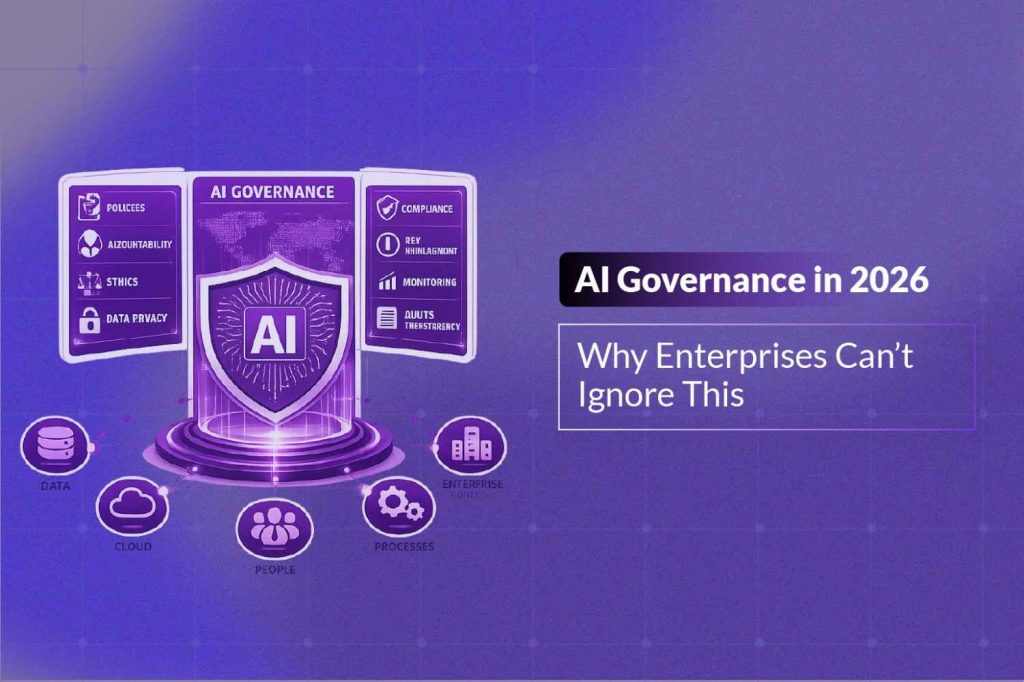
Modern AI enterprise governance now combines AI security, data governance, observability, access controls, human oversight, and compliance into one structured framework. The goal is simple: help enterprises scale AI safely without slowing innovation.
In many ways, AI governance is becoming what cybersecurity became a decade ago: essential infrastructure for modern digital businesses.
The Biggest Misconception About AI Governance
Many organizations still believe governance slows innovation. In reality, the opposite is happening.
Enterprises without governance frameworks often struggle to move AI projects beyond pilots because leadership lacks confidence in operational risk. Teams hesitate to deploy AI into customer-facing workflows. Security teams block integrations. Legal teams delay approvals. Eventually, momentum dies.
Governance is not what slows AI adoption. Poor governance maturity is. Well-designed AI governance creates operational confidence. It gives enterprises the ability to scale AI safely across departments without creating chaos.
The organizations scaling AI successfully today are treating governance as infrastructure, not bureaucracy.
Why AI Governance Became Urgent in 2026
Three things changed rapidly over the past 18 months.
1. AI Systems Became Autonomous
Modern AI agents do more than generate text. They can:
- Access enterprise systems
- Trigger workflows
- Execute transactions
- Analyze sensitive documents
- Make recommendations
- Interact directly with customers
- Coordinate across tools and APIs
As AI systems gained autonomy, the risk profile changed dramatically. A hallucinated chatbot response is one thing, but an autonomous AI agent making incorrect operational decisions is another. This shift forced enterprises to rethink oversight mechanisms entirely.
2. Shadow AI Exploded Across Enterprises
Employees are using AI tools whether enterprises officially approve them or not.
Teams upload confidential documents into public models. Developers connect unapproved APIs into workflows. Marketing teams generate sensitive content through external platforms. Customer support teams rely on AI summaries without validation.
This uncontrolled adoption created massive AI data security concerns. Many enterprises discovered they had AI usage across departments without visibility into:
- Data exposure
- Prompt histories
- Third-party model risks
- Compliance implications
- Access permissions
- Output reliability
AI governance became essential simply to regain operational visibility.
3. AI Governance Failures Became Expensive
Nowadays, enterprises are no longer discussing hypothetical AI risks. They are dealing with real consequences. Some common AI governance failures now include:
- Customer-facing hallucinations damaging brand trust
- Sensitive enterprise data leaking into external models
- AI-generated compliance violations
- Biased decision-making systems
- Unauthorized autonomous actions
- Inaccurate financial or operational recommendations
- Regulatory scrutiny over opaque AI processes
- Security vulnerabilities introduced through AI integrations
The cost of these failures extends far beyond technical issues. They impact revenue, customer trust, legal exposure, and operational continuity.
What Practical AI Governance Actually Looks Like
A surprising number of enterprises still approach governance as documentation alone. That approach fails quickly. In practice, effective AI governance is deeply technical and operational.
A Gartner survey found that organizations using dedicated AI governance platforms are 3.4 times more likely to achieve effective AI governance outcomes than those relying only on traditional governance systems.
Here is what mature AI governance typically includes in 2026.
1. AI Inventory and Visibility
Enterprises first need visibility into where AI exists.
Most organizations underestimate how fragmented AI adoption becomes internally. Different departments use different tools, models, and vendors simultaneously. A governance-first organization maintains a centralized inventory of:
- AI applications
- Model providers
- Internal AI agents
- API integrations
- Data access permissions
- Workflow automations
- Human approval checkpoints
Without visibility, governance becomes impossible.
2. Role-Based Access Controls
Not every employee should have unrestricted access to AI systems.
Modern AI governance frameworks apply granular permissions such as:
- Which models can employees access
- What data sources can AI systems retrieve
- Which workflows can agents execute
- Approval thresholds for autonomous actions
- Department-level restrictions
This is increasingly tied directly to AI security strategies. The more powerful AI systems become, the more critical access governance becomes.
3. AI Output Monitoring
One of the biggest operational mistakes enterprises make is assuming AI outputs remain stable after deployment. They do not.
Models drift. Context changes. Integrations evolve. Prompt structures degrade over time. Strong AI governance includes continuous monitoring for:
- Hallucination frequency
- Accuracy degradation
- Toxic outputs
- Bias indicators
- Security anomalies
- Compliance violations
- Workflow failures
Enterprises now treat AI observability similarly to cloud infrastructure observability. If you cannot monitor it, you cannot scale it reliably.
4. Human-in-the-Loop Controls
Despite rapid advancements, fully autonomous enterprise AI remains risky in many environments. This is why human oversight still matters. In high-impact workflows, governance systems often require human validation before AI can:
- Approve financial decisions
- Send sensitive communications
- Trigger operational actions
- Modify customer accounts
- Execute compliance-related workflows
The goal is not to eliminate automation. But it is to apply the right level of oversight based on risk.
5. AI Data Security Architecture
AI data security is now one of the fastest-growing priorities in enterprise infrastructure. Organizations are increasingly implementing:
- Private model deployments
- Secure vector databases
- Data masking layers
- Retrieval access restrictions
- Zero-retention AI policies
- Encryption pipelines
- Audit logging systems
This matters because enterprise AI systems increasingly interact with sensitive internal knowledge. Without proper controls, AI systems can unintentionally expose confidential data through prompts, responses, or integrations.
The Rise of AI Governance Tools
As enterprises scale AI adoption, AI governance tools are becoming a critical part of enterprise infrastructure. Organizations can no longer rely on manual reviews or scattered policies to manage AI risks at scale. They need systems that can monitor AI behavior, manage permissions, track outputs, enforce compliance, and secure enterprise data in real time.
In 2026, enterprises are prioritizing AI systems that are not just powerful, but also observable, secure, and controllable. That shift is making AI governance tools as important as cybersecurity and cloud monitoring platforms in modern enterprise environments.
The ROI of AI Governance
Some executives still view governance as a defensive cost center. That perspective misses the larger business impact. Strong AI governance directly improves enterprise ROI in several ways.
Faster AI Deployment
Teams move faster when governance frameworks already exist. Instead of blocking projects, legal, security, and compliance teams can approve deployments more efficiently because operational guardrails are predefined.
Reduced Operational Risk
Governance reduces the likelihood of expensive failures. Preventing one major AI-related compliance issue or security incident can justify governance investment immediately.
Higher Enterprise Adoption
Employees trust AI systems more when governance standards exist. This increases internal adoption and expands the practical business value of AI investments.
Better Customer Trust
Customers increasingly care about responsible AI usage. Enterprises that demonstrate strong AI governance gain reputational advantages, especially in industries handling sensitive data.
More Reliable Automation
Governed AI systems produce more predictable outcomes. That reliability improves operational efficiency and long-term scalability.
AI Governance Will Soon Become a Competitive Differentiator
This shift is already happening. In 2026, enterprise buyers increasingly evaluate vendors based on:
- AI transparency
- Security posture
- Governance maturity
- Data handling practices
- Compliance readiness
- Model accountability
Soon, enterprises without governance frameworks may struggle to win enterprise contracts altogether. The market is moving toward “trustworthy AI” as a competitive requirement rather than a marketing slogan.
The Future of AI Enterprise Governance
Over the next few years, AI enterprise governance will evolve into a core operational function, much like cybersecurity and DevOps. One major shift already underway is the integration of governance directly into AI development pipelines through continuous monitoring, compliance checks, audit systems, and runtime controls. Enterprises want governance to operate in real time, not as a separate approval layer after deployment.
At the same time, AI security and governance are beginning to merge into a unified enterprise framework. Organizations are combining AI observability, access governance, threat detection, compliance enforcement, and AI data security into centralized operational systems to manage risk more effectively across the AI stack.
Another major trend is the rise of autonomous AI agent development, which requires entirely new governance models. As AI agents gain access to enterprise systems and workflows, businesses will need stronger controls around permissions, tool usage, decision boundaries, escalation paths, and human oversight to ensure AI systems remain reliable and accountable at scale.
Also read: Building Ethical AI Agents: Addressing Bias, Privacy, and Trust in Conversational AI
The Real AI Governance Wake-Up Call
The biggest enterprise risk in 2026 is no longer failing to adopt AI — it is scaling AI without governance, security, and operational oversight. Over the last two years, enterprises have rapidly integrated AI into customer support, operations, analytics, and internal workflows. However, many organizations are now discovering that deploying AI at scale introduces entirely new risks around reliability, compliance, accountability, and AI data security.
As AI systems gain access to enterprise data and autonomous workflows, even small failures can create a major business impact. This is why AI governance is quickly shifting from a compliance discussion to a core operational priority for enterprises.
Some of the most common AI governance failures enterprises are now facing include:
- Hallucinated AI outputs impacting customer trust
- Sensitive enterprise data leaking into external models
- Uncontrolled shadow AI usage across departments
- AI-generated compliance and regulatory risks
- Autonomous AI agents making unreliable decisions
- Lack of visibility into AI system behavior and outputs
This is becoming the real AI Governance Wake-Up Call for enterprises. The organizations that will scale AI successfully in 2026 are not just focusing on adoption speed — they are building secure, observable, and accountable AI systems designed for long-term operational reliability.
Final Thoughts
AI governance is no longer optional for enterprises scaling AI in 2026. As AI systems become deeply integrated into customer interactions, business operations, analytics, and autonomous workflows, organizations need stronger control over how AI behaves, accesses data, and makes decisions. Without proper governance, even advanced AI systems can create operational, security, compliance, and reputational risks.
The enterprises that will lead the next phase of AI adoption are not simply the ones deploying more AI tools. They are the ones building secure, observable, and accountable AI systems designed for long-term scalability and trust. In many ways, AI governance is becoming the foundation that determines whether enterprise AI succeeds in production or fails under operational complexity.
At Xcelore, an AI Development company, we help enterprises build AI systems that are not just innovative but enterprise-ready. From AI-native products and AI agents to governance frameworks, AI security architecture, observability, and scalable deployment pipelines, we help organizations implement AI with reliability, control, and long-term business value at the core.
FAQs
-
1. What is AI governance?
AI governance refers to the frameworks, policies, security controls, and operational processes used to ensure AI systems remain reliable, secure, compliant, and accountable. It helps enterprises manage how AI models access data, generate outputs, and interact with business workflows.
-
2. What are common AI governance failures?
Some of the most common AI governance failures include exposure of sensitive enterprise data, inaccurate or hallucinated AI outputs, lack of visibility into AI systems, shadow AI use across teams, compliance risks, and unreliable autonomous AI behavior. These failures can impact both operational efficiency and customer trust.
-
3. What are AI governance tools?
AI governance tools help enterprises monitor AI systems, manage permissions, track outputs, enforce compliance policies, and improve AI security. These platforms provide visibility and control over AI behavior, helping organizations scale AI more safely and reliably.
-
4. How is AI governance connected to AI security?
AI governance and AI security work together to protect enterprise AI systems from risks like unauthorized access, data leakage, unsafe outputs, and compliance violations. Strong governance frameworks help ensure AI systems remain secure and controllable at scale.
-
5. What is AI enterprise governance?
AI enterprise governance refers to the organization-wide management of AI systems, policies, risks, and operational controls. It helps enterprises align AI adoption with business goals, security standards, and regulatory requirements.