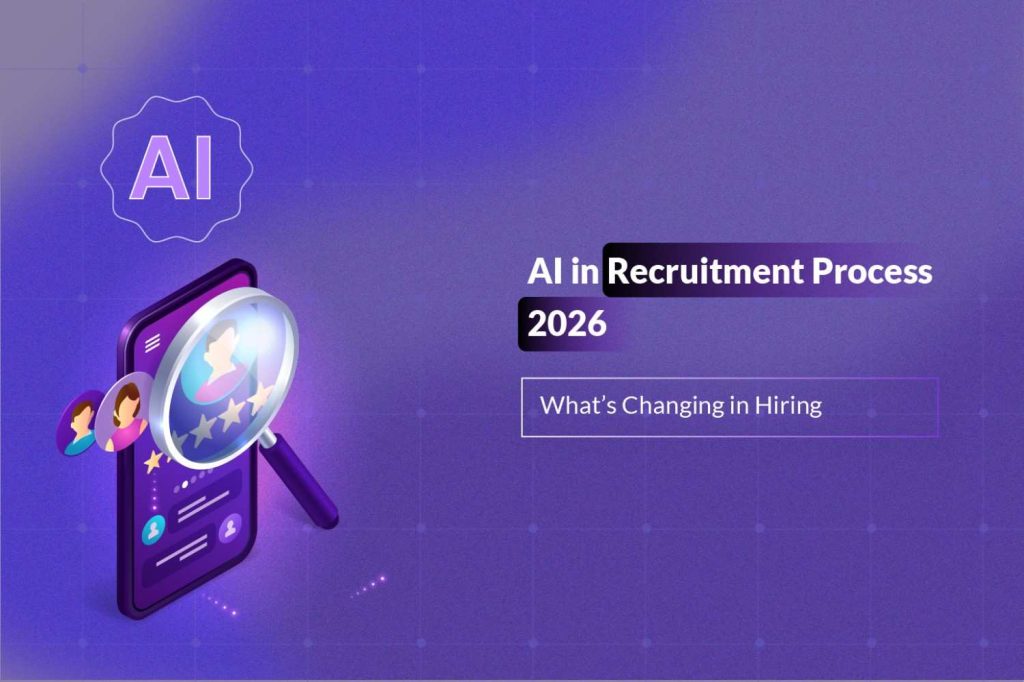
The AI in recruitment process has moved far beyond experimental tools and pilot projects. In 2026, it is deeply embedded in how companies source, screen, evaluate, and onboard talent. What started as automation for repetitive HR tasks has now evolved into intelligent decision-support systems that influence real hiring outcomes.
According to market research, companies already use some form of AI in recruitment. For instance, data from Weforum shows approximately 88% use AI for initial candidate screening. The shift is not just technological, it is structural. Recruitment is becoming faster, more data-driven, and increasingly predictive.
But with this transformation comes an important question: are we improving hiring quality, or just accelerating decisions that still depend on imperfect data?
Role of AI in Recruitment: From Automation to Decision Intelligence
The role of AI in recruitment has evolved significantly. Earlier systems focused on keyword-based resume filtering. In 2026, AI systems are far more advanced. They analyze patterns in candidate behavior, predict job fit, and even assess cultural alignment based on structured data inputs.
At a practical level, AI now supports recruiters in three major areas:
- Sourcing talent from large databases and social platforms using predictive matching
- Screening candidates through automated CV parsing and ranking models
- Interview support, including AI-driven assessments and structured scoring models
This evolution has reduced time-to-hire by nearly 30% in many tech-driven organizations, according to Forbes. However, efficiency is only one side of the story. The deeper impact lies in how decision-making itself is shifting from intuition to algorithm-assisted judgment.
AI in HR Recruitment: How Systems Are Reshaping Workflows
The use of AI in HR recruitment is no longer limited to large tech firms. Even traditional industries like manufacturing, retail, and healthcare are adopting AI-driven hiring workflows.
Modern HR teams now rely on AI to:
- Predict candidate success probability based on historical hiring data
- Identify attrition risks before hiring decisions are finalized
- Automate scheduling, communication, and candidate engagement
This has allowed HR professionals to shift their focus from administrative tasks to strategic hiring decisions. However, it also introduces a dependency on systems that may not always interpret human potential accurately.
In essence, HR is becoming less about manual screening and more about managing intelligent systems that filter talent at scale.
Benefits of AI in Recruitment: Why Companies Are Adopting It Fast
The benefits of AI in recruitment are driving rapid adoption across industries. Organizations are not just using AI for efficiency, but they are using it for competitive advantage in talent acquisition.
Some of the most impactful benefits include:
AI significantly reduces hiring time by automating repetitive tasks, allowing recruiters to focus on decision-making rather than administration. It also improves consistency in candidate evaluation, reducing human bias in early screening stages.
Another major advantage is scalability. Companies can now evaluate thousands of applications in minutes, something that was previously impossible without large HR teams. Additionally, AI-driven analytics help organizations identify hiring trends and improve workforce planning.
In many cases, companies report improved quality-of-hire metrics after adopting AI, especially when tools are combined with human oversight.
AI in Recruitment and Selection: Smarter or Just Faster Decisions?
The AI in recruitment and selection process is often praised for its speed, but speed is not the only metric that matters. The real question is whether AI improves decision quality.
AI systems excel at pattern recognition, but hiring is not purely pattern-based. Human potential, adaptability, and creativity often fall outside structured datasets. This creates a tension between algorithmic precision and human judgment.
A growing number of HR leaders now believe that AI should not replace decision-making but rather augment it. The best-performing organizations in 2026 are those that combine AI scoring with human interviews, ensuring both efficiency and emotional intelligence remain part of the process.
AI Tools in Recruitment: The New Hiring Infrastructure
The ecosystem of AI tools in recruitment has expanded rapidly. These tools now cover the entire hiring funnel, from sourcing to onboarding.
Common categories include:
- AI-powered Applicant Tracking Systems (ATS)
- Resume parsing and ranking engines
- Video interview analysis platforms
- Chatbots for candidate engagement
- Predictive hiring analytics dashboards
These are the popular tools being leveraged globally:
1. LinkedIn Recruiter
One of the most widely used AI-powered sourcing platforms, LinkedIn Recruiter helps hiring teams identify passive candidates using AI-based recommendations and advanced search intelligence. It is especially effective for enterprise hiring and professional networking-driven recruitment.
2. HireVue
HireVue has become a leading platform for AI-assisted video interviews and candidate assessments. Companies use it to automate first-round screening, analyze interview responses, and standardize evaluations across large hiring volumes. It is particularly popular in high-volume recruitment industries like retail, customer support, and finance.
3. Eightfold AI
Eightfold AI focuses on talent intelligence and predictive hiring. Its platform uses deep-learning models to match candidates with roles based on skills, career trajectories, and workforce planning data. Large enterprises use it not only for hiring, but also for internal mobility and retention forecasting.
4. Paradox (Olivia)
Paradox is known for conversational AI recruitment. Its chatbot “Olivia” automates candidate engagement, interview scheduling, and communication at scale. Companies with large applicant volumes use it to reduce recruiter workload and improve response speed.
5. Greenhouse
Greenhouse combines AI-assisted hiring workflows with structured interview processes. In 2026, it is increasingly used by startups and scaling tech companies looking for collaborative hiring systems with built-in analytics and automation features.
These tools are increasingly integrated rather than standalone, creating unified recruitment ecosystems. The result is a more connected hiring process where data flows seamlessly across stages.
However, integration also increases reliance on vendor algorithms, raising concerns about transparency and explainability in hiring decisions.
Challenges of AI in Recruitment: Bias, Trust, and Transparency
Despite its advantages, the challenges of AI in recruitment remain significant and cannot be ignored.
One of the biggest concerns is algorithmic bias. If AI systems are trained on historical hiring data, they may unintentionally reinforce existing biases rather than eliminate them. This raises ethical questions about fairness in automated decision-making.
Another challenge of AI in recruitment is transparency. Many AI systems function as “black boxes,” making it difficult for HR teams to understand why certain candidates are ranked higher than others.
There is also the risk of over-automation. When organizations rely too heavily on AI, they risk losing the human judgment needed to evaluate soft skills, motivation, and cultural fit.
Finally, data privacy remains a critical concern, especially with increasing regulation around candidate data usage and storage.
How AI Helps in Recruitment: Real Impact on Hiring Efficiency
Understanding how AI helps in recruitment requires looking at measurable outcomes. AI is not just improving speed, but it is also reshaping how decisions are made at every stage.
AI now enhances recruitment through AI ML Engineering and Generative AI Development, enabling predictive hiring, resume understanding, job description creation, and intelligent candidate matching at scale.
Recruiters now spend significantly less time on manual screening, allowing them to focus on strategic hiring conversations. AI also helps identify passive candidates who may not actively apply but are strong matches based on behavioral and skill data.
In addition, AI improves interview quality by standardizing evaluation frameworks and reducing inconsistencies between interviewers. This creates a more structured and comparable hiring process.
Case Studies and Real-World Results
Several organizations have already demonstrated measurable impact from AI-driven recruitment systems.
For example, large tech firms using AI-based screening have reported up to a 30% reduction in time-to-hire and improved candidate-matching accuracy. In retail hiring, AI chatbots have handled millions of candidate queries, improving engagement rates and reducing drop-offs in application funnels.
Hilton employs an AI chatbot, “Connie,” to answer routine candidate questions 24/7. It provides instant support and reduces recruiter workload. Similarly, Unilever Careers used AI-based assessment and video interviews to screen job candidates faster. With tools from HireVue and Pymetrics, the company reduced hiring time and costs.
Healthcare organizations using AI-assisted hiring have also reported better workforce retention, as predictive analytics help identify candidates more likely to stay long-term. These examples highlight a clear trend: AI is not just an efficiency tool, but it is becoming a strategic hiring layer.
Partner with an AI Chatbot development company to build a chatbot for candidate engagement and interview scheduling, tailored for your business workflows
Opinion: The Future of Recruitment Is Hybrid, Not Fully Automated
Despite rapid advancements, the future of hiring is unlikely to become fully automated. The most effective recruitment systems in 2026 are hybrid models where AI handles scale and structure, while humans handle interpretation and judgment.
AI can process data, but it cannot fully understand ambition, emotional intelligence, or contextual life decisions that often define career paths. This is where human recruiters remain essential.
The organizations that will succeed are not those that adopt AI the fastest, but those that integrate it thoughtfully, balancing automation with accountability.
Conclusion: AI in Recruitment Is Redefining, Not Replacing Hiring
The AI in recruitment process is fundamentally reshaping how companies identify and hire talent. From faster screening to predictive hiring insights, the transformation is undeniable.
Yet, the real challenge is not technological, but philosophical. Recruitment is no longer just about finding the best resume; it is about building systems that understand both data and humanity.
In 2026, AI is not replacing recruiters. It is redefining what it means to be one.
Ready to Transform Your Recruitment Process with AI?
From AI-powered candidate screening to intelligent hiring automation, businesses are rapidly integrating AI into modern recruitment workflows. Whether you want to build a personalized AI recruitment tool or integrate AI into your existing HRMS or ATS, Xcelore can help.
As an AI development company, Xcelore specializes in custom AI product development and AI integration solutions tailored to your business needs.
Connect with Xcelore to build smarter, faster, and more efficient recruitment systems powered by AI.