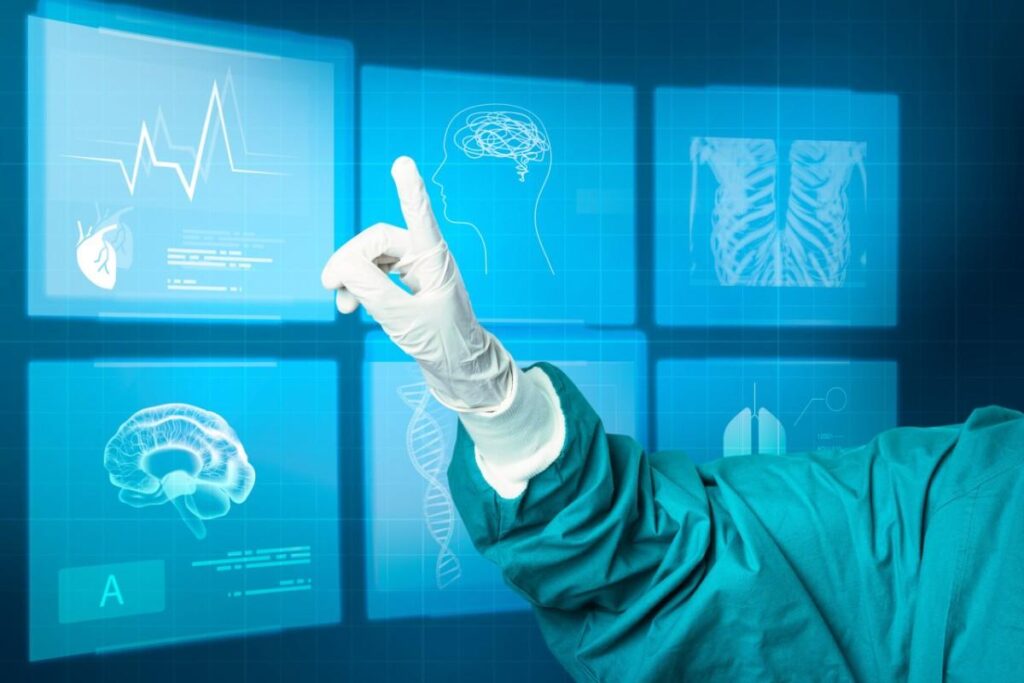
Generative AI in Healthcare is about to change the field in amazing ways, offering new solutions that go beyond what we currently have. Using advanced algorithms, generative AI can create, predict, and personalize treatments with incredible accuracy. This blog will look at how generative AI is being used in healthcare today and what the future might hold. We’ll explore its potential to speed up drug discovery, improve the accuracy of diagnoses, and tailor treatments to individual patients.
What is Generative AI and How Does it Work?
Generative AI creates new content that looks like real data. Unlike traditional AI which uses existing data for tasks, generative AI uses algorithms like GANs. GANs have two neural networks: one makes new data, and the other checks how real it looks compared to the training data. With practice, GANs and similar models learn data patterns, making realistic outputs like images or text. This helps in art, science, healthcare, and more, solving complex problems creatively.
Current Applications of Generative AI in Healthcare
Generative AI in healthcare is currently employed to improve patient diagnosis through advanced predictive modeling and to optimize administrative processes.
1. Drug Discovery and Development
The traditional process of drug discovery is time-consuming and costly, often taking over a decade and billions of dollars to bring a new drug to market. Generative AI has the potential to greatly speed up this process by:
- Identifying Potential Drug Candidates: AI models can analyze vast amounts of biomedical data to identify promising drug candidates. By generating new molecular structures that could potentially interact with disease targets, AI reduces the initial phase of drug discovery from years to months.
- Optimizing Drug Design: Generative AI can design molecules with specific properties, such as improved efficacy or reduced side effects. This is achieved by generating and testing thousands of molecular variations, and selecting the most promising candidates for further development.
- Predicting Drug Interactions: AI models can predict how new drugs will interact with other medications, helping to avoid adverse drug reactions and improving patient safety.
2. Medical Imaging and Diagnostics
Generative AI is making significant strides in medical imaging and diagnostics, enhancing the accuracy and efficiency of disease detection and treatment planning.
- Image Generation and Enhancement: GANs can generate high-quality medical images, such as MRI or CT scans, from lower-quality inputs. This is particularly useful in resource-limited settings where high-resolution imaging equipment may not be available.
- Disease Detection: AI algorithms can analyze medical images to detect diseases at an early stage. For instance, AI can identify early signs of cancer in mammograms or detect retinal diseases in eye scans with high accuracy.
- Radiology Workflow Optimization: By automating the analysis of medical images, generative AI can reduce the workload of radiologists, allowing them to focus on more complex cases and improving overall efficiency.
Key Notes –
NVIDIA has introduced Generative AI microservices to advance drug discovery, MedTech, and digital health. These microservices are accessible via the NVIDIA AI Enterprise 5.0 software platform, providing extensive capabilities such as advanced imaging, natural language processing, and digital biology generation.
According to Precedence Research, the global generative AI in healthcare market grew to $1.07 billion in 2022 and is expected to exceed $21.74 billion by 2032, showing a compound annual growth rate (CAGR) of 35.14% from 2023 to 2032.
3. Personalized Medicine
Personalized medicine seeks to customize medical treatment based on the unique characteristics of each patient. Generative AI in healthcare plays a crucial role in this approach by:
- Creating Synthetic Patient Data: AI can generate synthetic patient data that mimics real-world data, allowing researchers to train and validate their models without compromising patient privacy. This synthetic data can also be used to simulate various disease progressions and treatment responses, aiding in the development of personalized treatment plans.
- Predicting Treatment Outcomes: AI models can predict how individual patients will respond to specific treatments based on their genetic makeup, medical history, and other factors. This enables doctors to choose the most effective treatment with the fewest side effects.
- Developing Personalized Therapies: Generative AI can design personalized therapies, such as tailored drug regimens or customized prosthetics, that meet the unique needs of each patient.
4. Virtual Health Assistants
Virtual assistants powered by Gen AI are transforming patient care by providing real-time support and personalized health advice, showcasing the significant impact of Generative AI in healthcare.
- Symptom Checkers: AI-driven symptom checkers can analyze patient-reported symptoms and provide preliminary diagnoses and recommendations for further action. These tools can help patients decide whether to seek immediate medical attention or manage their symptoms at home.
- Mental Health Support: AI-powered chatbots can offer mental health support by providing cognitive behavioral therapy (CBT) exercises, mindfulness techniques, and empathetic conversations. These virtual assistants can be available 24/7, offering support to individuals who may not have access to traditional mental health services.
- Chronic Disease Management: Virtual health assistants can help patients manage chronic conditions by reminding them to take medications, tracking their symptoms, and providing personalized lifestyle advice.
Beyond virtual assistants, generative AI is also powering sector-specific healthcare software designed to simplify complex workflows and enhance patient engagement. Within hospital and acute care settings, AI-enabled hospital management systems accelerate bed allocation, staff coordination, and discharge planning, improving operational speed and reducing bottlenecks for both patients and staff.
In the ABA and behavioral health space, therapists often rely on tools, like an ABA practice management software from Theralytics, that automate treatment documentation, authorizations, payroll, and outcome tracking, allowing clinicians to spend more time on care while maintaining regulatory compliance Meanwhile, dental and specialty clinics benefit from AI-driven clinic management software that optimizes chair utilization, automates patient reminders, and streamlines billing, resulting in faster visits and more efficient front-office operations.
5. Risk Prediction in Pandemic Readiness
A pandemic is a widespread outbreak of disease that affects many countries or continents and a large number of people.
- Making Supply Chains Stronger: AI can manage supply chains better by predicting and preventing problems. It looks at global shipping, keeps track of how much medicine is in stock, and guesses how much people will need, so we can get medicine to where it’s needed faster.
- Better Public Communication: AI can study how people feel and see if false information is spreading during a pandemic. This helps leaders know what people worry about and plan how to talk to them to calm fears and get better cooperation.
- Using Resources Wisely: During a pandemic, it’s really important to use resources well. AI can look at how hospitals are set up, see what equipment is on hand, and know where workers are to make sure everything is ready where the disease might show up.
Future Prospects of Generative AI in Healthcare
While generative AI has already made significant contributions to healthcare, its potential is far from fully realized. The future of Generative AI in healthcare holds exciting prospects that could further revolutionize the industry.
1. Advanced Drug Discovery and Precision Medicine
As AI models become more sophisticated, Generative AI in healthcare will be able to generate even more complex and effective drug candidates. Future AI systems could simulate entire clinical trials, predicting how drugs will perform in diverse patient populations and identifying potential side effects before human trials begin. This could drastically reduce the time and cost associated with bringing new drugs to market.
Precision medicine will also benefit from advancements in generative AI. By integrating genetic, environmental, and lifestyle data, generative AI can create highly personalized treatment plans that are tailored to the unique needs of each patient. This approach could lead to more effective treatments with fewer side effects, improving patient outcomes and quality of life.
2. Enhanced Diagnostic Accuracy
The future of diagnostics will be marked by the integration of generative AI with other advanced technologies, such as wearable devices and mobile health applications. AI-powered diagnostic tools will continuously monitor patients’ health, detecting anomalies in real time and alerting healthcare providers to potential issues before they become serious.
Additionally, AI will enhance the accuracy of diagnostic imaging by combining data from multiple sources, such as MRI, CT, and PET scans. This multimodal approach will provide a more comprehensive view of patients’ health, enabling earlier and more accurate diagnoses.
3. AI-Driven Personalized Health Assistants
Future virtual health assistants will be even more advanced, offering highly personalized and context-aware support. These AI-driven assistants will integrate with electronic health records (EHRs) and other healthcare systems to provide patients with personalized health advice based on their medical history, current health status, and lifestyle choices.
Generative AI in Healthcare will also support healthcare providers by offering decision support, suggesting evidence-based treatment options, and automating routine tasks. This will free up healthcare professionals to focus on more complex and value-added activities, ultimately improving patient care and outcomes.
4. Synthetic Biology and Tissue Engineering
Generative AI will play a pivotal role in the emerging fields of synthetic biology and tissue engineering. By designing new biological structures and materials, Generative AI in healthcare can help to create artificial organs, tissues, and even entire organisms that can be used for research, transplantation, and therapy.
For example, AI could generate blueprints for 3D-printed organs that are tailored to individual patients, reducing the risk of rejection and improving transplant success rates. In tissue engineering, AI could design scaffolds and growth factors that promote the regeneration of damaged tissues, offering new hope for patients with chronic injuries and degenerative diseases.
5. Ethical and Regulatory Considerations
As generative AI becomes more integrated into healthcare, ethical and regulatory considerations will become increasingly important. Ensuring the safety, fairness, and transparency of AI systems will be critical to building trust and acceptance among patients and healthcare providers.
Regulatory frameworks will need to evolve to address the unique challenges posed by AI agents in healthcare, such as data privacy, algorithmic bias, and accountability. Policymakers, industry leaders, and healthcare professionals must work together to develop guidelines and standards that promote the responsible and ethical use of generative AI in healthcare.
Conclusion
Generative AI has the potential to change healthcare significantly. It can help find new medicines, make diagnoses better, tailor treatments for individuals, and provide virtual health support. The future looks bright for Generative AI in healthcare, with advances in precision medicine, accurate diagnostics, creating new biological materials, and AI-powered health assistants.
But to make the most of Generative AI in healthcare, we need to tackle challenges like keeping patient data safe, making sure AI doesn’t unfairly favor certain groups, following rules and ethics, and making AI work with existing systems. By working together, being creative, and using AI responsibly, the healthcare field can use generative AI to improve how patients are treated and how well they get.
As we move ahead, it’s crucial to use Generative AI in healthcare responsibly and ethically. We need to develop and use these technologies in ways that help everyone patients and healthcare providers alike. We’re just starting on the journey toward a future where generative AI is a big part of healthcare, and the possibilities are endless.
Frequently Asked Questions
1. What are the main applications of generative AI in healthcare?
Generative AI is utilized in healthcare for various applications, including drug discovery and development, medical imaging and diagnostics, personalized medicine, virtual health assistants, and synthetic biology. It aids in accelerating processes like drug candidate identification, enhancing diagnostic accuracy through advanced imaging analysis, and personalizing treatment plans based on individual patient data.
2. How does generative AI improve drug discovery?
Generative AI speeds up drug discovery by generating and optimizing molecular structures that could interact with disease targets. This technology enables researchers to explore a vast space of potential drug candidates efficiently, significantly reducing the time and cost traditionally associated with drug development.
3. What ethical considerations are associated with generative AI in healthcare?
Ethical considerations include ensuring patient data privacy, addressing algorithmic bias in AI models, maintaining transparency in AI-driven decision-making, and upholding patient autonomy in treatment decisions influenced by AI recommendations. It’s crucial to navigate these issues to build trust and ensure the responsible use of AI in healthcare.
4. How does generative AI enhance medical imaging and diagnostics?
Generative AI improves medical imaging by generating high-quality images from lower-resolution inputs and enhancing diagnostic accuracy through automated analysis. AI algorithms can detect anomalies in medical images with high precision, aiding in early disease detection and treatment planning.
5. What are the future prospects of generative AI in healthcare?
The future of generative AI in healthcare looks promising with advancements in precision medicine, personalized treatment plans, and AI-driven health assistants. It’s expected to further improve drug discovery processes, enhance diagnostic capabilities, and revolutionize patient care by integrating with wearable devices and advancing synthetic biology for tissue engineering and organ regeneration.