Search engines are no longer behaving like simple directories. A few years ago, ranking on Google mostly meant optimizing pages around keywords and building backlinks. In 2026, the game looks completely different. Today, AI systems summarize answers, recommend brands directly, and often solve user queries without sending traffic to websites at all.
That shift is the reason businesses are now comparing LLM SEO vs Traditional Off-Page SEO more seriously than ever before.
Evolution from Keyword Search to AI Answers
Earlier, users typed short phrases like “best SEO company” or “buy running shoes.” Search engines matched those keywords with indexed pages. Now users ask full questions such as:
- “Which SEO strategy works best for AI search?”
- “What is the future of off-page SEO?”
- “Can ChatGPT recommend my business?”
This behavioral change has forced search engines to move from keyword matching toward understanding intent and context.
Rise of Generative AI in Search Behavior
AI-powered search experiences from tools like OpenAI, Google, and other answer engines are changing how people discover information. Users now trust conversational responses more than traditional blue links.
This is where Generative AI SEO and AI search optimization become important. Businesses no longer compete only for rankings; they compete for mentions, citations, and recommendations inside AI-generated answers.
Why Businesses Must Rethink SEO Strategy
Search visibility today depends on much more than just keywords and backlinks. Businesses need to build strong entity authority, establish topical trust, and maintain a credible brand reputation across the web. Search engines and AI systems also favor expert-led content that demonstrates real experience and knowledge.
At the same time, content must be structured so that AI systems can easily understand and interpret it. A modern LLM SEO strategy combines these traditional trust signals with AI-focused optimization techniques.
Understanding Traditional Off-Page SEO
Traditional off-page SEO focused on improving a website’s authority through external trust signals. Search engines used these signals to evaluate whether a site was credible, relevant, and worthy of higher rankings.
Key Elements of Traditional Off-Page SEO:
- Backlinks: Links from other websites acted as trust signals or endorsements.
- Domain authority: Stronger, more established domains generally rank more easily.
- Anchor text relevance: Keywords used in backlinks helped search engines understand page context.
- Brand mentions: References to a brand across the web strengthened credibility.
- Social and referral signals: Shares, mentions, and referral traffic indicated popularity and engagement.
Why Backlinks Mattered So Much
Google’s early algorithms heavily relied on backlinks to measure authority. The assumption was simple: if trusted websites linked to a page, the content was likely valuable.
Over time, quality became more important than quantity. Search engines started prioritizing:
- Relevance of the linking website
- Context of the link
- Editorially earned backlinks
- Overall trustworthiness of the source
The Shift Happening Now
Backlinks still influence rankings in 2026, but modern search engines evaluate authority more holistically. AI-driven search now considers:
- Topical expertise
- Brand reputation
- Content quality
- Author credibility
- User trust and engagement
Traditional off-page SEO was mainly about link building. Modern SEO is increasingly about building real authority and recognition across the web.
Key Components of Traditional Off-Page SEO
Link Building Strategies
Link building remains one of the foundations of traditional SEO. Brands usually acquire links through:
- Outreach campaigns
- Resource pages
- HARO responses
- Niche edits
- Partnerships
However, low-quality link schemes are losing effectiveness because AI systems can more effectively detect manipulation.
Guest Posting and Digital PR
Guest posting still works when done for authority rather than pure backlinks. Publishing expert insights on respected industry websites builds trust signals beyond SEO.
Digital PR has become even more powerful because brand mentions now influence AI-generated search recommendations.
Brand Mentions and Social Signals
Search engines increasingly track brand discussions across platforms. Even unlinked mentions can contribute to perceived authority.
A strong social presence supports both traditional SEO and SEO for ChatGPT search because AI models often learn from public web discussions.
Directory Listings and Citations
Local businesses still benefit from consistent citations across trusted directories. Accurate business information strengthens trust and improves discoverability.
Role of AI in Off-Page SEO
AI is transforming how SEO professionals approach outreach, analysis, and authority building.
How AI Is Transforming Link Building
AI tools can now identify:
- Relevant websites
- Outreach opportunities
- Content gaps
- Link quality patterns
This saves time, but automation alone does not guarantee results.
Predictive Outreach Using AI
Modern outreach platforms analyze response probability, domain authority trends, and engagement signals before sending pitches.
This makes outreach more strategic rather than relying on mass-emailing tactics.
AI-Based Authority Analysis
AI systems can evaluate:
- Content depth
- Brand consistency
- Author credibility
- User engagement
- Sentiment signals
This is one of the biggest changes in the Off-page SEO vs AI SEO discussions.
Also read: AI in Off-Page SEO: 7 Strategies That Drive Rankings in 2026
What is LLM SEO?
LLM SEO is the practice of structuring, writing, and distributing content in a way that makes it easy for large language models to understand, trust, and reuse accurately when generating answers.
Unlike traditional SEO, which primarily aims to rank webpages in a list of search results, LLM SEO is focused on inclusion inside AI-generated responses. Here the model may summarize, cite, or synthesize information from multiple sources without showing a ranked page at all.
In practical terms, it means optimizing not just for keywords or backlinks, but for how clearly your content expresses:
- What an entity or concept is
- How it relates to other known concepts
- Whether it resolves a user’s intent directly and unambiguously
- Whether it is structured in a way that can be reliably extracted and reused in generated answers
In short, LLM SEO is less about “ranking pages” and more about becoming a trusted source that AI systems can confidently quote, summarize, or learn from when constructing answers.
Understanding Large Language Model Search
Large language models don’t work like traditional search engines that rank pages based on keywords and backlinks. Instead, they interpret meaning by analyzing context, relationships between concepts, and overall informational clarity.
This allows them to pull insights from multiple sources and generate a single synthesized answer, rather than simply listing ranked webpages.
Because of this, visibility in AI-generated responses is not strictly dependent on Google rankings. A page that is well-explained, contextually relevant, and aligned with what users are asking can still be included in AI answers, even if it doesn’t rank #1 in traditional search results.
Difference Between SEO and LLM Optimization
Traditional SEO is primarily designed to improve search rankings and drive clicks from results pages. Success is usually measured by position on Google and the amount of organic traffic a page receives.
LLM optimization, on the other hand, focuses on how information is understood, selected, and reused by AI systems when generating answers.
Instead of rankings, it prioritizes:
- Citations: Whether the content is trusted enough to be referenced in AI responses
- Contextual relevance: How well the content matches the intent behind a question
- Expert trust: Signals that the information comes from knowledgeable or credible sources
- Entity recognition: Clear identification of people, brands, topics, and concepts
- Semantic depth: How well the content explains relationships between ideas, not just keywords
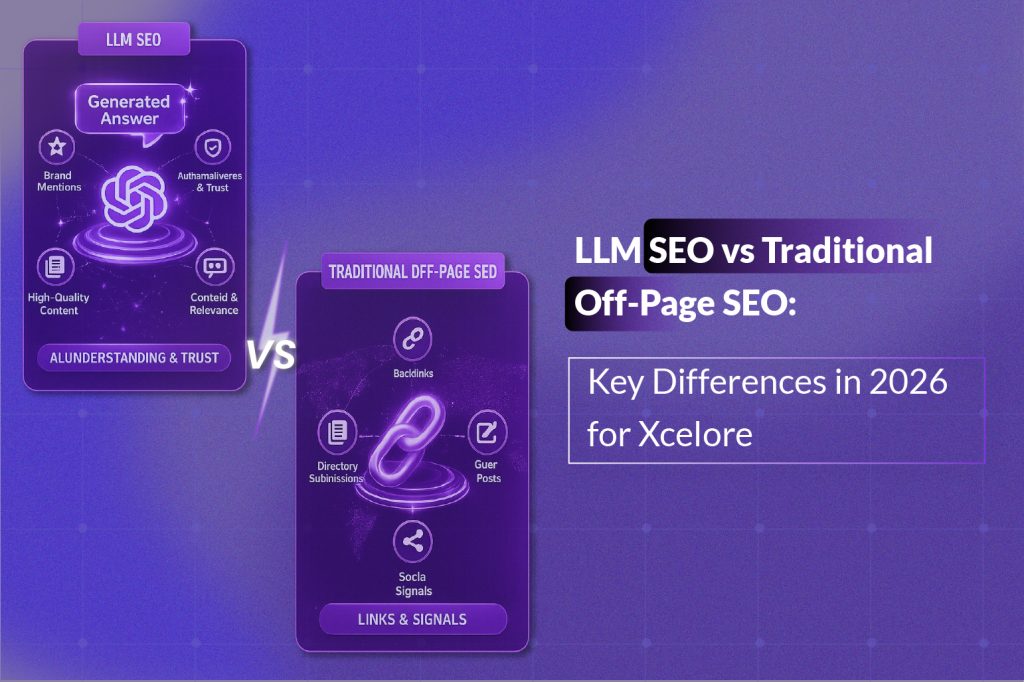
The key difference between LLM SEO vs Traditional Off-Page SEO: traditional SEO optimizes for visibility in search results, while LLM optimization optimizes for inclusion in generated answers and knowledge synthesis.
LLM SEO vs Traditional Off-Page SEO: Core Differences
Backlinks vs Contextual Authority
Traditional SEO heavily values backlinks. LLM SEO values:
- Expertise
- Context
- Consistency
- Brand trust
- Topical authority
Backlinks still matter, but they are no longer the only ranking currency.
Keywords vs Semantic Understanding
Old SEO focused on repeating exact keywords. Modern AI search understands:
- Meaning
- Intent
- Relationships
- User context
This makes content quality far more important than keyword stuffing.
Traffic vs Visibility in AI Responses
Traditional SEO measures success through clicks and traffic. AI search optimization focuses on:
- Brand mentions
- AI citations
- Recommendation visibility
- Authority perception
Comparison Table: Traditional SEO vs LLM SEO
| Factor | Traditional SEO | LLM SEO |
|---|---|---|
| Main Goal | Search rankings | AI visibility |
| Focus | Keywords and backlinks | Context and entities |
| Optimization Style | SERP-focused | Conversational search-focused |
| Success Metric | Organic traffic | AI mentions and citations |
| Authority Signal | Backlinks | Trust and expertise |
| User Experience | Click-based | Answer-based |
| Content Structure | Keyword targeting | Semantic organization |
| Sustainability | Algorithm dependent | Entity authority dependent |
How AI Search Engines Are Reshaping Discovery
Google AI Overviews and Zero-Click Searches
Users increasingly get answers directly inside search results without visiting websites. This creates more zero-click searches.
Brands now need visibility inside AI summaries rather than relying only on organic clicks.
ChatGPT and Conversational Search Trends
People now use AI assistants for:
- Product recommendations
- Research
- Comparisons
- Tutorials
- Local discovery
That makes SEO for ChatGPT search a major part of modern digital marketing.
Shift from Rankings to Recommendations
In the past, ranking first was the primary goal. Now the goal is becoming:
- Mentioned
- Recommended
- Referenced
- Trusted
AI systems prioritize reliable sources with strong authority signals.
How Do LLM SEO Tools Actually Optimize Content for AI Search?
Content Structuring for AI Crawlers
AI systems prefer content that is:
- Well-structured
- Easy to scan
- Context-rich
- Logically organized
Clear headings and concise explanations improve discoverability.
Semantic Optimization Techniques
Modern optimization includes:
- Topic clustering
- Entity mapping
- Semantic relationships
- Conversational formatting
This is where AI search optimization becomes different from traditional SEO.
AI Citation Optimization
AI systems prefer content that includes:
- Original insights
- Credible sources
- Expert commentary
- Accurate data
- Strong contextual clarity
Common Mistakes Businesses Make While Adopting AI SEO
Over-Reliance on Automation
Many brands publish AI-generated articles at scale without human editing. That approach usually creates shallow content with no real expertise.
Ignoring Human Expertise
AI can assist content creation, but experience still matters. Real examples and practical insights improve trustworthiness significantly.
Chasing Tools Instead of Strategy
Tools help execution, but strategy drives results. Businesses that blindly follow automation trends often lose content quality.
Why SEO Alone Isn’t Enough: The Importance of AEO
What is Answer Engine Optimization (AEO)?
Answer Engine Optimization (AEO) is the practice of structuring and optimizing content so it can be directly used in answers by search engines and AI systems, rather than just ranked as a webpage in search results.
Instead of focusing only on traditional rankings, AEO targets formats where users receive immediate responses, such as featured snippets, AI-generated summaries, voice search results, and conversational AI platforms. The goal is to make content easy to extract, interpret, and present as a clear, direct answer to user queries.
Why AEO Matters for AI Search
Answer engines prioritize:
- Clear explanations
- Concise structure
- Direct responses
- Authority signals
Without AEO, brands risk losing visibility in AI-generated search experiences.
Optimizing for Featured Answers
To improve answer visibility:
- Use question-based headings
- Provide concise explanations
- Structure content logically
- Add expert insights
How Brands Can Build Authority for AI Search Results
To perform well in AI-driven search, brands need to move beyond isolated content creation and focus on building clear, consistent authority signals across the web. Besides evaluating individual pages, AI systems look for patterns that establish who is credible in a given topic.
Building Entity Authority
Entity authority is about how strongly a brand is recognized as an “entity” within its niche. This is strengthened when a brand is consistently associated with:
- Its core expertise and niche topics
- Key people or authors within the organization
- Consistent descriptions of what the brand does
- Repeated mentions in relevant industry contexts
Over time, these signals help AI systems understand what the brand is known for and why it should be trusted in that domain.
Importance of Author Credibility
AI systems tend to prioritize content that can be linked to real, identifiable expertise. Content attributed to clear authors, especially those with consistent presence and subject authority carries more weight than anonymous or generic writing.
Strong author credibility is built through:
- Clear author identities and profiles
- Consistent topic focus over time
- Evidence of expertise (experience, citations, or industry presence)
Brand Mentions Across Platforms
Authority is reinforced when a brand is consistently mentioned across multiple trusted platforms beyond its own website.
These include industry publications, forums and community discussions, podcasts and interviews, social media conversations, and news or editorial coverage.
When these mentions are aligned in both topic and context, they create a stronger signal of relevance and trustworthiness.
This helps AI systems more reliably associate the brand with its specific areas of expertise.
Why Experience Matters More Than Keywords in Modern SEO
EEAT and Real Expertise Signals
Google’s EEAT framework rewards:
- Experience
- Expertise
- Authority
- Trustworthiness
This principle is becoming central to Generative AI SEO.
First-Hand Experience in Content Creation
Content based on real experience stands out because it reflects practical knowledge, not just definitions or rewritten ideas. It includes real examples, insights, and lessons learned from actually doing the work.
This makes it more useful and trustworthy for readers, while also helping search and AI systems identify it as higher-quality compared to generic, surface-level content.
Trust Signals That Influence AI Rankings
Important trust signals include:
- Expert authorship
- Transparent information
- Consistent branding
- User engagement
- Positive reputation
Is Off-Page SEO Dead After the Rise of LLM SEO?
Off-page SEO is not dead; it has simply evolved. Backlinks still matter, but their impact is now driven more by quality, relevance, and trust than by volume or scale. Search systems and AI models are better at detecting manipulation, so naturally earned, contextually relevant links carry far more value than bulk link-building tactics.
Because of this shift, modern SEO works best as a hybrid approach. Instead of relying only on traditional SEO, brands now combine it with AI search optimization, AEO, entity building, and content authority. Together, these layers improve visibility across both search engines and AI-generated results.
Future of SEO: From Search Engines to Answer Engines
The future of SEO is shifting from traditional search engines to AI-powered answer engines. Instead of users scrolling through multiple search results, AI systems are now providing direct, personalized answers and recommendations instantly. This evolution is changing the way people discover information online.
This shift has introduced a new approach called Generative Engine Optimization (GEO). GEO focuses on creating content that AI systems can easily understand, trust, and use in their responses. As AI-driven discovery continues to grow, GEO is expected to become one of the most important areas in digital marketing over the next few years.
To prepare for the next phase of search, businesses need to focus on building real expertise and authority in their industry. They should create experience-driven content, strengthen trust signals, and optimize their content for AI readability. This is the future of LLM SEO strategy.
Conclusion
The debate around LLM SEO vs Traditional Off-Page SEO is not about choosing one over the other. The reality is that both approaches now work together.
Traditional SEO still provides foundational authority through backlinks and brand visibility. At the same time, AI search optimization is reshaping how content gets discovered, cited, and recommended inside answer engines.
The businesses winning in 2026 are not the ones publishing the most content. They are the brands building genuine expertise, trust, and authority across the web.
As AI-powered search continues evolving, companies that adapt early will dominate visibility in both search engines and conversational AI platforms. Marketers must understand that modern SEO is no longer only about rankings, but it is about becoming the most trusted answer wherever users search.
Xcelore is an AI development company that enables businesses to leverage advanced AI solutions for smarter automation, better decisions, and scalable growth. Talk to us for AI solutions.
Frequently Asked Questions (FAQs)
-
1. What is the main difference between LLM SEO and traditional off-page SEO?
Traditional SEO focuses on backlinks and rankings, while LLM SEO focuses on contextual authority, entity recognition, and AI visibility.
-
2. Can LLM SEO completely replace backlinks in the future?
Not entirely. Backlinks still help establish authority, but AI systems now evaluate additional trust and expertise signals.
-
3. How do AI search engines decide which websites to cite or recommend?
AI systems prioritize trustworthy, well-structured, authoritative, and contextually relevant content.
-
4. Do businesses still need off-page SEO strategies in 2026?
Yes. Off-page SEO remains important for authority building, especially when combined with AI search optimization.
-
5. What are the biggest risks of relying only on AI-driven SEO strategies?
Over-automation, low-quality content, and a lack of real expertise can damage long-term visibility.
-
6. How can brands optimize content for both Google rankings and AI answer engines?
Brands should combine technical SEO, semantic optimization, EEAT principles, and conversational content structuring.
-
7. Are LLM SEO tools enough to guarantee visibility in AI search results?
No. Tools help optimize content, but authority, trust, and real expertise remain essential.